2020 year in review

My recap posts on 2019, 2018, 2017, 2015. I don’t remember writing with such consistency (my son was born Jan 2016, I guess that explains the gap?). Skimming these prior posts, I do see I’m repeating myself an awful lot, but it’s still rewarding to see how the same themes (and my attempts at framing them) have evolved over time, and quite gratifying when some predictions I’ve made turn out to be on the money.

As usual, I’ll write about a few topics that I personally found fascinating.

Genshin Impact and the coming “Industrial Age”

At the end of my 2019 post, I called Genshin Impact an aspiring blockbuster, which was not that bold a claim given the viral hype (and controversy) it already enjoyed in China at the time. It has easily surpassed my expectations, even more so in western markets.

I’ve already written a long post about the game. In the aftermath of the game’s explosive launch, much of the Chinese industry chatter was about “industrialization”. I’ve not seen a clear definition of the term in this context (it seems taken for granted), but loosely, the logic is that as consumers demand higher fidelity games (rivaling PC/console AAA in quality) and ever more content, Chinese developers will have to embrace the flywheel of “bigger teams (and more specialization of talent), more sophisticated production pipelines, and more advanced technologies and tools”.

In other words, Genshin Impact is seen as a landmark game, one that has permanently shifted consumer expectations higher, and subsequently started a new industry-wide arms race in China. In my view this is quite overblown – the dominant market leaders Tencent and Netease have for years chased higher budget productions made by “armies of developers” – but Genshin captured the zeitgeist with the audacity of its vision.

What’s next? A lot of UE4 projects, for one thing. To name a few: Tencent Quantum Studios’ Dawn: Awakening is an open-world survival game (with 3rd-person shooter gameplay) made in UE4. Lilith Games recently announced Farlight 84, another UE4 project with a post-apocalyptic theme, Battle Royale PVP gameplay (perhaps amongst other game modes) and mobile-PC cross play. (I don’t know if either of these will take off – their themes lack the easy viral appeal that Genshin Impact had.) Meanwhile, Tencent Timi Studios recently posted job ads for a “AAA-grade” realistic racing simulation, built in UE4 for mobile; and miHoYo has been recruiting UE4 developers as well.

When China meets the world

Chinese game developers have for years studied and learnt from their global industry peers – whether it’s GDC talks, studio visits, academic studies or direct talent acquisition. There still doesn’t seem like a lot of information flowing the other direction – language and culture are big barriers (for Chinese developers to share outwards – the “supply” side), but lack of interest on the “demand” side has been a deterrent as well.

In this aspect, the games industry seems a step behind the broader tech sector, where Silicon Valley now clearly pays a lot of attention to trends in China. When there is more interest, and deeper exchange of knowledge about China’s game development practices, I suspect there will be a good amount of bemusement and shock from the outside.

I’m reminded of an ancient news piece – when the first MacBook Air was announced in 2008 (by Steve Jobs memorably pulling it out of a manila envelope), a group of Japanese engineers did a teardown and expressed surprise at the “wasteful” and “expensive” internal design:

“If I proposed such a design, our company would never approve it,” said one of the engineers. “I can’t find anything that is technically superior. We can make the same computer at a lower cost,” said another.

In hindsight this was obviously missing the forest for the trees – the Japanese experts weren’t necessarily wrong, but their points were irrelevant in the big picture. Game developers should avoid making the same mistake when they examine Chinese game development – the sausage might be made in an ugly and wasteful way based on your perspective, but don’t neglect the end results or their growth trajectory.

Chinese developers have been self-reflective about the gaps. For instance, in this recent interview (in Chinese, but the Google translate is well worth a read) with the head of Timi J3 (the team behind Call of Duty: Mobile), he called out investment in tooling as one area where China still has much to learn:

姚远:… 再就是欧美厂商对工具化的实践比我们强太多。之前和《幽灵行动:荒野》的团队聊,他们说花5年时间做了个编辑器。这个编辑器强到什么程度呢?基本上随便拉一下,所有村庄、道路、人物、动物、植被全都出来。这就是育碧的工业化能力。

葡萄君:国内厂商不一定会做类似的事情。

姚远:是,国内很多项目因为开发周期限制,没时间做工具,但欧美厂商不一样。育碧的编辑部团队会在预研阶段做各种军事、历史的考证,去相关地点采风,完善工具,再慢慢把项目做起来。这个流程非常值得我们学习,如果真的要追求效率,还是得一开始就准备好。

Yao Yuan (head of Timi-J3): …Furthermore, European and American manufacturers’ practice of tooling is much stronger than ours. I talked to the team of “Ghost Recon: Wilderness” before, and they said it took 5 years to make an editor. How strong is this editor? Basically do some drag & drops, and all the villages, roads, people, animals, and vegetation will come out. This is Ubisoft’s industrialization capability.

Interviewer: Domestic manufacturers may not do similar things.

Yao Yuan: Yes, many domestic projects have no time to build tools due to development cycle constraints, but European and American manufacturers are different. Ubisoft’s editorial team will do various military and historical research in the pre-research stage, go to relevant places to collect features, improve tools, and then slowly start the project. This process is very worth learning. If you really want to pursue efficiency, you still have to be prepared from the beginning.

(English via Google translate with light edits.)

Earlier in the interview, Yao made this comment about their production capabilities:

举个例子,我们和一年前相比,同样是两三百人的规模,产能却翻了3~4倍。通过和近300人的外包团队协作,现在一个月能做若干玩法和地图,上百把武器和几十个角色。虽然有些内容总体所需的生产周期比较长,比如一个人物从概念设计到监修要3个月,但生产流程、管线都非常强大和成熟。

For example, compared with a year ago, we have the same size of two or three hundred people, but our production capacity has increased by 3 to 4 times. By cooperating with an outsourcing team of nearly 300 people, we can now make several game modes and maps, hundreds of weapons and dozens of characters in one month. Although some content requires a relatively long production cycle, for example, it takes 3 months for a character to go from conceptual design to IP-stakeholder approval, but the production process and pipeline are very strong and mature.

(English via Google translate with light edits.)

So the picture here is, this team is consistently churning out vast amounts of live-ops content, despite relatively immature tooling (compared to their western peers), and their efficiency is rapidly improving. And they have stayed on top of the organizational challenges of running such a large team. And there is still a lot of productivity upside if they do seriously tackle tooling – that’s the scary part.

5 years of Honor of Kings

Honor of Kings launched in late 2015. SCMP did a profile recently, and their graphs painted the picture succinctly:

Let’s be clear: the “real” lifetime revenue is a lot higher than this $7.8B figure from Sensor Tower, as it does not include China Android revenue (understandably hard to model), and Honor of Kings has very low revenue outside China. Indeed, I would say you can double that figure to $16B and possibly still be low. Coincidentally, $16B is a cool 100B RMB, a nice round figure for half a decade.

Beyond these eye-popping (and speculative) numbers, it’s hard for me to talk about Honor of Kings without doing some soul searching. Professionally I had a ring-side seat to this spectacle – I was a part of the China team at Riot Games, based in Hong Kong in 2015/16. I played the game when it launched, and was 1) amazed by how it recreated some of the high satisfaction moments of PC MOBAs, but 2) also confident that it was not a major threat to League of Legends as the gameplay was still too shallow for core players. My main takeaway was that Riot should absolutely look into making a mobile MOBA as well.

To show my thinking then: in March of 2016, I wrote a post titled “Are mobile games disruptive?“, and the disruptive game I was talking about was Clash Royale (which took up every second of my day when I wasn’t taking care of my newborn):

I believe mobile games have so far followed the [disruption] theory here:

– They have focused on catering to previous non-gamers / casual gamers, and most of the early successes reflected this (Angry BirdsCandy Crush SagaFlappy Birds)

– These games were simpler to play, and offered less complexity in the gameplay

– These games were generally looked down upon by core gamers

What gets interesting is what happens next. The disruption theory says that from this low market position, the new entrants are able to mount an attack on the establishment thanks to both product evolution (so they catch up in product experience) and their new attributes which the power users (core gamers) previously didn’t care about.

While my memory is fuzzy, I believe I largely stopped playing Honor of Kings for fun after the initial few months. However, by Chinese New Year 2017, it was clear that a disruption was playing out according to Clayton Chistensen’s theory. League of Legends players were being pulled into Honor of Kings en masse: it turns out social ties and bragging rights were more powerful motivations to many (if not most) people than gameplay depth and mastery. But really, the bigger story was how Honor of Kings activated so many non-gamers.

So that’s what it feels like to be disrupted.

I’ve often described Honor of Kings as an attack from below – if you think of the hierarchy of MOBA players as a pyramid, with the very pinnacle being esports players, Honor of Kings successfully activated the bottom tier first. There was little organic endorsement or word-of-mouth from the establishment influencers. (The game did try to piggyback on the popularity of League‘s esports celebrities, with ambush marketing like getting Faker to do a livestream.)

League of Legends: Wild Rift, in contrast, will be an attack from above. I played a modest role in getting this project off the ground (and I’ll shamelessly overstate it on my Linkedin page), so it’s something quite close and dear to me. The existential question for Wild Rift has always been: is there any chance against Honor of Kings?

Sentiments aside, I think the answer is yes, even in China. The League “establishment” that shunned Honor of Kings have been dying to play a League mobile MOBA, and perhaps this echelon of esports pros and streamers can create a big enough beachhead. And there is still a brand premium in my opinion, though that picture is nuanced as Honor of Kings has leaned into Chinese culture – in a way, it’s a bit like Apple versus Huawei in China. At the end of the day, players across all tiers of the pyramid will try Wild Rift – the question is can Riot get them to stay.

As an anecdote, I’ve been lurking in a wechat group of League influencers who have overcome formidable obstacles to play the game on Asian servers. Some of them are already organizing pro teams and recruiting players at the top of the ladder. Their enthusiasm is infectious, and gives me cautious hope about the next chapter in this saga.

Lastly, one other personal reflection from these 5 years is that, even with the personal experience of how Honor of Kings disrupted League of Legends, I was able to repeat the mistake when it came to thinking about PUBG Mobile. I had seen an early build before its launch, and I was impressed. But my gut again told me that it would not satisfy PUBG players, and its input complexity would be overwhelming for casual players. I was definitively wrong on both – I guess that speaks to how strong one’s biases can be.

(Optional extra reading – this piece in Gamesindustry.biz shows Timi leadership’s reflections about Honor of Kings and their views on industry trends.)

China’s dynamism

Taking a step back from games for a moment. I came across this year in review letter by Dan Wang, who is a tech analyst based in Beijing. It is thought-provoking and beautifully written, and honestly I envy his prose. (Seriously, you should stop here and go read that letter instead.)

This small bit particularly resonated with me:

This year made me believe that China is the country with the most can-do spirit in the world. Every segment of society mobilized to contain the pandemic. One manufacturer expressed astonishment to me at how slowly western counterparts moved. US companies had to ask whether making masks aligned with the company’s core competence. Chinese companies simply decided that making money is their core competence, and therefore they should be making masks.

This “can-do spirit” is Chinese game developers’ biggest (and perhaps most overlooked) strength – it’s the rising tide that lifts all boats. While studios elsewhere debated first principles about whether MOBA / FPS were viable on mobile, Chinese studios simply hacked away at it. When the Chinese government tightened the publishing license process, companies rapidly pivoted to overseas expansion. And with this “industrialization” wave, Chinese developers are again just diving head-first.

Having recently lived in the US for almost a decade, I feel the stark contrast. As I was writing this, a mob of Trump supporters stormed the Capitol building. (It may well have been a scene from a dystopian video game like The Division 2.) There are bitter divides and deep social justice issues. It feels trivial, and perhaps disrespectful even, to be discussing game development against such a backdrop – but I feel the need to argue that Americans must find a way to rekindle a similar can-do spirit, and just build stuff. Build institutions, social welfare, infrastructure, housing, startups… Whatever it is that motivates you, which hopefully for some would be video games.

This is obviously a huge topic that was discussed in the US in 2020, when Marc Andreessen wrote his “It’s time to build” post. I didn’t follow the rest of the discourse closely, but I enjoyed reading this essay “On cultures that build.” I’m not well equipped to really add more to the conversation, but I will say this: China faces huge (if not bigger) societal challenges as well, but part of the dynamism is rooted in people’s belief that they can (and must) improve their livelihood via hard work. They have the lived experience of the dizzying growth – the building of everything – of the past 40 years. For Americans, more cultural exchange and economic ties with China – not less – may have a nice side-benefit in combating the complacency.

M1 Macs

In my 2018 post, I briefly speculated on “the beginning of the end of the PC (x86) platform”. With the arrival of the M1 ARM-based Macs (finally), I’d like to raise my bet.

I haven’t used a M1 Mac yet, but from everything I’ve read so far, it sounds like a generational leap in objective performance as well as subjective user experience. Now the question becomes, is this strategy and capability unique to Apple, or will others attempt to follow suit? I’d argue yes, if not simply because of the gravitational force of the mobile ecosystem. In particular, if Nvidia’s acquisition of Arm is cleared, Nvidia will be in an enviable position to attempt some big integration plays here.

If there is such a foundational migration on the Windows side of PCs, one clear worry is app inter-operability during the transition. It’s hard to imagine the Windows side offering as smooth a transition as Apple is doing with Rosetta 2, thanks to the much more fragmented hardware stack. And games as a special category of applications may suffer the worst of any transition. Again – a gaming-focused company such as Nvidia could be particularly motivated to navigate a path through this.

There is some irony, to me, if at the end of this, it’s consoles (due to their long generational cycles, and current commitment to backwards compatibility) that become the laggards that stick with x86.

Personal stuff

2020 was the first full year I’ve lived in mainland China for over a decade, and the first time I’ve lived in Shanghai. My timing was pretty good, in retrospect. When the strict lockdown started in late January, we thought we had the worst luck, but by May, life was mostly back to normal (even masks were mostly gone, except where mandated such as in public transit).

In the summer, many friends went vacation traveling again; we didn’t as we had very young children. But we couldn’t resist booking a short vacation trip for December. Alas, the weather in Xishuangbanna wasn’t warm enough to take advantage of the private pool we had in our villa, but it was still a pleasant trip.

Shanghai is a very livable city. I say that as a proud Beijinger. The summer is still too hot and humid for my liking, but the city has a good balance of culture (with a dash of western influence), urban planning, and pace of life. Beijing feels too bureaucratic, and it takes too long to get anywhere. Shenzhen feels too rushed, and the hot humidity is just as bad as nearby Hong Kong. Los Angeles – I love the climate, and the parks, but I don’t miss the driving.

The pandemic also gave me some new perspectives about effective governance. The US response has been appalling to see from afar. I wonder how much of it is uniquely the failings of the Trump administration, and how much is reflective of the general state of decay and complacency in US institutions. To be clear, I’m not looking at this from a lens of US versus China as superpowers, or other sorts of macro-economic debate. I’m much more concerned with the micro-economic life decisions we make as a family – where we should spend our precious years together, and can offer us the best mix of professional fulfillment, income, education, and life experiences. And for me the US fell a lot in the rankings this past year.

Investing: some years ago, there was a popular startup catchphrase about seizing the big trends, coined by Xiaomi founder Lei Jun: “even a pig can fly if it is in the middle of a whirlwind.” (Jack Ma, who’s living through some interesting times himself recently, apparently had a witty response: “when the wind stops blowing, it’s the pigs who fall to their deaths.”) The stock markets certainly made me feel like a pig facing a hurricane, torn between FOMO and having a nasty fall. It was quite surreal to see the market movements in contrast to pandemic life.

Remote work was a much discussed concept, and a collectively forced experiment. In my case, with 2 young kids running around the apartment, working from home simply did not work. When my older son’s kindergarten re-opened, it was marginally better. I’d probably need a private office away from the office to make remote work viable.

To wrap up with the games I played in 2020. I played various mobile games due to professional interest, but the one that stuck with me, surprisingly, is Merge Mansion. (Disclosure: my current employer, Supercell, invested in the developers.) I’m not a puzzle game player, and this is a game that’s still very early in development with a lot of rough edges. But it became the perfect time-killer game, and I’ve averaged 20 minutes of play every day for several months now.

On PC/console, I played Hades more during early access in 2019 than I did in 2020, but I should go back and play it some more to experience the complete game. During the depths of the spring lockdown, I occupied myself with Ghost Recon Wildlands and The Division 2. Fall Guys probably brought the most joy and laughter, and it was eye-opening to see how much it resonated with my 4 year-old. Later in the year, Ghost of Tsushima was an easy crowd-pleaser, which I spent more time on than I should have.

The game that resonated the most with me though, without a doubt was The Last of Us Part II. Its harrowing discussion of trauma, empathy and perspective-taking was particularly fitting for these times we live in. And the toxic fandom around the game felt like an inadvertent meta commentary that echoed the game’s core themes. Months after my playthrough, I still think about my experience with the characters. Perhaps it’s time to pop the disc into that new PS5…

Genshin Impact (2020)

Genshin Impact has had a great global launch – indeed, I struggled to come up with some good comps on Sensor Tower as it has really stormed out of the gates. In terms of launch revenue, I actually couldn’t recall a better game than Pokemon Go. See below launch-aligned revenue graph:

If we just look at China, where it’s easier to compare apples-apples (at least for iOS only, since Sensor Tower doesn’t track China Android), we have an early 3-way tie across AFK Arena, Brawl Stars and Genshin Impact – as some of the best launches of 2020:

As a side note – AFK Arena’s $60M launch month on iOS in China (in January before Chinese New Year), is the best new mobile game domestic launch this year as far as I can tell. (The usual caveats about lack of China Android estimates apply…)

But, Genshin is not just a mobile game – in China, it launched on PC first on Sep 15, a full two weeks of early access. I still find this an unusual choice – the most affluent, hardcore gamers rushed in on day 11, but the negative reviews came in almost instantly. Snobby PC/console gamers mocked the game’s lack of polish and lower graphics fidelity compared to premium AAA titles; whereas mobile gamers looking for a progression head-start via PC immediately raged at the poor gacha loot table. They didn’t hold back their emotions on Taptap:

The poor reviews didn’t seem to impact sales much (and the Taptap crowd is hard to please). It’s also interesting to contrast this reception with the western audience reception – there seems to be a lot of voices expressing surprise that the game offers so much content and is free.

In any case – it’s very early days yet as we are barely two weeks into the official launch, but all things considered it’s a great start for Genshin Impact. It will be fascinating to see how the game trends over the next few months.

Core gameplay

The game is quite well-reviewed on Metacritic (though a small sample size), and deservedly so. The scope of the open world, the combat system, and the character roster (and their visual presentation) are impressive.

The game is most fun (I’m currently Adventure Rank 27) when you are doing the dependable open-world loop: you start out with a particular objective (maybe a quest, or just a point-of-interest you spotted in the horizon), and along the way you get side-tracked by numerous side content. There is a lot of side content: collectibles, side quests / daily missions, environmental puzzles, loot chests that respawn periodically… You get the picture.

Genshin Impact certainly takes a lot of inspiration from Zelda: Breath of the Wild‘s open-world formula, but ventures far enough to end up in its own place. The biggest departure is combat: Genshin referenced the elemental interactions from BOTW, and converted it into a catchy combo system that still feels intuitive enough. It can get repetitive, but it’s still satisfying to set up an explosive fire-lightning combo (for example), and there are hints in the equipment system (I haven’t gotten far enough yet) of intriguing build possibilities.

Personally, I’m not too concerned with the graphics fidelity on PC – I’ll always take smooth frame-rate over graphics quality, and this is where Genshin does not fully deliver. On mobile, I can’t run reliably run 60fps on an iPhone XS Max (even when I toggle everything down); and the game’s min-spec on iOS is iPhone 8 Plus, which suggests dev challenges with performance optimization (in comparison – PUBG Mobile‘s min-spec is iPhone 6s).

I do want to talk a bit about gameplay feel and polish, where Genshin is behind its PC/console peers in some areas. As a player, I found myself often wrestling with the game’s character, camera and controls (the “3Cs”), on mobile (more egregious) as well as on PC. Some examples of jank:

  • Ranged aiming feels finicky in general, even on PC with mouse; sensitivity settings are too coarse in my opinion. And for mobile / PS4 there should have been some aim-assist support (even if they can be turned off).
  • The camera has janky movement at times – as a tiny example, when you fall and roll forward, the camera takes too long to recover from facing downwards, and requires a manual adjustment2.
  • Some characters have attacks that dash through the enemy, which would require you to rotate the camera 180 degrees to see the enemy again. This is in my opinion dangerous design space for a 3rd-person mobile game with virtual joysticks.
  • Similarly, the Traveler’s ability that creates a giant rock is also dangerous design space in combat: this is a climbable rock that can cause unintended player interactions; and it often displaces enemies to the top of the rock, where they don’t seem to know how to get down (and thus severely disrupting combat pacing). The fact that the ability is aim-able is also stress-inducing on mobile.
  • Enemies who are displaced from the combat area (for example, falling off a cliff) get reset (with full health), which is often frustrating.

I’ve also found the game’s boss fights tend to have more jank and annoyances. For example, the first major boss fight below:

There’s a bunch of things here that irritated me (and yes, my skills are probably below-average…):

  • The level requirement stated upfront was a bit of a misdirection, as you are given a trial character with their own level, and the whole fight is primarily designed for that character.
  • Unskippable cut-scenes, which is a pretty big no-no if players have a chance of having to replay this fight several times (which I did…).
  • The flight combat sequence starting around 1:30 has readability issues, with the backdrop that is quite static and the boss always center-screen – the first 2 times I played this fight, I didn’t understand I could actually fly towards the pick-ups (I tried maneuvering and felt I couldn’t change direction).
  • The final phase has a custom camera angle (side-scrolling), which is a bit jarring as most of the game you are not driving your character’s movement primarily with left/right input. Combined with the ledges, this created a level where I fell off quite a few times – while not lethal, it was very annoying for combat pacing.

Over time, the player learns to work around these problems, but there’s clearly a gap in terms of the developer’s capabilities, sensibilities, and/or priorities – these are the 20% issues that can take 80% of the time to solve to get that AAA polish.

Progression and monetization

When it comes to progression and monetization, Genshin at a high level shares a lot of the generic Chinese mobile RPG template (of which AFK Arena, mentioned earlier, is the current best-in-class example).

The basic formula of such games is a deep progression system (with layer upon layer of different stats to chase), with stringent upgrade gates interlaced with periods of relatively smooth leveling. The stringent upgrade gates provide heavy incentive to do the daily/weekly grind for resources (certain key resources can only be farmed on specific days of week). And the sheer amount of dimensions to progress (amount of characters + depth of each character) converts into aggressive monetization design, where ultimately cash can be turned into characters (through gacha), upgrade resources (directly purchased), stamina for grinding resources and so on.

This is the rinse-and-repeat formula that hundreds of Chinese games have used – Soul Hunters, Naruto, Honkai Impact 3rd, Onmyoji, Arknights, AFK Arena, to name just a few of the biggest over the past decade.

The marriage of such a formula to the open-world gameplay in Genshin is at first jarring – the early leveling experience of a player who immediately spends several hundred dollars on gacha is going to be very different (and arguably for the worse – as all sense of early pacing is out the window) from a non-spender. I know such a gamer – he is trained to plunking down a few “648”s (by convention the most expensive SKU in the cash shop, roughly $100) any time he starts a Chinese mobile game – and were it not for social peer pressure, he would have churned several times by now (despite spending almost $1k already…).

After 20 hours in, when I’ve largely picked up the various complex systems and are somewhat invested in some characters, the disconnect starts to go away. It becomes very clear that access to a lot of fun gameplay is gated behind monetization – the 5-star characters that everyone is enamored with are not going to come easily (and even if you unlocked them – you need so many duplicate copies to fully level up their powers). You can still have a good time – but you will be missing out on a lot of gameplay possibilities.

Regardless of whether you monetize or not (or how much), the grind is still somewhat egalitarian3. That’s the other funny part of this RPG formula – it demands both money and time.

Usability pains

One part I’d like to complain loudly about is the game’s UI/UX and usability issues – not only because I suffered lots of irritations here, but also I feel there’s a hard-to-measure (but perhaps material) impact on the game’s engagement. Genshin is already overloaded with design complexity (as is typical with Chinese RPGs), and the usability issues amplify the cognitive load.

I already discussed some issues in the gameplay section above, but here are a couple of examples specifically about the UI. This part of the discussion is quite tactical.

First, I found it baffling that the map and quests UI were not integrated. They are activated via separate buttons on HUD, and don’t link to each other.

On the world map, you actually can’t see available quests (with the exception of the 4 daily quests). You have to “track” a quest in the Quests UI for it show up in the map. This would be much less of a problem if the Quests UI were available as a pop-up / side-bar in the Map UI. But currently, you have to jump back and forth across 3 UI screens to complete a simple action of “select a quest and find nearest teleport point”.

The Map UI is also lacking functionality in some other basic areas. For instance, you can place custom nodes on the map to keep track of points-of-interest (players use it to tally the important collectibles, for example). But you can’t “navigate” to a custom node, which feels like a pretty useful interaction.

For an open-world game, the Map feature should be something that really emphasizes ease of use – help you make decisions about what to do next, and get out of the way as fast as possible, so you stay immersed in the world. But in Genshin it currently is subpar compared to most contemporary open-world games (e.g. Ghost of Tsushima for a very recent example). I honestly can’t remember the last time I was so confused at the map feature of a game in this genre.

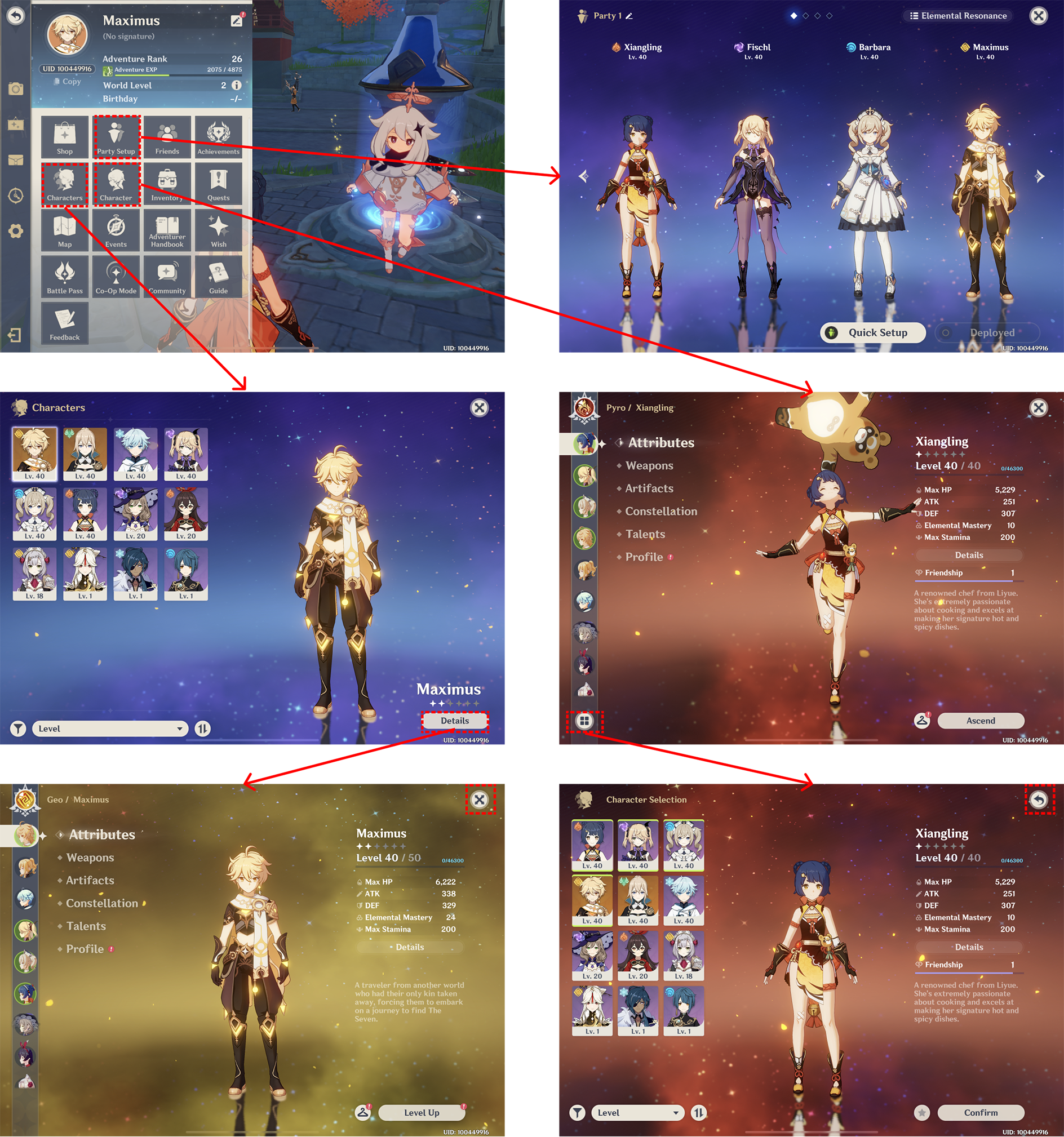
The second UI issue I’d like to talk about is the various screens related to character and team management – I did a quick navigation flow to help illustrate my point:

Broadly speaking there are 2 distinct needs: roster selection and character management (leveling, gear management, skills upgrades etc.). So having separate menu entry points for “Team setup” vs “Character” does make sense, even though they could be combined in an alternative flow. But I find the “Characters” vs. “Character” flows puzzling – they are largely made up of same/similar screens (just with reversed navigation), but there are some weird UI inconsistencies:

  • The ordering of characters is inexplicably different – in “Characters”, sorted by level by default; while in “Character”, the active roster is shown first, then the rest by levels.
  • The “Characters” screen and the “Character selection” pop-up also make for an interesting comparison: these two screens have largely the same layout and high level purpose (view list of characters, select one to navigate to), but have numerous small UI differences (list of 4 in a row vs 3 in a row; blank space vs. right bar of character details; “X” vs “back” navigation buttons…).

I might sound nitpicky here, but these small inconsistencies add up to unnecessary cognitive load (forcing the player to actively think), which begs the question of why do these 2 largely redundant flows exist?

To me, this is a reflection of lack of holistic game polish, and perhaps related to the production culture, which I’ll do some extrapolation and speculation below.

Closing thoughts

I wrote a post last year “Assessing China’s game development capabilities.” I think Genshin Impact is a continuation of the trends I discussed there, but it should also be proudly celebrated by Chinese developers as a product breakthrough in original IP on the global stage.

It succeeds in part due to its sheer audacity in vision and content scope – original IP, open-world, cross-platform (with mobile as the core), and years of live-ops content runway. miHoYo is well positioned to tackle this, having honed its IP creation skills in the Honkai franchise, and with good access to China’s “industrial scale” mobile production capabilities.

I do think it’s a “quantity over quality” approach, as I feel the game clearly prioritized volume of content (and future expansibility) over polishing details. But again, this is the proven formula for Chinese devs – getting the fundamentals barely good enough, then production scaling like crazy. Whereas western devs tend to be wary of the content treadmill (e.g. WoW’s expansion cycles), Chinese devs seem unfazed about embracing it. They don’t enjoy it – but they are more willing to grind it, and for the successful games, the economics seem to pay out well. While we don’t know for sure currently, I expect Genshin to have a stream of major updates planned already (the next one is probably close to completion by now), and the update cadence may again surprise the global audience4.

(UPDATE: the update schedule was actually announced, and it looks like initial reactions from the hardcore community globally was disappointed. See this reddit thread.)

Where Chinese devs should/need to grow further, in my opinion, is the discipline, thoughtfulness, (and frankly) prioritization of better UX5. This is not easy to do – in my personal experience, I’ve found Chinese devs’ strong production-scaling tendencies and general haste to be big barriers for holistic game polish. But as the market, and gamers, get more demanding, I expect higher emphasis here in future, which may force shifts in development models.

Before I forget, a couple of things to highlight that are part of the game’s breakthrough:

  • First is localization: I played the English version for a while before switching back to Chinese, and I thought the English localization had very high production quality, made by a veteran team of writers and VO cast.
  • Second is the music: I love it. It’s clear no expense was spared in music production, and the soundtrack is lovely. However, sometimes the music transition triggers seem a bit ungraceful (again, perhaps one of these polish cases).

At a macro level, I think it’s safe to speculate that Chinese devs are going to have even bigger ambitions post-Genshin, despite significant external headwinds (China-domestic regulations, state of economy, global geopolitics). The NA/EU market is the last frontier geographically. It will also be interesting to contrast East/West approaches to cross-platform: Chinese devs will be grounded in mobile-first (otherwise they leave a lot of money on the table with the China-domestic market), whereas western devs will tend to prioritize PC/console à la Fortnite.

  1. As a sign of Chinese gamers’ constant vying for status (which is a huge part of their motivation for gaming), gamers actually complained loudly that miHoYo opened the servers a couple of hours ahead of schedule – they felt betrayed about missing out on snatching a sexy low-digit UID.
  2. I don’t remember specifically, but this was probably one of the ear flicks that caused me to give up on using a controller on PC.
  3. If you spend for stamina, you earn the privilege to grind more.
  4. While simultaneously being criticized by Chinese players for being too little too slow – such is the diminishing returns.
  5. by UX I’d like to refer to this particular framework here.

Epic vs. App Stores

The ongoing fight between Epic and Apple / Google is one of the biggest tech stories of the year. The situation is very fluid, with a lot of developments since last week, and a ticking time bomb by end of August.

Not surprisingly, there’s been a lot of “takes”, most of which is candidly not too useful, and a small amount that have covered the situation from insightful angles. Instead of regurgitating these insights, I thought I’d just list a few here (most of these are usual suspects if you surf a lot of tech punditry):

The Chinese Android app stores example

I think it’s rather futile to debate the abstract merits of “open” vs “closed,” which at the ideological level is the heart of this fight. Tim Sweeney has been very consistent over the years – his public criticism of UWP is spiritually similar to his stance against Apple / Google, and I believe it’s stemming from not merely a business interest calculation (though he is often accused of such), but a genuine belief in “open.” 1

Instead, I think it’s more useful to discuss the Chinese Android app distribution landscape, as a real example of why Epic’s desired state (open up iOS to 3rd party stores and alternative payments) may not be good for consumers. (The linked Chinese post above is a great read on this, below is my brief summary of the same topic.)

When Google abruptly exited China in 2010 (and along with it, the Google Play store), there was a gold rush to fill in the vacuum left in the Android ecosystem. At a 30,000 ft level, a series of things happened:

  • In the beginning there was a flood of independent stores, with notable ones like Wandoujia (funded by ex-Google China head Kaifu Lee’s Innovation Works) and 91 Assistant.2
  • In a landmark deal at the time, Baidu acquired 91 Wireless (which owned the 91 store) for almost $1.9B in 2013.
  • As of 2013 Tencent also had an Android app store MyApp. After Tencent leveraged WeChat’s popularity to promote MyApp (“if you wanted the latest version of WeChat, go to MyApp”), MyApp gradually became one the most popular stores.
  • In 2014, prominent Chinese Android handset brands (with the exception of Xiaomi) formed a coalition called the “Mobile Hardware Alliance”. A major goal of this coalition was to exert influence in the distribution of games (which was recognized as the key cash-cow in app stores) in the Chinese Android ecosystem.

The current state of stores, at a high level, is this:

  • All the Chinese Android brands have their own stores, and because of the coalition, these stores have significant weight.
  • Tencent MyApp is the biggest non-OEM owned store.
  • The once prominent independent Android stores (without backing of OEM or a major social app like Tencent’s QQ/WeChat) are greatly declined in presence.
  • Collectively there are still dozens of stores.

How about the economics – let’s talk about that 50%?

  • There isn’t a unified rate – everything is negotiated. But indeed, if you are a game publisher not Tencent or Netease, the 50% store cut is the common term you will get.
  • Strictly speaking, this isn’t an “Apple-apple” comparison, as these Chinese Android stores call this “joint operations” of games where in theory they are providing more value-add (funneling more traffic etc.).
  • The prevailing rate for Tencent and Netease have been pushed down to 30%. (And of course Tencent keeps 100% in its own MyApp store.)

To summarize, the Chinese Android app store landscape is very much objectively a worse state than the Apple / Google monopoly Epic is complaining about:

  • Consumers have a confusing user-experience (overwhelming amount of store choices, fraud / security / malware concerns, inconsistent UX of the same app across different stores).
  • Developers are typically giving up a much higher share of revenue.
  • Developers have a lot more development costs / headaches (support dozens of app stores, SDKs, builds).

To be clear, it’s not a certainty that we will see a similar end-state if the Apple / Google “app distribution market” and “payment market” is opened up by regulation. (For one thing, the Hardware Alliance thing is clearly suspect to anti-trust scrutiny.) But it is clearly a possibility with strong factual support.

Problems that Apple should address

Having argued why “the grass isn’t greener” on the other side that Epic desires, let’s briefly talk about issues that Apple should tackle. This part is focused on gaming specifically.

For the 30% rate, I do believe (and clearly I’m biased with a vested interest here…) that this should be pushed lower with how the ecosystem has grown and evolved, even if purely arguing from an economies of scale perspective. Ultimately though, economics are a reflection of “who owns the customer”, so Valve’s model of volume-based tiers (starts at 30%, drops to 20% for sales above $50M) isn’t a bad reference. (This is also the common logic in retailer / wholesaler agreements.)

(Alternatively, Apple can continue to make confidential deals with the biggest partners, offering rev share discounts on a case-by-case basis.)

Apple also should update its strategy (and thus policies) regarding emerging services like cloud gaming. The rejection of Microsoft xCloud on iOS feels short-sighted, and untenable in the long-run if cloud gaming does take off. (It’s also a bit silly that at the same time thousands of HTML5 games are available directly within WeChat, which seems like a much bigger violation; arguably xCloud is offering much better games that would enrich the user-experience of iOS gamers.)

To end on a light-hearted note. Every time I write about Apple and mobile gaming, I will bring up my dream for an Apple-designed controller peripheral. I don’t think that will ever happen, but one can dream…

  1. Conversely, Apple, like Nintendo, like Disney, have been decades-long champions of the “closed” side of the debate. Just for transparency, at at the abstract level I lean closer to this camp, because I idolize seamless user experiences (which are typically easier to realize in a “closed” ecosystem).
  2. As a sign of the times, a popular feature-set back then was a PC client that was a storefront and also a manager for the download and installation to the phone, similar to using iTunes to manage iPhone apps.

The Last of Us Part II

Some notes on the controversial blockbuster sequel.

***Spoilers warning*** I’ll be liberally discussing all aspects of the game, so please do not read further if you want to avoid spoilers.

First a quick note about my play experience – I got the disc a week after the launch date, by which time there was already a massive storm online. Despite my efforts, I did have some key story points spoilt, so going in I was somewhat prepared mentally.

I could only afford to play a couple of hours a day, a bit more on weekends, so it took me a good two weeks to get through. My final session was a 5-hour binge on a weekday night, ending at 3/4am (that day at work wasn’t very productive).

I started the game late, was armed with some knowledge of the drama, and had the play sessions paced out – I felt all these were positive factors that helped me enjoy the game. To me this game is a flawed modern masterpiece, that deserves to be remembered as one of the most ambitious narrative games of the decade.

Narrative structure & theme

TLOU2 follows a very rigorous structure, which I’d break down as follows:

TLOU2 acts

The structure showcases the game’s risk-taking ambitions. In my view there are 2 primary risks taken: 1) the story decision to kill off the predecessor’s protagonist, Joel, as the inciting incident; 2) in a surprise switch at the half-way point, forcing players to play as Joel’s killer, Abby – and revealing that this is a game with dual playable protagonists on the opposite ends of a revenge plot.

In retrospect, to me the game’s real theme is about how people deal with trauma, via a story of hate-driven vengeance. The game delivers a traumatic event to players (Joel’s death), then forces players to go through the stages of grief (both in the game as Ellie, and in real life with their own feelings towards Joel). The perspective change to Abby is an experience in forced empathy, which to me is a secondary theme.

The perspective shift is not new as a literary device – Game of Thrones clearly leveraged this to great effect with memorable characters like Jaime and Tyrion Lannister. But this feels like the most ambitious example in a video game I’ve played, and the effects were fascinating. In the climatic fight between Ellie and Abby, like so many players, I did not want to hit the attack button. But, just like the predecessor’s climatic surgery room scene (which you revisit so many times in this game), the game does not offer you a choice. Thankfully, the game ends the fight mercifully.

I’m not going to go deeper on the narrative and theme – that would be a huge endeavor, and many people have already offered lots of great content. I’ll link here one video I particularly enjoyed.

Game loop & “level” pacing

The game’s narrative beats (the bullet points structure above) serve the long-term and mid-term motivations. At times this can feel ham-fisted: I felt Ellie’s 3 days in Seattle was a bit repetitive in its use of “go to point X to find the next clue about Abby’s whereabouts”. Anyhow, if we zoom in 1-2 levels further, we get to the layers of the “core loop” below:

  • Long-term goal, e.g. find Abby
    • Mid-term goal, e.g. go to Hospital
      • A series of “levels”, or set-pieces

My loose definition of a “level” here is a 5-20 minute section of gameplay made up of elements from the following:

  • Combat, stealth or non-stealth (sometimes forced non-stealth)
  • “Walk and talk”, the most basic way to deliver the story
  • Exploration, which is a lot of ambient storytelling (reading notes etc.)
  • Scavenging and crafting
  • Environment puzzles (some light platforming gameplay)
  • On-rails set pieces, e.g. car chases
  • Mini-games, like guitar simulator
  • Cut-scenes

From a player perspective, I wouldn’t say there’s any crazy systemic design innovations – these are the proven gameplay elements of Naughty Dog action adventures. The craft comes from the thoughtful sequencing & arrangement to create great pacing, and the insane polish (and the vast technical investments to deliver that polish).

What I thought the game did particularly well for pacing, was keeping players on their toes with surprises. Examples:

  • Have you grabbed by an enemy (either transitioning into combat or a cut-scene) as you go through a level transition (“squeeze through this space”, exit this door)
  • Give you a clear environment puzzle, then as you are moving towards the solution, have the floor collapse under you into a mini-boss fight
  • Give you a workbench (for equipment upgrades), as you start reviewing your upgrade choices, have enemies rush you and grab you from the bench

The game does these surprises very sparingly (like only once) – but they are very effective at making you second-guess yourself and stay alert. Is there going to be a jump-scare at that next workbench? (No.)

Also, they are done in a fair way – in the workbench example, these enemies didn’t spawn out of nowhere; they came out of a locked room in the apartment. So if you had planted some mines in front of that door before you engaged the workbench, you would have had the jump on them instead. This is the level of detail and polish that surpasses player expectations.

Transitions – in my view, any time where you go through a transition where you cannot backtrack (e.g. going through a door/gate and blocking it behind you, going down a sliding slope, jumping down a vertical), that’s usually a sign of a level transition, which serves pacing and possibly technical goals. There are also occasionally hard transitions after cut-scenes (teleporting you to a location), some of which I felt created dissonance (after having you struggle mightily for a few hours to get to a place, it seemed trivially easy how you got to another location).

There are some issues for me with the basic gameplay formula. Resource hoarding is a pretty big problem (at least at moderate difficulty). Thematically as a post-apocalyptic survival adventure, the game encourages players to engage in stealth through tight resource constraints. This is in conflict with utilizing the fun combat skills that players unlock. (The player could tweak the difficulty settings very granularly, for example increase the environmental resource amount to encourage more open combat.) To be clear, I actually agree with the game’s trade-off here: the combat is less fun, but thematically more immersive. But it’s one element why some players find this game un-fun to play.

Another problem created by the scavenging gameplay and ambient stortytelling is backtracking. That is, after clearing an area, combing back through it to open every last drawer, and trying to find every ambient story point / collectible. This is again in conflict with the desired pacing. And it also creates narrative dissonance – “I gotta hurry to rescue my friends… but after going through every drawer.” Even in levels/sequences where there was clear urgency, I couldn’t help but think – hey, maybe there’s some rare collectible here, I should take my time.

Lastly, the concessions in the buddy AI was at times immersion-breaking. As a Naughty Dog convention, there are many parts of the game where you have an AI companion. This serves important story goals (after all, without a buddy, it’s hard to have “walk and talk” sequences), and they can assist in puzzle and combat gameplay as well. But in stealth gameplay, they still land in uncanny valley too often – they can sneak around, and will look for positions of cover, but it feels like overall they are still treated as invisible to enemies. I’m not 100% sure of this – there was one occurrence where it felt like the companion was detected; but on the hand there’s probably a dozen occurrences where the companion should have been spotted, but was completely ignored (sometimes comically).

Problematic game length

This was the biggest issue I had with the game. If we take each bullet point in the 4-act structure above as a “chapter”, and each chapter roughly takes up 2-3 hours of game time, then we get to a 20+ hour game length. In my own experience, I got to the end of Act 2 cliffhanger after roughly 18 hours, and ended the game after about 32 hours. For a linear action adventure, it’s both an astonishing feat and an excessive over-indulgence.

I feel it’s the product of compromises – it was set that the game would have dual protagonists, and each protagonist’s arc demanded a experience that couldn’t be too compressed. But the end result is a journey that is both too long and still too rushed. There wasn’t space to flesh out the numerous side characters, and I’d loved to see more of the Seraphites’ story, for example.

I can’t help but think, what if this game was broken into 2 parts, and released episodically? This is most probably a terrible idea, with lots of risky questions – how will the episodes be priced, how far apart would the releases be? How many players would purchase the first episode but not the second? But to me it would seem to be a better match with the game’s ambitions, and could perhaps help position expectations better.

Alternatively – what if the “chapters” were unlocked at an announced schedule? Like an episode a week (more practically, maybe one chapter every couple of days)? There might be something here, if a narrative-focused game’s content release factored in the social media cycle – e.g. the weekly reddit discussion/reactions of the latest Westworld episode, and the community activity leading up to the next episode. Again, probably a terrible idea still…

Player expectations / toxic fandom

I feel we also have to talk about the massive community controversy since the game’s release. In hindsight, the marketing misdirection was probably too clever and came across toying with players’ emotions. And the overly-strict spoiler guidelines to reviewers was also a major lost opportunity to align player expectations. For example, I don’t think there would have been a significant downside for reviewers to discuss the dual protagonists setup – yes, it would have been less surprising in that moment, but the forced experience in empathy would still hold (and players would be less distracted wondering how long the Abby section would last).

I think I can empathize with much of the community angst, especially the most fervent fans who dived in on launch day and were shocked. That moment of shock, and initial grief, became a rallying call online, and took on a momentum of its own. In contrast, professional reviewers under embargo had to process that moment in isolation, and were obligated (professionally) to finish the game and reflect on the whole experience. This is perhaps one factor contributing to the gulf of opinion between professional reviewers and players.

However, this raw emotion of anger / denial is in no ways justification for the massive abuse (racism, sexism, homophobia, transphobia and various other forms of prejudice / bigotry) hurled at the makers of the game. (Unfortunately, this is all too common these days – The Last Jedi and the 2016 Ghostbusters come to mind.) The sense of entitlement is out of whack. The industry, and the fans, need to reflect on this.

And I guess there’s some meta irony that a game about hatred (it’s futility and overcoming it) is the subject of so much futile hatred. It is after all, a video game, a work of fiction. Perhaps this was the 5D chess that Naughty Dog was playing all along. But at the end of day, as a developer, and as a player, I hope that we can see more games take risks like TLOU2, and I hope the controversy doesn’t discourage game-makers.

(Early) Thoughts on Valorant

I’ve wanted to write this post for a few weeks now, but have not yet had time to extensively play the game. Finally I decided I should just jot my current thoughts down (or these thoughts will just be lost in time), noting that it is founded on a dangerously shallow understanding of the core game.

A quick disclaimer: I used to work at Riot Games, the developer behind Valorant, the game I’m about to discuss. My tenure at Riot overlapped quite a bit with this game’s development, but I was never affiliated with the project. My discussion below is based on public info.

Valorant is Riot Games’s new FPS currently in closed beta for PC platform, and its first new game IP since League of Legends a decade ago. There’s a lot riding on this game: in the short to mid term, this game will largely determine whether Riot is an multi-IP games studio,1 or “just” the League of Legends company (which to be clear is an extremely enviable position). It’s also a major test for Riot’s R&D process, as the game has been in development for over 6 years.

Savvy beta marketing

Marketing-wise, Valorant has had a great start. Its Twitch beta key strategy (keys randomly drop by watching Valorant streams, initially with designated partners, later with all channels) has overall been a resounding success.2 This is a mechanic that CS:GO players are familiar with, as CS:GO tournaments have often used in-game drops as rewards for watching streams. One criticism of such tactics is that they inflate Twitch engagement numbers; that certainly happened with Valorant, though I don’t think it’s Riot’s goal to hit specific viewership goals, but rather, to have optimal visibility / hype around the game’s beta launch – and that goal was more than fulfilled. (Possibly over done, even – for a while, Reddit was filled with complaints about not being able to get a key despite watching dozens of hours.)

Riot has also deployed its community engagement best practices to great effect. I’ve skimmed the subreddit over the past few weeks, and the community has generally been very appreciative of Rioter engagement. The “devs vs streamers” showmatch (where the devs won by a landslide) also earned the team a lot of street cred.

Gameplay

The core game (“5v5 character-based tactical shooter”) can be crudely described as 80% Counter-strike and 20% Overwatch. Counter-strike lends the main structure of the game: the 5v5 rounds-based format (with its economy macro play), the map objectives (bomb plant / defuse), and even the broad strokes of the weapons and gunplay feel. It even brought over the esoteric mechanic bunny hopping.3

The limited selection of grenades in CS is replaced with an expansive character system (the “20% Overwatch“), and character abilities are mostly about utility – detection, blocking vision / movement, mobility, and so on. Abilities are not free to use; instead, charges are purchased with hard-earned cash at the beginning of every round, which suggest their origins in CS-grenades. (Ultimate abilities are the exception: they are charged up by kills, deaths, planting / defusing, or collecting power-ups.) Damage-dealing abilities have been contentious within the community, partly due to Riot’s own marketing statements.

Based on very limited game time, I would say the core game works. It builds on the proven foundations of Counter-strike, and adds variety and depth with the characters system. It’s a very strong execution of a clear game thesis.

Bull & bear cases

This is where I make some wild speculations of the game’s future. This is done in earnest as a thought exercise, but take it for it is – subjective predictions and guesses. I’ve also intentionally pushed myself to plant some stakes in the ground, instead of hedging – so there’s a higher chance I look like an idiot in a few years time when I look back at this.

The game environment – cheating, toxicity, etc.

The seedy underbelly of a competitive online game. Riot has had a lot of experience manage this aspect in League of Legends, but it remains a challenge. In particular, anti-cheat is a never-ending war of attrition, and FPS games on PC seem to have the worst of it – PUBG, Apex Legends, Call of Duty: Warzone, and of course CS:GO. Riot made a big promise – “a commitment to anti-cheat from day one”, and promptly walked into a big, ongoing, controversy with its anti-cheat software, Vanguard. (A quick search will turn up lots of articles discussing this.)

As an aside – the situation around Vanguard tells you a lot about the PC platform. Vanguard asks for very high level system privileges, and raises legitimate concerns about privacy / malware / digital surveillance – the fact it can do so, and needs to do so4, is a problem unique to PC gaming (I’d guess Android is close). There are cheaters on console and iOS, but the scale / prevalence does not compare – for example, see the recent story about console Call of Duty players turning off crossplay to avoid PC cheaters. (And the compatibility headaches it is running into, with all sorts of hardware / software configuration edge cases, is also unique to PC gaming.)

Anyways – some of the Vanguard controversy is founded in conspiracy-theory land – singling out Riot for its ownership by Tencent, and thus leaping straight to concerns over Chinese hacking. Unfortunately, it is a sign of the times, and the trajectory of worsening US-China relations. But I won’t delve into that here.

The bear case here is that the security drama severely hampers the game’s growth, or even sinks it. But I think that would be extremely unlikely.

I am more concerned about toxicity, and how it reduces the addressable audience. Here I’m more pessimistic. I don’t expect Riot to do much better than it did in League – which is to say, the game will have a male-dominant (like, ~90% male) community that is frequently toxic, and often prejudiced and hostile against female (and other minorities) gamers. This bleeds into my next point.

Audience

This is the biggest variable to Valorant’s future (and encapsulates many other variables, so this is not a MECE analysis). To start with my conclusion – if you were to ask me right now, I’d guess that Valorant stays safely within the confines of the existing PVP-shooter audience, and carves out a playerbase from various existing shooters; it will have a loyal following, but it will not challenge battle royale’s position as the leading PVP-shooter sub-genre globally.

The bull case for Valorant is where the game goes beyond converting its bulls-eye target of Counter-strike players, and attracts players of other adjacent PVP shooters – Overwatch, Rainbow Six Siege, Call of Duty, PUBG, Fortnite, Apex Legends, Escape from Tarkov… Going even more broadly, it could also appeal to players of other types of real-time multiplayer PVP games, such as League of Legends itself – this poses a mild cannibalization risk (which I wouldn’t lose sleep over).

It’s hard to imagine the game converting a lot of non-PVP gamers. I would guess that Riot does not have much interest in targeting them (at least not for this game), in contrast to, say, Fortnite‘s efforts at building a digital lifestyle brand (and catering to a wide gamer demographic). A lot of this is rooted in the company culture, which for years was “HARDCORE GAMER”, but this has been relaxed/widened a bit in recent years. Still, Valorant‘s Game Overview section on its beta website is pretty telling about the intended audience:

Here’s what we think it takes for you to trust a game enough to invest: 128-tick servers, at least 30 frames per second on most min-spec computers (even dating back a decade), 60 to 144+ FPS on modern gaming rigs, a global spread of datacenters aimed at <35ms for players in major cities around the world, a netcode we’ve been obsessing over for years, and a commitment to anti-cheat from day one.

Shooting in VALORANT is precise, consequential, and highly-lethal – we want you to win on your skill and strategy alone.

This is a laser focus on CS players, and disgruntled players who’ve complained about the “shitty netcode” of just about every shooter with a PVP mode. (Maybe it’s just for the beta phase, where they are prioritizing veterans above all else.) I’d argue this language is alienating to players less familiar with PVP-shooter games, who don’t necessarily understand jargons such as “128-tick”, and thus this marketing actively reinforces the existing male-dominant audience stereotype.

The arguments for a bear case come in a few flavors. The first is where CS players churn and flow back to CS, because at the end of the day, Valorant is a different game. There’s some premature indication of this on reddit, where CS veterans would demand certain types of mechanics (that are present in CS). This is a delicate balancing act, and looking at Riot’s early days with League and Dota veterans, I’m not too worried that Riot would over-cater CS veterans. (But the League / Dota analogy would also suggest that loyal CS players will stick with CS, and even be antagonistic to this new game which poses a threat to their community – this would limit the efficacy or targeting CS players to begin with.)

The second bear case argument is where Valorant fails to capture players other than CS die-hards. This does not seem to be the case so far, but I would guess the ceiling here is not high. My negativity here is largely emotions-based: since Valorant’s inception 6 years ago, we’ve witnessed some dramatic new entrants to the PVP shooter space – Overwatch, PUBG, and Fortnite, to name just a few. These games all brought some genre-defining “fresh” factor. I couldn’t help but feel that Valorant in comparison feels too old-school, too familiar (“I know exactly what I’m getting into”). There’s a market premium for novel experiences – for example, that first chicken dinner was unlike any game experience I’ve ever had before – and Valorant judged by its cover is treading on familiar ground.

The last argument is about overserving player needs. I recently came across this excellent article on fy_iceworld – and vivid memories of playing CS1.5 in college in China came roaring back. I was the snob that begged classmates to play the “real game” (as in, play 5v5 bomb defusal mode), and we did very occasionally; most of the time though, we were “messing around” in fy_iceworld or playing 20-person PUGs (with max economy every round, of course). My point here being, if my cohort of CS players 15+ years ago is any indication (highly anecdotal, and a long time ago, for sure), the majority of players around me were playing CS “casually”. (Just like the vast majority of soccer enthusiasts around the world are not playing 11vs11 games on full-sized grass pitches with FIFA rules.) If Riot is too strict on the game modes offered, and don’t provide “casual” outlets in-game, it could cause these “bottom of the pyramid” players to churn, which could also pull away their social connections.

Esports

I don’t have much to say here, except that Valorant is clearly built as an esports title (in the proud tradition of CS), and it should have a vibrant esports scene that helps with maintaining the game’s player engagement. I also think that for spectators, shooters are much easier to understand and follow conceptually (vs MOBAs), and thus the bull case could be as big (or bigger) than League esports today. So I’m personally quite bullish here, and think that Valorant could enjoy disproportionately higher esports popularity relative to its active playerbase.

One bear case argument is societal attitudes towards video-game violence, and how much that impacts a shooter like Valorant when it comes to sponsorships or broadcast coverage. This may be an issue in North America.

Winning the Chinese market

I’m quite bearish here. Valorant will have a difficult road to launch in China (could be delayed by years), and even then its prospects are murky.

There is a strong bull case to be made. Firstly, Riot is owned by Tencent, which has market-leading publishing capabilities in China, and did a phenomenal job publishing League. Secondly, the PC PVP-shooter landscape is much less crowded (and more stagnant) than it is in North America – PUBG, Fortnite, Apex Legends, Call of Duty franchise are all not officially available in the market. Based on one source (tracking PC cafe consumption), the market leader remains Tencent-published CrossFire (launched in China in 2008), followed by Tencent’s self-developed Assault Fire as a distant second (10x engagement gap), with Overwatch and CS:GO in 3rd and 4th place. One could argue that the market is ripe for a new entrant, and Riot + Tencent is a fearsome combo.

But the bear case is quite stacked as well. To begin with, there is the regulatory uncertainty – for years, the trend has been in one direction, and that is tightening. And US-China relations are at historic lows, which makes getting the license approval for a US-based IP that much harder. (There’s a reason the big names above are all absent.) There’s a low (but non-zero) possibility that Valorant never gets a license.

Second of all, the CrossFire audience may not be interested in Valorant, despite the superficial similarities. This links back to my earlier point about fy_iceworld and the audience motivations.

Thirdly, the initial Chinese player reaction has been mixed, which reflects some brand gaps and taste differences. On NGA (a popular forum for Chinese hardcore gamers), Valorant‘s gameplay has been labeled “缝合怪” (stitched-up monster), which is a common term to describe video games that mash-up mechanics from different games5; and the visuals were unfortunately derided by some as “browser-game quality” (not understanding or refusing to acknowledge that it’s a conscious art style choice). These comments partly stem from hostile rivalry between Riot’s supporters and supporters of Blizzard and Valve. Blizzard is clearly the biggest and most beloved studio brand, and their Chinese supporters seem a tad unhappy about Valorant possibly taking players from Overwatch; meanwhile Valve supporters are still holding a grudge from the League – Dota2 rivalry, which has always felt much more intense in China. However, I do think the art style is an acquired taste to many Chinese players.

And last but not least, there’s the question of mobile.6

Mobile

I’ll try to be concise here: my take is Valorant needs to have a mobile version, but it will be very challenging to get it right.

First, the most popular PVP-shooter globally, by a long margin, is a mobile game. PUBG Mobile announced 100M MAU last May. Its sibling game in China, Peacekeeper Elite (rebranded for regulatory reasons), was estimated to have had 197M MAU this March. So it’s plausible that the combined PUBG Mobile franchise currently has over 300M MAU – about the population of the US, or comparable to Twitter’s MAU.

In the China context, what this means is “all gamers are hardcore gamers”, if you define “hardcore” by genre played. To put this into a picture: Chinese moms are playing mobile battle royale with their children.

These Chinese moms will likely never play PC games, if they don’t already. A fraction of these kids will, but I’d bet majority of them will be mobile-only gamers. Clearly, Valorant is not a game made for them (and not every game needs to be made for the widest audience/platform); but I can’t help but feel Valorant cannot be a truly global game (which matters for its esports aspirations), without at least trying to accommodate such players somehow.

So should Valorant make a mobile version? The core game’s methodical play and precision aiming does not translate well to current mobile shooter control schemes (or console either). PUBG Mobile can get away with it, and retain the spirit of the original PC game, because the maps and the encounters are so open-ended – it’s only during close quarters combat where the gameplay feels like a parody at times. Perhaps CrossFire Mobile could be a reference here: the game superficially resembles its PC ancestor, but I’ve heard the engagement with the content is notably different from PC.

In closing…

As a meta comment: this post probably both took me the most time to write (10 hours over 3 nights, as I debated endlessly with myself), and left me least satisfied with the results. I hope you find it marginally useful. If I were to do it again, I would break it up into a couple posts, so I can have the energy and the space to mull over a specific point.

For the game discussed, I guess my overarching sentiment is moderate pessimism over product-market fit. Valorant is strong execution against a clear game thesis – I just don’t know how big that audience is, versus other possible opportunities.

  1. This doesn’t take into account Riot’s studio acquisitions – Radiant in 2016 and Hypixel in 2020, where there’s scant public info about their projects.
  2. Side note – I was surprised that beta keys could only drop on Twitch – I would have thought Riot would have enabled other streaming properties, such as Youtube & Mixer, to also participate. I speculate this is due to a lack of infrastructure (APIs etc.) on these partners, rather than lack of interest on Riot’s part.
  3. I don’t claim to be an expert on FPS games; I couldn’t understand why this mechanic is needed, aside from making CS players feel at home. It reminded me of creep-stacking and denying in Dota, and League of Legends choosing not to implement them.
  4. This is one of the hotly debated points in the controversy.
  5. Star Wars Jedi: Fallen Order is another recent game that got this meme label. Not bad company to keep.
  6. For folks who’ve read some other posts on this site – do I sound like a broken record about mobile yet?

Platform alliances and fragmented user experiences

As a bit of funny context, I’m writing this post amidst one of the biggest stock sell-offs in recent decades. US stock markets actually triggered their circuit-breakers after opening 7% down, and paused trading for 15 minutes. I thought I’d try to be a bit more constructive with my time (while sipping some scotch), instead of just fidgeting in front of my portfolio dashboard.

Nvidia’s GeForce Now has been a steady thread of gaming news in recent weeks. Despite (or rather, exactly due to) what feels like a more compelling end-user value proposition (stream the games you previously purchased), numerous publishers large and small (Activision Blizzard, Bethesda etc.) have pulled their content from this service. Publishers’ perspective is simple: they really don’t like it when a new service generates revenue off their content, without their permission or share of profits. (This The Verge article gives a good overview and analysis of the situation.)

One interesting development today – on one hand, another large publisher, 2K Games, pulled their content; on the other, Epic Games endorsing the platform with the full weight of their store.

The Epic decision is interesting partially because how transparent Tim Sweeney is with his intent. To quote him directly:

Epic is wholeheartedly supporting NVIDIA’s GeForce NOW service with Fortnite and with Epic Games Store titles that choose to participate (including exclusives), and we’ll be improving the integration over time.

It’s the most developer-friendly and publisher-friendly of the major streaming services, with zero tax on game revenue. Game companies who want to move the game industry towards a healthier state for everyone should be supporting this kind of service!

Cloud streaming services will also be key players in ending the iOS and Google Play payment monopolies and their 30% taxes. Apple has decreed that these services aren’t allowed to exist on iOS, and therefore aren’t allowed to compete, which is megalomaniacal and won’t stand.

Some quick observations. First of all, Sweeney caveats/acknowledges that this support still requires publishers’ participation. So the actual impact / enrollment still needs to be seen. (When I first saw the headline without reading Sweeney’s original tweet, I thought it was an unilateral move and wondered how that would work.) And if it does not result in a great majority of the store’s titles becoming streamable, it could mean a very fragmented (and confusing) end-user experience – for example, would Epic Game Store (EGS) add a platform tag on each title that shows which ones are compatible with GeForce Now?

Second, Sweeney discloses his motive is at least partially (if not primarily) about forming an alliance against iOS / Google Play. This makes theoretical sense, and is the sort of classic partnership that gets discussed in business strategy classes. The reason Epic is so eager to rally support against iOS / Google Play platform rules is simple – across the entire video-games vertical, mobile (due to its sheer scale) is generally the biggest opportunity for revenue growth, and the 30% platform fees are likely the biggest opportunity for profit (bottom-line) growth. This logic is the same whether Epic sees itself as a games developer or a publishing platform for 3rd parties.1

For this particular partnership, I’m a bit dubious whether it will meaningfully move the needle. I’m generally bearish on streamed gaming – I think it’s cool technology in search of a problem / audience, and if the strategy is to reach multi-billion gamers, I’d argue mobile-first (or mobile-only) remains the best path over the next 5 years.

Anyway, the other part I wanted to write about is the fragmented user experience in this age of multiple co-existing / overlapping games platforms. What do I mean? To use AAA games as an example – to date, publishers have all built their own launchers / platforms (Uplay, Origin, Rockstar Social Club) alongside distribution platforms such as Steam, GOG and EGS. Players are all familiar with the experience of launching a Ubisoft game on Steam / EGS, just for it to pull up Uplay and the game itself. Putting aside the obvious overlapping functionalities (duplicate social features, overlays, platform achievements, cloud saves), I’ve also seen cases of weird hand-offs – for example, the initial game download was handled by Epic, but during the first launch Uplay initiates a huge patch.

Also – alliances can be temporary, and every break-up is a chance for fragmentation. When Bungie exited its partnership with Activision on Destiny, and moved over to Steam, what did that mean for players’ friends-lists? (They stayed on Battle.net.) And how long will Bungie keep its PC migration service up? (Not that it matters that much, as inventory rapidly devalues with new expansions.)

There can also be player-caused fragmentation. Again using Ubisoft as an example – I bought The Division 2 on EGS, but purchased the Warlords expansion directly on Uplay. Would this cause any weird experiential issues on EGS? (I don’t know because I’ve not launched the game via EGS since, which I’m sure is exactly what Uplay prefers.)

Similarly, there are (and will be more) fragmented experiences when we talk about “cross-platform-play”. Experiential fragmentation is not going away (at least without a huge fight), because it’s not fundamentally a technical problem, but rather a business model / strategy problem – just as it is in the above case of GeForce Now. In theory, the combination of cross-play and free-to-play monetization is exactly opposite what large platform incumbents like Microsoft and Sony want: they want to have a monopoly on network effects, and they certainly don’t want out-of-network spending. In practice, there are complicating motivations,2 and some games like Fortnite have a big enough audience to force the issue, though as we have seen these games remain the exception.

From the end-users perspective – a lot of this is exactly an argument for a vertically integrated platform with monopoly market share, in exchange for an user experience guaranteed to be seamless. For PC, that sounds a lot like Steam, which I guess partially explains the player anger towards EGS. But Steam’s monopoly was always built on shaky grounds (the underlying attributes of the PC platform), and Steam’s margins were Epic’s opportunity.

  1. By the way, if it’s not clear, I am not being critical of Epic’s motives.
  2. Microsoft as the also-ran to Sony, has an incentive to open up and share the network.

Tom Clancy’s Ghost Recon Wildlands (2017)

I’ve been holed up at home due to the 2019-nCoV coronavirus outbreak. The news and social media coverage got really depressing really fast. This got me itching to play a laid-back, single player, third-person-shooter with modern military weapons.

Turns out, there’s not many games that fit all of the above. Max Payne 3 was the first game I turned to, even though I had already played it years ago. I quickly remembered my previous annoyance at Rockstar’s heavy-handed narrative style in that game. I could go back and play Max Payne 2, which is probably my all-time favorite third-person-shooter… But the graphics do look a tad dated now. So ultimately I ended up buying Tom Clancy’s Ghost Recon Wildlands during the Steam sale for $30.

(Loosely summarizing the game’s setting: you play as a covert operative in a fictional version of Bolivia that has been overrun by a powerful local cartel. Your goal is to bring down the cartel one territory – from a huge open-world map – at a time.)

I had quite a lot of hesitations going in. The game had fairly mixed reviews (69 on Metacritic for PC), many of which seem focused on the repetitive missions and formulaic Ubisoft open-world. I thought I was okay with these faults – the “job to be done” for me was to chill and mindlessly shoot up some bad guys. I was a lot more concerned with some criticisms around stealth gameplay – to be clear, I didn’t want much stealth gameplay (see my “job to be done”), and I didn’t want to be frustratingly replaying some missions because of stealth requirements.

Thankfully, this game is primarily an open-world shoot-em-up, and stealth is mostly optional.1 Yes, if you crank up the difficulty setting and go for realism, you shouldn’t expect to be able to outgun whole armies (with air support) by your 4-man squad. But at regular difficulty you can certainly approach most areas “weapons free”, especially if you are riding in on an attack chopper with mini-guns blazing. (Doing so has been quite cathartic, in my current state of mind.)

Indeed, the attack chopper approach makes most early to mid-game level content feel broken thematically. The session loop becomes “scour the map for a nearby attack chopper, get it, and then blaze through missions”. To balance against this, some later areas are designed with SAM missiles to enforce a no-fly zone.

Quick commentary on vehicles: like any proper open-world, there’s plenty of variety across land, sea and air, but by far choppers offer the most utility – they are the easiest to control, seem just as fast as the planes I’ve seen, and offer insane firepower. From a design perspective this seems quite unbalanced. As a random idea, setting an ammo limit (at higher difficulties) could be a good way to bring them in-line for players who want more realism, without sacrificing the laid-back gameplay at lower difficulties.

Another commentary I have is around what makes the formulaic open-world core game loop sticky. It’s all about the layering of activities and rewards. A typical mini-loop looks something like this:

  • Look at world map – pick an objective
  • Seek a mode of transportation, often involving acquiring the transportation by force which becomes a player-created mini-quest
  • Travel to objective destination – en route, get offered many optional distractions, from emergent world events (GRW doesn’t offer this, but RDR2 and The Division for example both do this a ton), to optional side-quests / rewards
    • Get sidetracked by optional distractions, after which the loop is reset or continue to original objective
  • Arrive at objective destination, get offered again nearby distractions (some may be trivial, like a collectible reward)

    Finish objective and restart loop (the whole loop might have been anywhere from 5-20 minutes)
  • This short loop is quite sticky, even on repetitive play into the hundreds of hours, as it offers both nice natural branching activities (as well as a player-driven overarching goal), and lots of rewards big and small. All of this is layered on top of the most basic loop – the satisfying gunplay of every single enemy encounter (the audio-visual feedback of a headshot or bullet-spray).
  • After so many open-world games, the above seems common sense, but there are still serious offenders that break the flow – Far Cry 5 immediately comes to mind with its heavily intrusive story-quests, which when triggered will literally snatch you from whatever you were doing (like, flying a chopper) and declare you have just been captured. (That was enough for me to churn from that game.)
  • My last commentary is regarding loot. As a modern military shooter, guns and gear naturally bring a deep loot system, and this game goes as deep as any. There are both standard guns with lots of modification options (which all need to be unlocked), as well as special unmodifiable guns (effectively, legendaries). These loot (there seem to be hundreds of guns) can be acquired via missions, achievements and/or micro-transaction crates. At first glance it looks impressive and desirable, with lots of “chase” items; but after 20 hours or so I think the “chase” items feel largely cosmetic and diminishing returns hit hard (after all, do you really need 20 assault rifles that largely play the same?).

    1. So far I’ve only encountered one mandatory stealth – no kills – mission, which involves a cameo from Sam Fisher.

    Annual parties in China

    With Chinese New Year right around the corner, the annual ritual of burning a full month on corporate annual parties has thankfully come to a close. Here I’m jotting down some observations about the practice.

    First off, to state the obvious – Chinese New Year (CNY), which usually lands somewhere in January/February is a big deal. The whole country shuts down for about a week, as literally hundreds of millions of people scramble to get back home for family gatherings. For corporate life, right before CNY annual bonuses have usually just been decided; there are a lot of year-end business summaries, presentations and discussions.

    And then there are the annual parties, which occur at every level of the org. Tencent, for example, has a corporate annual party (tickets are raffled) usually held at a sports stadium, where key executives take part in some performances. Then the business units will have their own respective parties, trickling down to the departments / teams.

    There are 3 typical components of any party:

    • The performances, usually singing / dancing acts, and often modestly budgeted mini-films. Usually each sub-department provides one act
    • Prize raffles, which occur throughout the night, with each prize’s sponsor (a “boss”, partner team etc.) clearly identified. A current-gen max-spec iPhone is a typical good prize, while grand prizes can go quite a bit higher. If a “boss” (say, a director level manager) happens to win a prize, there can be a loud chant of “double”, which means the “boss” is supposed to re-draw the raffle and double the reward out of their own pocket
    • Drinking and toasting. For mid-level managers and above, this feels like the main function of the night: an elaborate and potentially stressful ritual of toasting and hazing, accompanied by private conversations. These conversations are often powerful bonding moments where important business alignments are forged / reinforced. It’s one huge networking and alliance-building session facilitated by a lot of alcohol

    The reason I said at the beginning that a full month is consumed by these annual parties at various levels is because of the invitation format. All these parties can have guests external to the org, and it is important to pay respect (and who you send to the party shows your level of respect to the host). If your work depends on a web of relationships with other departments at the company, you may be expected to attend a whole host of parties to oil these relationships. Which ones you go (and skip) reflect your priorities.

    At the ground level, these parties are rare moments for the team to vent and let off some steam. At the studio/team level party (usually the smallest and most intimate party you attend), many people get very, very drunk. Subordinates team up and get their team leads drunk. Disciplines which feel they have been under the whip of another discipline (say, game design barking orders at engineering and art, as is the norm in Chinese studios) extract revenge. The next day often is still a work-day in theory.

    Thoughts about 2019

    An unfashionably late (as usual) post about 2019 and the big games industry themes that I found interesting. Similar to last year’s post this will be focused on the China perspective.

    Further global footprints

    A continuation of the past several years – 2019 saw Chinese devs & publishers continue to expand globally. Representative titles such as PUBG Mobile continued to gain ground, ending the year as one of the year’s biggest games in terms of revenue and active players. (Note that the game’s revenue is going to be meaningfully higher than popular estimates, as the game is integrated with various non-Apple/Google 3rd party payment channels that are significant – or even the majority in terms of payments market share – in Southeast Asia and other emerging markets.)

    Similarly, Garena’s Free Fire was also raking it in – primarily from Southeast Asia and South America – reporting over $1B in lifetime revenue since its 2017 launch. (Garena is based in Singapore, though Free Fire‘s dev team is based in Shanghai if I’m not mistaken.)

    To sum it up – real-time competitive PVP mobile games (by Chinese developers) PUBG Mobile, Free Fire and Mobile Legends are now household names across the Middle East, South and Southeast Asia, and South America.

    It wasn’t just about emerging markets – Call of Duty Mobile blew open the gates to the prestigious North American market. While it has a lot to work to do to lift monetization, it is likely changing the perspectives of the gamers who have the most platform choice (and who have been the most snobbish towards mobile gaming).

    IP partnerships

    Staying with Call of Duty a bit more: I’m very confident we are going to see a lot more of these types of East-West IP partnerships, purely out of necessity. Simply put, I’m not aware of any western studio that have the proven capabilities today to execute in-house against the development and publishing of a mobile game similar in technical complexity to PUBG Mobile or Call of Duty Mobile. Epic and Fortnite is the closest example I could think of – but even there, their mobile optimization and global footprint pales compared to the above.

    In a way, these partnerships, or talks of such partnerships, are nothing new – for example, over the past few years, Blizzard have certainly talked several times with Netease, Tencent et al about mobile projects around all of their various IPs. (Personally I’d love to see a Starcraft game on mobile.)

    But what is likely new is the seriousness of these conversations now – the Chinese devs have a lot more proven successes to point to, and the western IP holders are a lot more educated about the proven market demand. So expect to see a lot more of these, and possibly a lot sooner than you’d guess.

    Chinese design innovations

    What I personally found most interesting last year though, was the startling success of Chinese devs when it came to their biggest deficit traditionally – game design innovation. It was truly a break-out year.

    Consider the following list of titles:

    • Auto-Chess
    • Archero (I wrote about it here)
    • AFK Arena
    • Punishing: Gray Raven

    Each of these games were hugely successful in 2019 in some way. Auto-Chess spawned a esports genre after itself (and certainly disrupted the landscape of adjacent CCGs). Archero caught lightning-in-a-bottle with its surprisingly elegant (and highly addictive) core combat. Arknights and Punishing: Gray Raven both represent best-in-class games in their respective genres today (tower defense and 3rd-person action), on top of stylishly creative original anime-IP (interestingly, both were apocalyptic sci-fi in theme). And mobile developers couldn’t seem to stop talking about AFK Arena, a brilliant iteration from Lilith Games on a genre they themselves largely created half a decade ago.

    Also – almost all of these games on the list come from relatively unknown developers (the exception being Lilith). This certainly feels like the silver lining in the deep winter that Chinese devs have inhabited the past 2 years (venture funding has been nonexistent since 2017, and the game license issue has froze up the domestic market). I look forward to the many pleasant surprises that the surviving studios will bring to market – whether it’s aspiring blockbusters from known studios such as Genshin Impact (by miHoYo), or the next wave of indie hits.

    Assessing China’s game development capabilities

    This seems to be a re-occurring discussion I have on this blog, but with the release (and early positive reception) of Call of Duty Mobile (developed by Tencent Timi – J3 studio; published worldwide by Activision and Garena in respective markets), it’s worth refreshing this conversation.

    Similar to PUBG Mobile, Call of Duty Mobile seemed to immediately receive praise for its technical performance. Players are wow’ed that “this is playable on mobile”, “it runs so smooth!” Etc. It is indeed an impressive feat, with no doubt lots of hard labor and ingenious solutions to hard problems. In its sum it’s Chinese developers reaping the rewards of their half-decade investment in mobile development at AAA scale.

    Framework sketch

    If we take a step back and snapshot Chinese developers’ capabilities in the global games industry value chain, we might get something like this (excuse my crude hand-drawn graphic):

    China’s capabilities in the global games industry value chain

    Here, the value chain component labels are intentionally generic (I’ll come back to this later). And the artificial separation of “Design” and “Manufacturing” are divergent from reality, but you get the rough idea.

    The main observations I tried to capture are:

    • In the console platform, China has traditionally only had a minimal / partial “manufacturing” role, in insourcing or outsourcing (e.g. western developers’ China studios that help their western teams finish their games; or large outsourcers like Virtuos). A lot of this is due to the lack of a home-grown market
    • In PC, Chinese developers made lots of games, but they were generally non-AAA and in the lower end of the market (for example browser games). There were various attempts at shipping these games to a global audience, but nothing that became a cultural phenomenon
    • In mobile, Chinese developers are leading the charge on almost all fronts (with exception of “design” which I will break down in a bit), pushing the technical boundaries as well as going deeply to emerging markets that have historically been neglected by most publishers. Their capabilities in manufacturing and distribution are industry-leading

    Now coming back to why I generically labeled it “manufacturing” and such: this is thanks to a quick chat I had with a co-worker this week. My colleague has an education background in industrial management. When I started discussing with him what I thought were the strengths / weaknesses of Chinese developers, he instinctively mapped it to industrial manufacturing – “it sounds like they are very good at running the factory – operating manufacturing processes, solving the production line issues, ensuring output quality etc. But these production line engineers tend to be terrible at new product development because they are focused on totally different sets of things.”

    I thought this was a great insight. And yes, game developers tend to know whether they enjoy and are good at making new games or working on live titles (very few developers are great and passionate about working on all stages of a product’s lifecycle). But mapping it back to an almost archaic manufacturing-line metaphor really helps distill the point.

    (One other benefit about the generalized industrial labeling is we are reminded to explicitly reference what has happened in other industries – for example appliances and consumer electronics.)

    A side-bar about Design

    So, to the part about “design” and China’s capabilities here. First off, here I’m using “design” in the more general sense (and it’s probably a poor word choice on my part) – it refers to loosely everything to do with new product development. I think this is by far Chinese developers’ weakest area. Thinking out loud here, there’s a few factors why:

    • China has a relatively shorter history of game development, and the industry has always been skewed in narrow areas (online f2p)
    • Much of China’s recent growth has been in perfecting the production line – working around harsh memory constraints to realize a feature, designing a networking model that supports twitchy real-time multiplayer gameplay in unreliable mobile network conditions, making the game run on 5-year old phones, efficiently integrating with a long list of social networks / app stores… When most teams have focused on being the best production line team, they lose the mindset for new product development
    • China’s shorter-term planning and rampant clone culture results in less value placed on original design, and thus less exercised muscles
    • And to some extent, China’s education system and societal values are detrimental to fostering type of talent that excels at creativity and independent thinking (this is obviously a huge topic in itself, and it’s easy to overstate this factor’s impact; but I think it does exist and should be listed)

    Known unknowns vs unknown unknowns

    So, coming back to Call of Duty Mobile. In many aspects it’s a great product and the team should be proud of what they’ve accomplished. It’s a great showcase for the Manufacturing prowess of Chinese developers.

    From the extremely few anecdotes I’ve heard about this project (casual conversations with folks from both Activision and Tencent), the Activision team was fairly hands-off with the game’s development. (In Activision’s IR comms, the game is also described as “Published by Activision, and developed by Tencent Games’ award-winning TiMi Studios”.)

    I think in this specific case, this IP-licensing model works, because there was likely little doubt what the desired gameplay experience is (bookended by PUBG Mobile on mobile, and the decade-plus refined Call of Duty experience on console).1 That is to say, the challenges in this project are mostly known unknowns – “how do we solve the input challenges?”; “how do we recreate these iconic CoD maps to fit the memory budget?”; “how do we ingest Activision’s raw assets into our assets pipeline?” etc. Or really, mostly known knowns, as Timi has already overcome most of these challenges in their previous (now canceled) PUBG game.

    For this type of known unknown work, as it relates to mobile games, I doubt you can find more capable developers than Tencent and Netease. And I expect them to find further success with other IP licenses, for example, the rumored Apex Legends mobile game, or even the negatively primed Diablo Immortal (which I still cautiously hope will defy expectations). And I could imagine them tackle something like Destiny or World of Warcraft2.

    Basically, anything where there’s a beloved IP on top of proven gameplay (that can be adapted to f2p)- call Tencent / Netease and get it on mobile. Forget your own biases about what should / shouldn’t be on mobile. The Chinese teams will solve all the seemingly impossible challenges, and the game will reach an otherwise unreachable audience (the billion plus players in emerging markets, the older / younger gamers for whom mobile is a much better lifestyle fit than console / PC).

    But for exploring unknown unknowns, or in our industry, creating games that doesn’t have a clear reference or have so many new ideas ingested that it has become something evolutionary, I still think the heavy-weight teams in China generally lack the DNA, culture and org structure to effectively pursue. Games like Zelda: Breath of the Wild, Portal and Clash Royale, to name a few random examples.

    Thus as a closing thought, the marriage of global Design capabilities to Chinese Manufacturing seems like a literal $10B opportunity (if not more). It is clearly incredibly hard to do, starting from a lack of talent – people who are passionate / knowledgeable about game dev, speak the languages, and are adroit at bridging the cultures. But I’m quite optimistic that this will improve over time. Perhaps Apple’s “Designed in California. Assembled in China.” Is one gold standard we could look at.

    1. Before PUBG Mobile there were perhaps lots of questions of “why would players want to play that on mobile?” But now that’s been answered loud and clear by literally hundreds of millions of players.
    2. Netease already made a thinly veiled WoW clone…