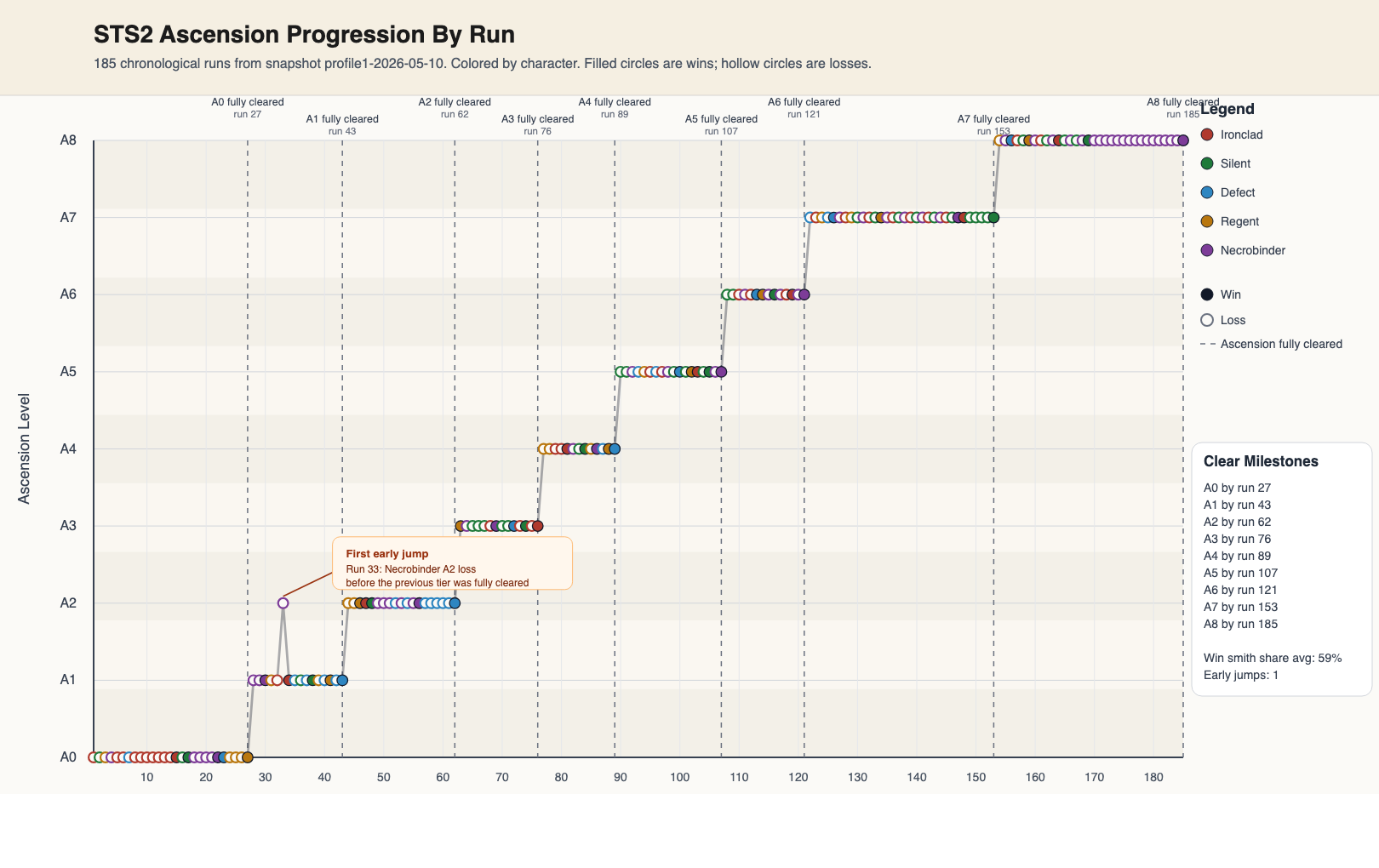
I never got into the original Slay the Spire. I’ve spent 160 hours in the sequel so far, and I’ve improved from terrible to bad as a player. (In the chart above, you can see I’ve steadily advanced to Ascension level 9 on all 5 characters.) By now, I’ve internalized a few things about why this roguelike series is so replayable – engaging for thousands of hours for its most devout fans, rivaling the best live-service games. (Years ago I heard from a fan of the original: “1,000 hours is just the beginning for Slay the Spire.” Now I’m starting to get it.)
Let’s discuss the sources of this replayability.
To start with an (obvious) negative, it’s not sustained by live-service content keeping the gameplay “fresh”. There is a live-service feel during Early Access, as the devs iterate on content (anywhere from balance tweaks to replacing bosses) and add features, but the intent – at least judging from the original game’s development – is not a live-service strategy.
Instead, I think the big pieces are the following:
- “Easy to learn, impossible to master” core gameplay depth. This was already validated in STS1, and refined in STS2
- Extending the core gameplay to social play with native multiplayer (STS1 only had modded multiplayer)
- Embracing the modding scene and thus facilitating UGC
Below, I want to spend some time dissecting the core game design; I won’t go in detail on multiplayer or modding in this post.
Core gameplay depth
Easy to learn
(If you are already familiar with how roguelike deckbuilders play, skip ahead. Below is partly a writing exercise for me to concisely explain what the game is.)
The game structure of Slay the Spire 2 is quite straightforward:
- Combat is an intuitive card-based system:
- You have a deck of cards
- Every turn, You draw a number of cards, and have an energy resource to play few cards
- When all cards are drawn from the deck, they are shuffled and form a new draw pile
- Objective is to kill enemies before they kill you
- 3 core attributes: HP, attack damage, block (temporary health that mitigates damage, expires each turn)
- Every turn, you act first; the enemies’ actions are telegraphed
- Lots of modifiers that add variety / depth on top of this foundation, e.g. debuffs that reduce the enemies’ damage or make them take more damage
- You have a deck of cards
- A single session (run) consists of progressing through a classic roguelike branching-nodes map:
- Players choose the next immediate node (combat, mystery node, shop, rest, treasure etc.), but just as importantly, visualize and plan out the longer term path
- The combat difficulty scales up as the map progresses, with several boss fights as key checkpoints
- Deckbuilding is the primary way for the player to become stronger to meet the increasing challenge
- Through the nodes, players are often presented with opportunities to add (or in rarer cases, remove) cards to their deck
- Relics (abilities that trigger based on specified conditions) and potions (consumable spells) are the other important sources of in-run progression
- Beyond a single session, the game offers a difficulty system (Ascension, ranging from 0 to 10 currently) that bumps up the challenge overall (e.g. all enemies do more damage or have more health), and provides a longer-term mastery goal for the player
I think the game is intuitive to pick up, arguably even for someone who’s never played video games. “Playing a deck of cards” is a helpful reference that reduces onboarding cognitive load, while the damage formula and character stats are also simple enough to quickly grasp (this is inherited from a broad lineage of board and card games, but still worth stating).
Impossible to master (Is Slay the Spire 2 a difficult game?)
What’s not easy, is actually winning a run. Even at the starting A0 difficulty, the game demands a certain amount of fluency with the “language” of card games and deck-building theory,1 game knowledge (cards, the playable classes, the enemies, etc.), and good decision-making.
At the same time, high level players are already able to beat the highest difficulty at very high consistency – for example, conservatively speaking a 60+% win-rate at A10, regardless of character. To hear them discuss the game (there’s a decent Youtube scene, in particular I was quite inspired by some content from Jorbs in this post), the game’s difficulty is quite manage-able, or even “easy”. (You’ve also got the speed-runners, winning a game at the highest difficulty in 10 minutes.)
One underlying theme of these high achievers is that they have played the original, a lot. “A thousand hours” was often literally cited, and they share the opinion that the experience gained transfers quite directly to the sequel (understandably, given the core of the game is largely intact). So we could say that the game is not literally “impossible to master” – depending on how strict you are with the definition of “master” – but it requires a surprising amount of time investment to do so.
A sensible follow-up question then: how did a single-player PVE game create such depth?
From a systems perspective, there’s nothing that’s “obviously” groundbreaking here. I’d say the fun and depth of the game comes from a combination of (a) the craftsmanship and taste in the design execution, most centrally the card pool; and (b) the volatile effects of imperfect information, randomness and a convoluted feedback loop on decision-making, both within a single combat encounter and across an entire run.
I’m not going to attempt a discussion of how to design a good card game. There’s probably been several books written about the topic; otherwise design discussions about Magic or Hearthstone would be natural entry points to go down this rabbit hole. Instead, let’s talk about point (b) a bit more.
Imperfect information is constant in every combat. Almost every turn, the player is asked to make an ambiguous decision of “what are the best cards to play this turn?” A extremely common scenario looks like this:
- The enemy will attack you for 12 damage
- You don’t have enough damage to kill the enemy outright this turn
- Close candidates for optimal play is often between:
- play 3 Defend cards (each giving you 5 block, so you create 15 block, fully mitigating the incoming attack but also “wasting” 3 block)
- or, play 2 Defend + 1 attack (so you block for 10, taking 2 damage, but also dealing some damage to the enemy)
There’s no universal “optimal” approach here, because it depends not only on the enemy’s remaining health and action pattern (this is knowable/deterministic as enemy behavior is scripted and fixed), but also what cards you draw in future turns (not fully knowable/deterministic, as you can only see the remaining draw pile). So it’s also plausible, with hindsight of what cards you actually drew in the following turns, that the optimal play in the above turn was actually to not block at all, but just rush down the enemy’s health (because you avoid a much bigger attack later).
Imperfect information also comes into play over time across a run:
- Future card rewards are hidden info, so deckbuilding always features opportunity for speculation (”this card is great if I get this other card later, but otherwise it’s risky/bad”)
- You don’t know what enemy you will face in each combat node, and of course you don’t know what will happen when you select mystery “?” nodes on the map
A convoluted feedback loop primarily refers to deckbuilding and other player decisions outside the scope of a single combat. Deckbuilding itself is a deep topic:
- The general principles of a good deck are teachable:
- Enough “upfront” and “scaling” block and damage
- Ways to accelerate or improve the quality of your deck during combat (draw more cards; remove “bad” cards; generate more energy, etc.)
- Suitable ratio (”density”) of different kinds of cards
- Cards with specific functionality that solves specific enemy mechanics you may face (e.g. AOE damage; removing debuff cards that the enemy inserted into your deck; ability to deflect some damage back to the enemy, especially when the enemy does lots of “multi-hit” attacks)
- But, the application of these principles is hard in practice:
- At the beginning of a run, when you only have the bad starter deck cards, what do you focus on improving first? And how do you adjust your plan based on the actual first few card rewards you are given?
- How do you keep a good grasp of what your deck needs, as the game progresses? For example, how do you know if you have enough damage or block? Are you over-compensating? This requires good contextual evaluation of upcoming challenges, and what you already have (and really, what’s working in your deck)
- Static evaluations of card quality (tier lists) are seen as mental shortcuts, but they are often not useful in practice, because the “S Tier” card you see may be irrelevant or detrimental to your deck’s immediate needs
The convoluted feedback loop occurs when the implications of a “mistake” is only evident much later in the game – you got too greedy with a card pick (you picked the higher value card which doesn’t immediately improve your deck), which resulted in you taking more damage per combat, which led to you having to rest for HP healing instead of upgrading a card at a campfire, which made your deck comparatively weaker in subsequent combats… It’s a gradual negative snowball, which makes the lesson hard to pinpoint and learn.
(An interesting and specific way to visualize this is to simulate the expected HP loss of a fight with the addition of removal of 1 card. A delta of +/- 1 HP a fight might not sound like much – but such incremental differences are exactly how the outcome of the game is shifted.)
Looking at it from the opposite end – acquiring mastery in this game requires the accumulation of many little optimizations. This might sound like a bland truism that could be said of many games, but it feels more pronounced and sharp here.
Impressions from my play experience
I have played quite a lot of runs, though my play pattern (spreading them across all characters) is definitely trading off depth for breadth. Below are some takeaways:
- The UX choice to auto-increment the difficulty after you’ve won a run strongly anchors players to view the difficulty levels as a form of progression, as opposed to an opt-in challenge. This may be a source of many players’ frustrations with the game
- The difficulty bumps themselves reveal how “small” changes have big impact (the convoluted feedback loop). For example, one difficulty level added a curse card to your starter deck: the card does nothing and is also “ethereal” (it disappears from your deck this combat, if not played when drawn). In effect, this is just a dead card that negatively impacts your first draw pile. But there are memorable moments when you can really feel it
- I’m often surprised by how my deck performs, which reflects that I still don’t have a good grasp of mechanics and their strengths / weaknesses. There’s been a few games where the “killer” card in the final boss fight was not core to my game-plan at all
- My win-rates across characters are divergent enough to tell a story. The characters that I do better on (the Regent and the Defect) probably (accidentally) suit my mental model of the game better; meanwhile, I’ve struggled for example on the Silent, who is often seen as both “simple” and “brokenly strong” by elite players
- In my last losing streak (16 games on the Necrobinder at A8), it often felt like nothing was clicking, and I was just being whittled down one battle after another. I’m sure there were lots of micro-adjustments I could have made, but mostly I just felt directionless. That’s an interesting sensation after I’ve already spent 150 hours in the game
Market reception
Now let’s talk briefly about the business side. While the original was a indie darling that amassed a cult following over time, Slay the Spire 2 entered Early Access as a juggernaut, immediately hitting a peak of 574k CCU on Steam (the original peaked at 33k in its first 5 years). This fits a familiar trend in recent years, where established IPs have better odds to command gamers’ increasingly scarce time and attention.
Review bombing
Part of the scale-up is due to Steam’s playerbase growth, especially in China. This is where things got interesting though, as after a brief honeymoon, the game landed in hot water with the Chinese player community and got review bombed en masse. As far as I can tell, Chinese players were very unhappy about the game’s content and balance changes (”nerfs”). To me this is a fundamental (and tragic) misunderstanding between the developer and this playerbase. Chinese players live and breathe live-service games, and are used to channeling their anger to push developers to appease them (meanwhile, Chinese developers are adept at monetizing their playerbase – it’s a fraught relationship, to put it mildly). The developers of Slay the Spire 2, Mega Crit, likely see Early Access as exactly that – iterating the game with a live audience, to get it to a final release state. So they are probably at least a bit surprised at the flood of negativity to content iterations. I don’t think they necessarily want to treat the game as a live-service, but now they are forced to at least partially adapt to a live-service mindset.
Modding
I mentioned earlier that native multiplayer and modding were 2 smart bets the developers made. For multiplayer, apparently the signals were already there in the original (players modded the game to add multiplayer support), so it was a high ROI feature. For modding, there’s going to be an explosion of content (some players have already ported the entirety of the original game into the sequel as a mod), as AI coding has drastically reduced the barrier to entry and also the development time. If the developers have any “platform” aspirations (which they may not, if they are just passionate about the game itself), they certainly have the foundation to take a shot.
- For example, why would you pay hard-earned resources to remove a starter card from your deck? The value is not intuitive for someone who has not played other card games before. ↩
I completed Ironclad (Ascension 10 double bosses) and found both great pleasure and plenty of challenges throughout. However, I lost interests in all the other four characters around half way (at about Ascension 4-5)… I think some of them (like the Silent and the Regent) lack the challenge and some (like the Defect) are just not that interesting or engaging.