After ~45 hours, I’ve finished my first playthrough of Phantom Blade Zero, from Chinese studio S-Game. As perhaps the most high profile action-RPG from China since Black Myth Wukong, this game has solidly delivered against its AAA aspirations.
The devs have announced 4 million copies sold across PC and PlayStation in 72 hours, which is a great result for a studio’s first AAA entry, but also quite far from Wukong’s 10 million copies in 72 hours watermark. This is against a widely-quoted 400 million RMB (~60M USD) development budget; with majority of sales being in China with a ~40USD regional price, we can do some napkin math on rough profits.
More qualitatively, I would say the domestic reception from both players and industry have been measured happiness. For players, the game largely delivered against its promises (and I’ll dive deeper in a bit) and proves that Wukong wasn’t a one-off. There’s plenty of pride as well. For the industry, it reinforces the narrative that Chinese devs are no longer followers or only low-cost imitators. But it’s also quite clear that the ability to create (and market) games that resonate outside China still needs lots of nurturing, especially in the premium purchase space.
Enough business fluff; let’s actually talk about the game.
Gameplay: Souls-inspired, not a Soulslike
Phantom Blade Zero is a Wuxia-themed action RPG, in the popular third-person action camera angle. It wears its influences on its sleeve – a lot of the combat reminded me of God of War while looking like Sekiro, and there are lots of superficial elements from Metroidvanias and Soulslikes (bonfires, unlockable shortcuts, and gating exploration with abilities that unlock later).
But to be very clear – this game is far from being a Soulslike. The hallmark of the classic Soulslike is the high tension in basic level exploration – the lethality of the environment (not just the enemies, but also the traps and falls) was what made reaching a new bonfire (or unlocking a shortcut to a previous one) such a pleasant relief and hard-earned break in pacing. In Phantom Blade Zero, bonfires still serve as bookmarks in session pacing, but there is little tension in exploration, and bonfires are plentiful to minimize backtracking. Furthermore, enemies, including regular mobs, don’t respawn, so the level content is very much intended as a one-time experience. I don’t know what was the direct intent behind this choice, but it has one benefit which is the game’s economy is thus easily controlled.
The devs also made some interesting choices with the combat mechanics. It has both a very accessible floor and still a pretty high skill ceiling. The player has HP and a stamina bar to manage; blocking and heavy attacks expend stamina, while light attacks and dodging do not consume stamina. (When your stamina is depleted, you are briefly stunned and unable to block while the stamina bar refills.) Perhaps like many players, I started out tapping block to try to time it to the enemy’s attacks (as one would do in Sekiro), and consequently I found I was taking a lot of chip damage. The lightbulb moment was when I realized I should just hold down the block button – this consumes stamina at a steady pace, but otherwise for most normal attacks you are not punished at all (or rather, you are not rewarded for well-timed blocks). The exceptions are the 3 color-coded special attacks: blue means you can parry to counter; red is for dodge and countering; and if the whole screen is greyed, you need to dodge or suffer a heavy stamina penalty. Thus for the typical combat flow, I’m constantly holding down my block button while spamming light attacks, and what I see is a flurry of *Sekiro-*like blades clashing – it’s a visual feast with usually little of the actual intensity of Sekiro. And then occasionally I react to the color-coded attacks.
Furthermore, once you equip two main weapons, you can swap between them in combat, with each weapon providing its own stamina bar. (There’s a short cooldown that governs the swap.) This means weapon-swapping is highly encouraged, if not simply for replenishing stamina to keep on blocking.
What this intentional generosity to blocking affords is attack speed, sometimes to a fault. The default speed of almost all combat animations feel incredible – this game surely has one the best-looking clash of swords in a video game. But it also means that attack wind-ups are often negligible, especially with enemy ranged attacks (and why you learn to always keep that block button pressed). And occasionally (especially towards the latter sections) the game goes for mischief, starting a boss fight with a fast red attack that one-shots the player. (In one such case, I fell for it again a second time – shame on me – but only lost half my health, which I guess is the devs acknowledging their naughtiness.)
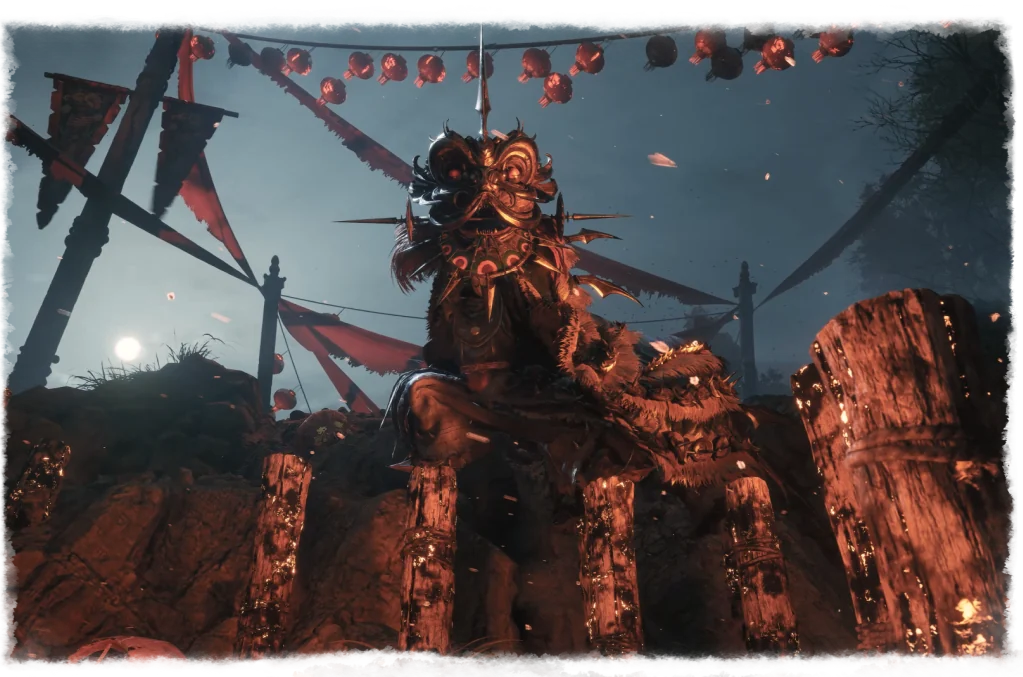
With all this said, I feel the defining principle of the game’s combat is spectacle. There are over 70 boss encounters, and the visual flair just keeps going up. (I felt I was playing *Final Fantasy XVI* in the final boss fight.) Again, this is not the FromSoftware experience, where every boss fight is meant to be mastered through repetition. Instead, they are audio-visual experiences meant to be savored, with actual skill-challenge taking a back seat. And due to the game’s deep Wuxia theme, there’s a uniqueness to the spectacle – my favorite boss fight of the whole game is one where you fight a lion dance team (the featured image of this post above). It was deeply satisfying to see the devs’ creativity applied to that staple of Chinese heritage.
I’ve seen praise of how the game is respectful of players’ time – the devs are made a lot of content, and they want you to get to them. This is reflected in the difficulty tuning, the enemies not respawning, and the helpful world map indicators that remind you of important collectibles or quests. The game wants you to explore and collect the various things scattered throughout the levels, but doesn’t try hard to make these into puzzles (so, no hidden doors or tricky platforming jumps). At a meta layer, I see this as a (partial) response to the popularity of Soulslikes. It’s helpful to remember that Demon Souls and Dark Souls originated as a response to the design trends of their time as well – what’s old is new again.
Where the game misses
The game is not without blemishes. The world map sometimes can be more annoying than helpful, as it doesn’t capture the verticality of the levels, so you could be near an icon but actually need to take a long detour to actually reach it. The combat camera does a lot of auto-movement based on the enemies – which makes the game more accessible on the whole – but can be incredibly frustrating when you are fighting a mob, because it overrides your manual lock-on. This is even more egregious when there are a few ranged enemies in the background that you want to reach – you will often turn around midway.
Another glaring level-design problem in the game is the inconsistent treatment of boundaries and where you can or cannot fall. You might remember that Black Myth: Wukong had a lot of similar issues. Phantom Blade Zero is not much better. (To be fair, at least you don’t get lost nearly as much.) The root cause is prioritizing art presentation over gameplay clarity, while also wanting some level exploration. The game wants the scenery to not be (literally) blocked by fences or rocks, but it also doesn’t want the player falling off ledges all the time – so invisible walls are liberally used to contain the player. But occasionally, the game does want you to jump off that bridge, to reach the playable area below – so jump forward on a ledge, and you will still fall off, and more often than not immediately to your death (the technical term is you hit a kill volume). What makes this comically bad are the instances where you are fighting on rooftops, and the flashy combat combos you perform takes you over the edge – to your instant death. (I can imagine this being particularly rage-inducing, at game’s highest difficulty, which is a hardcore mode where you have 66 lives total in the save.) This can be avoided if the game chooses to not allow players to run on rooftops, or, not set fights on rooftops; but that’s such an iconic Wuxia trope, of course the devs went for it.
Wrapping up
Phantom Blade Zero is not the cultural phenomenon that was Black Myth: Wukong, but many ways it is a better-made game. It proves that Chinese game devs have gained real mastery in the AAA action space. Studios like Game Science and S-Game are cultivating a generation of game devs who will be confident to branch out and perhaps start their own studios one day. There is also the juicy fact that both Game Science and S-Game had spent many years in mobile, with several titles shipped. Perhaps PC/console AAA was always their true calling, but successfully navigating that transition demonstrates the can-do attitude fueling Chinese devs.