I was in San Francisco for GDC 2023. The last time I was at GDC was 2011, as a poor student, so I won’t pretend to be intimately familiar with the conference. I didn’t do much networking, though I did catch up with a few friends I haven’t seen in a while.
Good talks
I attended over a dozen GDC talks Wednesday to Friday, since I got the Core Pass. (Monday and Tuesday’s agenda was mostly for the Summit Pass.) I tried to sample different types of content, though my natural interests gravitated me towards 3 themes – game design, product management, and leadership soft skills.
“The Science of Managing Transitions During Crisis” and “Tell Me What to Say: Active Feedback Techniques for Teams” were my 2 favorite talks out of those that I attended. I was quite surprised by this, as I’m usually a bit on the jaded and cynical side when it comes to “business self-help” types of content. But those speakers totally won me over with their timely content which was well tailored to the quirks of the games industry. And their sharp public speaking skills left an impression – at a particularly soul-searching moment in “Tell Me What to Say”, Drew Kugler (a veteran executive coach) stared down the audience and pronounced: “YOU are here (at this talk) for a reason”.
I’d be amiss to not also mention “Prioritizing Roadmaps for Growth: Simplified Framework for Small and Growing Teams“, which was a short, sweet and uber-practical talk for product managers. In small teams I’ve been on, it’s common to eschew the more rigid dev processes (anyone love playing planning poker?), but far too often teams just end up suffering from a lack of process. The framework shared in this talk felt light enough to be adopted.
Expo floor
I squeezed in a couple of hours to walk the expo floor. It’s always a good reminder of how mature the modern video-games industry is: just look at the vast amount of suppliers providing various tools and middleware, and how specialized some of the solutions were – there was a vendor dedicated to motion capture of fingers. I’m guessing that maybe AI will take over the expo floor properly next year; for 2023, VR/AR and web3 booths are still around, and paying good sponsorship fees.
It may be a bit of a cliché, but I do believe you can get a sense of the players’ standings in an industry just by measuring the size and production value of their expo booths. In that regard Epic / Unreal Engine certainly seemed to have one of the biggest spaces, and they had a good crowd.
I also had a funny “duh!” moment on the floor: I was checking out one of the weird peripherals on display, and I commented to the exhibitor that it seemed like an interesting alternative to controllers. Then I realized I was in the alt.ctrl.GDC section, and alt.ctrl is literally “alternative controllers”.
Vibes / trends
Attendance at 28k was high, and more than doubled the 12k of last year. But this wasn’t an outlandish number per se – it only matched 2018’s record, despite a post-Covid rebound. I’m curious about the geographical distribution of attendees – it seemed like I was running into fellow Chinese speakers everywhere.
I didn’t go to any of the Unreal talks – my colleagues covered that – but it did feel that Epic made the biggest announcements. Much has been said already about UEFN, the new Verse language, and the new Fab marketplace. It’s clear that Epic is investing heavily across many fronts, and I’m almost tempted to make analogies to classic Microsoft which was immensely powerful / profitable due to owning both the platform (Windows) and the biggest app on the platform (Office). Epic is not at that level of dominance in our industry, but they certainly have a lot of the right stuff.
I don’t know if this is new – it might be – but there was a real effort by Tencent (and to a lesser degree, Netease) to spread awareness of their capabilities. Not only did Tencent sponsor a developer summit (which enabled them to deliver a host of talks on various aspects of their dev muscles), one of their in-house studios Lightspeed sponsored a summit as well. Unfortunately they may be swimming against the tide here, in light of the current US/China geopolitics.
I’ve played Marvel Snap for about two seasons (Dec / Jan). I was late to check it out, out of laziness and lack of personal interest in turn-based card games. My quick verdict is it deserves all the praise it got, and has unexpectedly filled a “casual” competitive-PVP need that I was ready to give up.1 At the same time, the game certainly has its live-service challenges, and I’m eager to follow how the team will address them in their roadmap.
Design innovations
I look forward to the future design talks from Ben Brode and team that will shed light on their inside perspective. From the outside, I feel the game has the following significant innovations:
Core gameplay
The game’s core game reaches the vaunted heights of “easy to learn, difficult(impossible) to master” through a set of design choices that are mutually reinforcing:
Simultaneous turns, and only 6 turns total.
Simple Hearthstone-like energy system.
Small deck (12) and hand (max 7) size – by default you draw 9 cards in a full 6-turn game, which is 75% of your deck.
3-lanes board, and limited card interactivity / simple win condition: you and your opponents’ cards aren’t dueling each other, there’s no attack/block or health, and very few cards can directly destroy opponents’ cards – it’s just who has more card power in 2 out of 3 lanes.2
Each lane has a unique effect per game, from a huge and actively growing list. This RNG introduces a lot of variation which provides a unique puzzle to every game.
Card abilities fall into intuitive categories, while end-game complexity comes from cards with memorable unique effects that open up new archetypes.3
The signature “snap” mechanic, which introduces a way for players to bet and double-down on the game’s outcome, and adds a Texas Hold’em-like mind-game layer. At first I wasn’t sure whether this was a gimmicky mechanic that was negligible to the game; now I see it as a huge design bet with wide-reaching impact (both positive and negative) on the whole game – more on this later.
The sum of these designs is a core game that is intuitive to learn, has deep replayability, and requires ridiculously low time commitment for a single game (thus very easy to impulsively tap “play” again right after a game – whether you won or lost). It is addictive, with all the pros and cons associated with that word.
Meta loop
On the meta side of things, Marvel Snap also takes some calculated risks, with the results being more divisive in the community:
The game ditches the card packs / loot boxes paid acquisition model, and card acquisition is primarily from randomized rewards chests earned through engagement. The notable exception is the card bundled with every $10 season pass, and for the past 2 seasons the 2 cards (Silver Surfer and Zabu) have largely dominated the “meta”. There is also an “end-game” rotating card shop where you can spend “tokens”, an ultra-rare soft currency, to acquire a card that you’ve set your eyes on. (To visualize this: after almost 2-months F2P play I have 5000 tokens, which can afford 5 “Series 3” cards at 1k each, or 1 “Series 4” card at 3k. I can’t afford any of the ultra-rare “Series 5” cards which would cost 6k.)
While individual cards have a shards-based upgrade system,4 they do not feature stats progression or individually become more powerful in anyway – what changes is the visual presentation of the card. At the same time, I can’t label this as a purely “cosmetic” progression, since these upgrades also count towards the main progression track (“collection level”), which is where you unlock cards.
There’s a purely cosmetic card skins (“variants”) system, and the game has a large variety of styles. As a F2P player I’ve not spent any of my earned currency on skins, but I can see the appeal to the community, in terms of collecting a specific variant of a card, and then upgrading that variant deeply to create a very unique look.
Overall the progression and spend depth is very tightly controlled. You can’t buy progression outright – you can buy a limited amount of extra missions per day, so this is a “pay-to-grind-to-win” game. The developers have explicitly stated their design philosophy that players should not expect to own all the cards, and the game is about everyone owning a unique collection. I see this as a razor-sharp double-edged sword: on the one hand, with a steady inflow of new cards (one card added per week), players are guaranteed an never-ending chase and long-term motivation; on the other hand, the frustration of not having a particular card and feeling locked out of the fun can be churn-inducing.
Sampling the vocal minority on Reddit (and also watching some Snap content creators on Youtube), it feels veteran players (who’ve finished the guaranteed early game card pools of Series 1 & 2) all feel frustrated about the card acquisition pace, regardless of whether or how much they’ve monetized. This is the intended experience – only the devs will know whether the metrics support the thinking behind this choice.
Speaking about my own 2-season F2P experience, I can say Marvel Snap has one of the most generous and rewarding loops in the first few weeks of play. You get a deluge of cards,5 fast, which unlocks a lot of basic deck types and gameplay possibilities. Then things slow down considerably, and depending on how much you are grinding per day, you will eventually be soft-currency constrained (you have shards to upgrade cards, but you are out of currency to complete the upgrade). This is the main rate-limiter to the progression. At my current level (early-mid Series 3), I roughly earn enough currency to unlock one reward chest per day from the progression track, which on average means one new card every 2 days. But I often neglect the new card anyway, even if it’s a top tier one, since I likely won’t have all the cards needed to form the community-tested meta decks. This means that if I’m serious about climbing ranked, I’m playing a small sample of meta-worthy “budget” decks that I have access to in my collection state.
Despite this, I still find the ranked climb addictive – I got to Rank 60 (“Platinum”) in my first season, and 70 (“Diamond”) in the current season, after the rather brutal season reset of 30 ranks. This is still a far cry from the Rank 100 (“Infinite”) goal, which I know is do-able F2P – if only I “git gud”. Doing some napkin math – I might have played a thousand games this season, which certainly speaks to the game’s high replayability.
“Snap?”
Coming back to the “snap” mechanic specifically, as it has wide-ranging impact both on the meta and the core gameplay.
Talking about the impact on meta first – since it’s more straightforward – the “snap” mechanic adds a novel twist to the traditional MMR-based ranked PVP experience, and goes quite far to break the fatigue with the usual (and stale) “50% expected win-rate”. It does so by simply adding variance to the rewards of a single match, and giving players a great deal of control over that variance (you decide to bet, double-down, or quit). This allows for more risky or RNG-based decks to be viable in ladder-climbing. Indeed, the community quickly came up with a new metric to measure the efficacy of a deck – average cubes (ranked points) won per game – alongside the good old win-rate metric. It is quite possible for one deck to have a lower win-rate but higher average cubes than another deck.
In terms of core gameplay impact, “snap” significantly raises the skill ceiling of the game, as it is a mechanic that directly rewards game knowledge and the ability to read the game state (and predict future states). To fully exploit this mechanic, players need not only mastery of their own deck’s strengths and weaknesses, but also pattern recognition of what their opponent could be playing (based on up-to-date knowledge of the game’s “meta”,6 which basically requires consistent time commitment to the game). To paraphrase Jeff Hoogland, a content creator for the game, “snap” is the most difficult mechanic in the game, and you need to relearn “when to snap” with every new deck you play (while also factoring in what your opponent could be doing).
In addition, “snap” also greatly impacts card-play patterns, as it places greater emphasis on surprising the opponent. If the board state seems already clearly in favor of one player, and only then does that player “snap”, the other player would most likely fold (retreat) and not accept the bet. So to get the rewards for “snapping”, players must snap earlier (when both players feel they have a good chance) or when they feel they can somehow dramatically reverse the tides with an unexpected play. As a very specific example: Shang-Chi is a 4-cost card that destroys all opponent-cards that have 9 (or above) power in a lane (it’s one of the very few “tech” cards that can directly destroy opponent’s cards). It’s turn 4 (you have 4 energy to play cards with), your opponent does have a 9-power card on the board, and you don’t have better cards to play. In a game without the “snap” mechanic, it’s probably optimal to play Shang-Chi this turn so you bank the advantage and don’t waste the energy.7 But in this game, it’s could be optimal to waste the energy and save the card for a great last turn surprise.
Lastly, one downside (to some players) of the “snap” mechanic is it often takes away the big climatic finish of a game, because one player decides to retreat (and avoid possibly losing lots of cubes) rather than play out the turn. This is certainly true – the stats from this Jeff Hoogland video show that for a high-level player, 2 out of 3 games are concluded with a retreat.
Production – lean and mean
Marvel Snap clearly shows that it is made by devs with a lot of experience. As a game just beginning its live-ops lifecycle, feature scope is aggressively managed, with many “table-stakes” features still missing (for example, there is no friends-list, chat or other social features yet).
At the same time, the game already has a number of features that support live-ops longevity, while being low cost to maintain / extend:
The in-game locations (the unique RNG modifiers of each lane) is probably quite low cost to develop (it’s reusing existing card mechanics), and the twice per week “featured location” mechanic (a particular location is marked to appear more often) is a simple-yet-effective recurring event to temporarily alter players’ deck choices
The card variants / infinity splits system effectively adds unlimited personalization depth to any card, and while a F2P player like me might wholly ignore it (it feels impossibly out of reach to really care about), I would still (begrudgingly) agree that some of the end results look amazing (and desirable)
The game also already supports web-based events (i.e. an in-game banner that opens up a browser webpage in-app, showing a live-ops event). I would suspect the publisher Nuverse influenced this, as this setup (while aesthetically limiting) allows for very flexible live-ops development without the need to roll out patches (or even support from the game developer if they are not operating the game directly), and is extremely common in Chinese games
Market performance
Lastly, I wanted to take a quick look at the market performance so far. This part is probably the most speculative, since we are going by 3rd party data (estimates), and for a lot of the data you can argue both the bear and bull case.
One question is “what is the meaningful comp?” for Marvel Snap – what games are we going to compare it to? We can compare it to the top-performing games irrespective of genre, or we can just look at the CCG (collectible-card-games) genre which it clearly fits in. I don’t think there’s one right answer here; I’m quite curious how the Second Dinner team themselves think about this.
As for my personal answer, I’ll go with the latter and mainly focus on direct genre comps. A quick browse on Sensor Tower (source for most of the numbers below, and excludes China Android) shows not a lot of new games that have broken out in this space in recent years; Yu-Gi-Oh! Duel Links (global release 2017, 87M downloads to date, $758M net revenue lifetime) and Yu-Gi-Oh! Master Duel (2022, 9M downloads, $103M net revenue) are the breakouts in revenue, while Magic: The Gathering Arena (2021, 7M downloads, $58M net revenue) is helpful to illustrate the size of the audience even for one of the most fabled brands in the genre.
From this narrow genre lens, I’d say Marvel Snap‘s launch is an unqualified success: 15M downloads and $44M net revenue in about 4 months of global release. It also holds up decently (though not as well) in comparison to Hearthstone on mobile. Hearthstone saw a massive bump 1 year after global release (as the game released for tablets first, and then released to phones after a year), and would certainly have a stronger start than Marvel Snap. In any case, Marvel Snap is showing it can absolutely go up against the biggest names in its genre.
But how about from the broader lens of all games, ignoring genre? I’d argue the team should also be proud of themselves. On Sensor Tower, I looked at the top mobile games by revenue for the past 24 months, filtered for games that were released within the last 3 years (i.e. filter out the evergreen games like Honor of Kings or Candy Crush). On this list, the top 3 were Lineage W with a massive $734M net revenue (from only $4M downloads – and majority of that revenue was from South Korea alone); Royal Match with $631M net revenue from 83M downloads; and Cookie Run: Kingdom with $260M from 22M downloads. Yu-Gi-Oh! Master Duel was #13, while Magic: The Gathering Arena occupied #22. Marvel Snap is currently at #29, and will certainly go up in the rankings. This is an impressive feat for the first game of a new studio, regardless of the pedigree of the talent.8
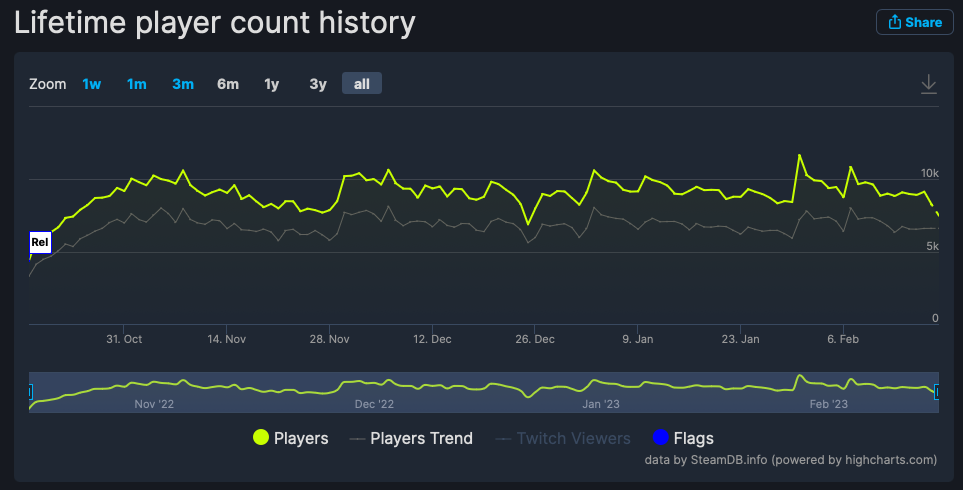
As a minor point, the concurrency chart for Marvel Snap on Steam shows a steady game with very sticky retention. It’s hard to read too much into this, as this is a tiny fraction of the total player base, but one reasonable hypothesis could be that this is a decent sample of the game’s most hardcore players (who will actually multi-home and play this mobile-first game on PC), and the steady trend line is encouraging.
For the bear case, there is certainly room for concern in the rapidly declining downloads: at ~250k weekly downloads, it’s comparable to Hearthstone‘s weekly downloads 15 months after their phone release. But I’d say there are too many unknowns here to really know what’s going on (what’s intentional / expected, what’s reversible). The game isn’t live in China yet (and probably won’t be, for a couple of years), so the Hearthstone comp isn’t apples to apples. The publisher, Nuverse (part of Bytedance), should have lots of money to fuel UA, but they are an unproven organization (per Sensor Tower, this is already the biggest game they’ve launched, in terms of downloads). And I don’t know what is the actual division of labor between Nuverse and Second Dinner. In any case, revisiting the data in 6 months will give a lot more clarity on the game’s long-term legs.
Mostly due to life circumstances – we came up with the term “gamer soul, adult responsibilities” years ago at Riot to describe this. ↩
The math can still get quite complicated with more advanced cards and combos. ↩
There is a concern about the long-term design maintenance of cards, since these unique cards often introduce exponential levels of effort to balance and constraints to future card-design space – for example, the January season pass card Zabu, which reduces the cost of all 4-cost cards by 2; or Mister Negative, which when played inverts the cost / power of each card in your deck. ↩
As of this writing – you unlock 97 out of the game’s total 200 cards once you are Series-2 complete ↩
What decks / strategies are popular in the community; not to be confused with the design-lingo “meta loop” that usually refers to the game’s long-term systems. ↩
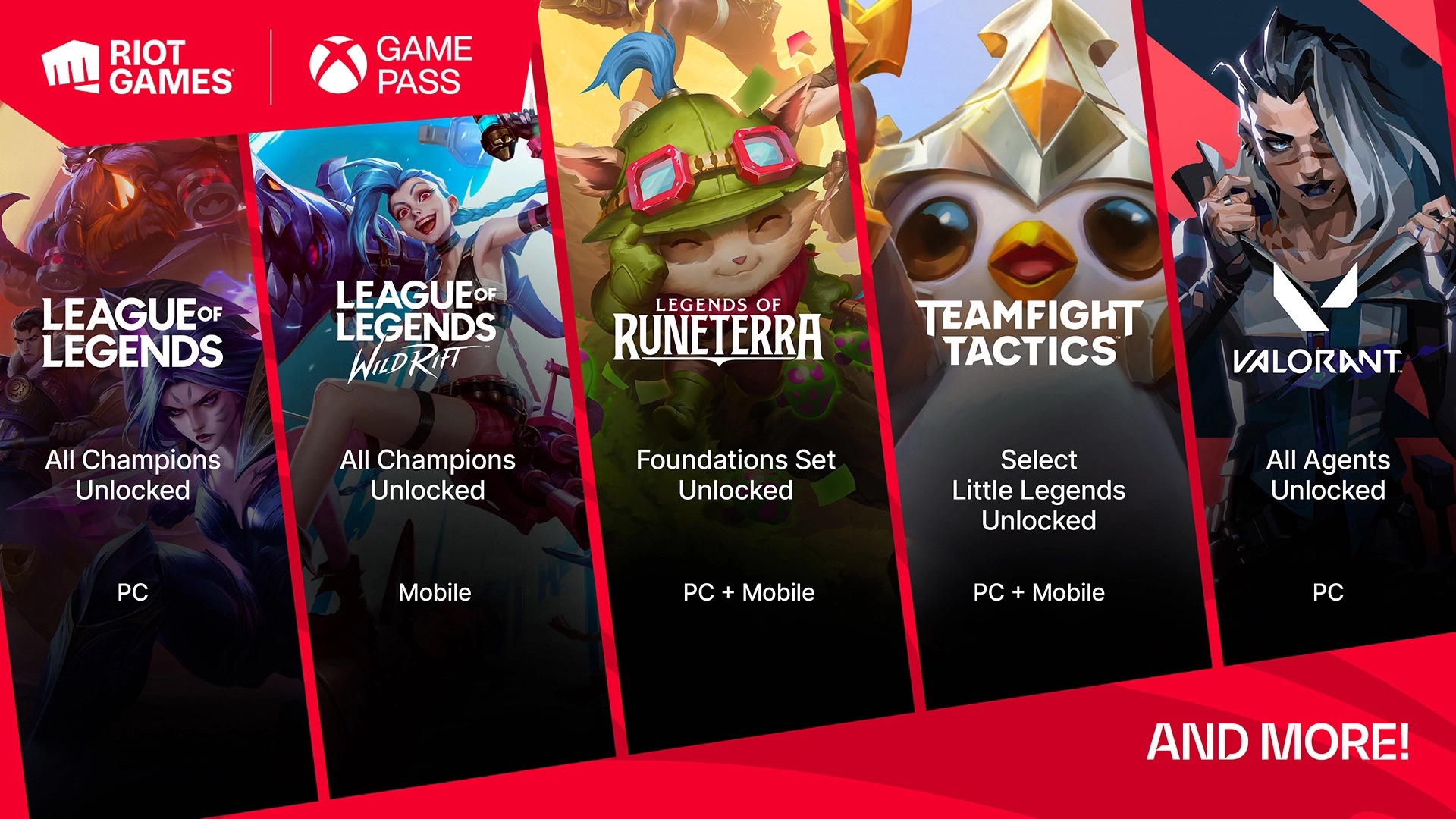
Xbox announced a Game Pass deal with Riot Games (my previous employer, I left in 2019). The deal covers all of the live service games in Riot’s portfolio, across PC and mobile platforms.
I have a few thoughts in reaction to this news. The first is the surprisingly large value Riot is putting on the table. This is not a small experiment; Riot didn’t go the safe route of starting with one game and deciding to expand or not based on the metrics. And even if it were just one game, say League of Legends, the monetary value of “All champions unlocked” is not trivial. As a quick “valuation” exercise:
Buying them all outright (even though few players do this – you can earn soft currency and unlock champions by playing) is easily hundreds of dollars – you can google for various answers, players have done this math before.
An alternative comp is to look at Asia, where “all champions unlocked” is a B2B product that PC cafes in Korea and China pay Riot for. If you assume Riot charges a Korean PC cafe $0.2 for every hour of this service, and on average players play 30 hours per month (both of these are like 10-year-old stats in my head), then “all champions unlocked” is by itself a $6/month service.
However you look at it, it seems that Riot is offering a ton of value here – so much so that, if you are a dedicated fan of Riot’s games, you should sign up immediately for Xbox Game Pass just for the Riot benefits alone.
This sparks an interesting offshoot question – instead of working with Microsoft, why didn’t Riot roll out its own “Riot Games Pass” instead? I would imagine this scenario had to have been part of the internal strategizing. And that would feel more in line with the M.O. of the Riot Games I know circa 2015 – doing it alone, desiring total control of the player experience.
I don’t have any inside knowledge, so I can only venture some guesses based on looking at the exchange of value in this deal:
From a player acquisition perspective, it seems more likely that Riot is funneling players to Microsoft – League announced 180M MAU last year, although a significant portion are players from China, which Xbox Game Pass doesn’t officially serve; while Xbox Game Pass last announced 25M subscribers. But Riot does also gain a new channel where new players could flow in, and it may be a previously underserved (more console-oriented) player-base. Thus Riot stands to benefit from all future Xbox Game Pass marketing, as a % of future Game Pass subs could convert to Riot players.
Based on the above, I would imagine there’s a sizable monetary component to the deal, flowing from Microsoft to Riot. I’m not a BD person, I don’t have a good sense where to start to try to model this component. It could be a fixed per-year amount. It could be calculated based on actual player engagement (some sort of revenue share / pre-defined payout based on metrics). It could be a combination of the two.
To Microsoft, I also think there’s a Game Pass content strategy component to this deal as well – having popular live-service games, like Riot’s portfolio, acts as a natural buffer against AAA seasonality, and probably helps with smoothing out churn.
Another interesting part of this deal is the mobile games included. This has the effect of providing an off-platform (iOS / Google Play) way to monetize a mobile game’s content, though in the past this was usually done by the game’s publisher directly, as opposed to another platform like Microsoft here. It will be curious to see if there’s any response from Apple & Google, especially if Microsoft starts rolling up additional mobile games into Game Pass and could threaten to end-run IAP regulations.
From Riot’s perspective, I can also think of a number of risks to this deal that needs to be managed:
The monetary math: does the inflow from Microsoft cover the possible loss of all future champion revenue (to use League of Legends as an example)?
The game economy and player behavior implications: during my time at Riot, I felt the long-held internal view was that providing all champions for free (which is what DotA 2 does) has negative effects on players’ onboarding flow, matchmaking quality, sense of ownership and progression. This deal seem to override these concerns.
In summary: this deal took me by surprise, but I think it could make sense for both parties. It would be fascinating to follow how this impacts both companies going forward.
To write about Elden Ring feels almost as daunting as it is to finish it. My first play-through clocked in at around 135 hours, which is the longest of any FromSoftware game I’ve played, and really, any game I remember ever finishing. And so for a few days after that play-through, I sat around thinking about writing, and instead started a second fresh play-through (as opposed to the NG+ route).
As of this writing, I finished the second play-through at 42 hours, and it took me another 7 hours to breeze through NG+ on that save, and get the Platinum trophy the hard-earned way (instead of manually reloading a save file). For the purposes of this write-up, I’m glad I did these 2 extra play-throughs, as it allows me to see through some of the magic (but also appreciating them more).
In terms of my credentials as a fan of FromSoftware’s works, I’m somewhat of a halfway convert. I’ve finished Bloodborne (2015), which was my introduction, and Sekiro (2019); I played Dark Souls III (2016) for maybe 20-30 hours, but never finished it; and I’ve dabbled 10-20 hours in Dark Souls (remastered) and maybe 10 hours in Demon’s Souls (PS5 remake). Suffice to say, I understand the Soulsborne formula, but I’m not a master of its earlier iterations.
Over the years I’ve written a few times about these other FromSoftware games; I’ll try to build on some of the prior analyses below.
The basic loop of Soulsborne game is familiar enough by now:
you begin as a fairly weak character, with some very basic gear. From a checkpoint (Sites of Grace in Elden RIng, Bonfires / Idols / Lamps in other FromSoftware titles), you explore the nearby area, killing enemies and collecting loot, until you unlock the next checkpoint, run out of resources (healing potions, which initially you only have a few bottles of), or (very commonly) die.
You can rest at any checkpoint to fully recover your health and your potions; but doing so also revives all the enemies (except those that can only be fought one-time, like bosses), and thus in a sense resetting any partial progress.
If you die, you respawn at the most recent checkpoint, having lost all of the currency you had; you can recover them if you successfully reach your corpse – but if you die again before then, the currency is lost forever.
You can spend your hard-earned currency at any checkpoint to level up, by gaining a point in one of your attributes (vigor, endurance, strength, dexterity, mind etc., fairly typical labels of fantasy RPGs). The level up cost follows a formula that has stood the test of time – literally, as it is the same math used in the original Dark Souls, Bloodborne and Dark Souls III.1
Eventually, you will run into some boss fights. Many boss fights are optional – you can simply go explore elsewhere.
As you make progress exploring, you will level up, unlock more healing potions and skills, find more and better weapons, and also upgrade those weapons. You are becoming more powerful, but you are also facing harder enemies as you explore deeper; and thus the basic loop perpetuates.
Elden Ring is an attempt to take this basic loop, and stretch and fit it to an open-world game. In their execution, FromSoftware has been able to leverage their traditional strengths in intricate level design, while also adopting design patterns from the open-world genre.
Level design principles
FromSoftware is rightfully renowned for their level design craftsmanship. I’ll try to summarize it in a few principles:
Unlockable shortcuts that serve as progression meters. The classic example is a door that is locked from your side, close to a checkpoint. When you eventually reach the other side of the door and open it, the previous checkpoint economically becomes a new “rest point”. Purely from a level layout perspective, this is not the most striking feature, but it ties in heavily with the core loop.
Interconnectedness. This was more notable in the original Dark Souls and Bloodborne to a degree. You discover paths that eventually lead you back to a surprising earlier section of the world. These connections serve practical functionality as shortcuts, but they also deliver a strong feeling of awe and immersion in the world.
Verticality. Every location seems to be designed with verticality as a cornerstone, with at least 2-3 heights at which gameplay can unfold. For example, a hall where you might first play through the ground level (and find yourself being attacked by enemies on the second floor), and eventually find yourself outside on the roof. And this also becomes a pattern to players – if you are ever in a space with a tall ceiling, odds are that there’s a higher level you can get to, with some secret loot.
Economical use of space (and thus assets). A corollary of the above point, but sometimes the designers intentionally flex their spatial prowess – for example a space where you play once normally and then later again upside down.
Real world scale. Locations are built to scale, so when you do end up on the top of the castle wall, and look down to the valley of the mountain where you began, you truly appreciate the scale of the design.
If the place can spawn an enemy, you can reach it. This invites the player to explore more thoroughly, as levels are filled with secrets, and an “unreachable enemy” is a clue that there are parts you haven’t found yet.
Memorable traps. A shiny chest in the middle of the room is often a trap, either with the chest itself (mimics in Dark Souls), or with an enemy waiting in the blindspot of the room. Another example is an enemy with their back towards you, slowly walking away – there is likely another enemy waiting in ambush, again in the blindspot of your 3rd person camera. And then there are the numerous “jump-scare” type ambushes. The thing to note about these patterns is that they can be used very sparingly to great effect – it only takes one good use to make players double-check every time in future 2.
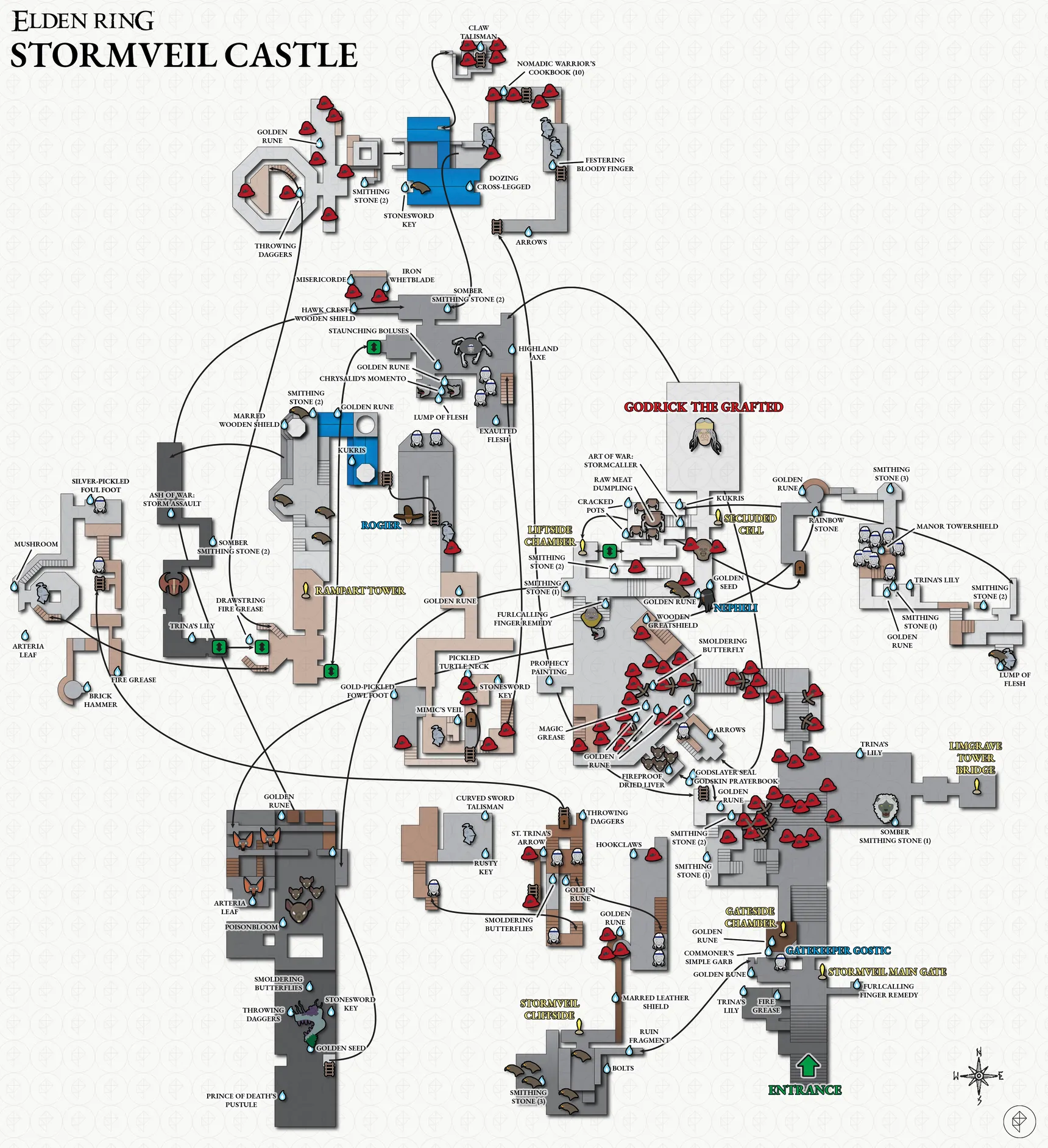
The classic example of all the above is a castle (of which there are many in the Soulsborne universe). In Elden Ring, Stormveil Castle is the first notable example. To illustrate the complexity of the level design in this location, we can simply look at Polygon’s map – this map is hard to read, precisely because it is trying to represent a maze-like 3d space through a number of 2d cross-sections:
In Elden Ring, the big question was how FromSoftware would extend its principles to a much bigger scale, and I felt the answer was “same principles, with some patches addressing anything super broken”:
The 6 key destinations of the world (with intricate labyrinths, loot and bosses) – the proper terminology is Legacy Dungeons – are self-contained components that follow the proven design principles above, and executed to FromSoftware’s usual quality.
Ruins, caves, catacombs, smaller castles and various other smaller locations (which are one-and-done consumable content) populate the “open” part of the world. While the majority offer combat challenges, there are a small amount of puzzles.
Some of the later catacombs are particularly memorable in how the designer creates a puzzle by re-using the same level layout in different layers of the tomb, inflicting confusion on the player – “I thought I’ve been here already? But why is there a different enemy?”
The verticality principle is taken to a grander level – in Elden Ring there are enormous areas of the world that are directly on top of each other, shown in 2 layers of the map. And there are bits of the map where you can only reach by traversing through a section of the other layer first.
Restrained handholding. Much has been said online about the map and navigational UI (in comparison to, say, Ubisoft open world games). I think the point is not that Elden Ring offers no directional handholding, but rather, it does the bare minimum and expects players to be able to understand:
For example, the actual map is hidden until players collect the map fragment, but in the hidden view there is an icon for the location of the map fragment, which serves as a natural priority destination for the player to work towards.
The big pointers on the sites of grace offer a heavy-handed nudge in terms of bigger objectives.
While the map does not offer comprehensive UI to highlight the points of interest, the map is quite readable and you can easily spot the places you’d probably want to visit.
The gradual unfolding of the map’s true scale was a neat trick that awed players (the map zoomed out as you explored beyond its boundaries), and is contrary to typical open-world map designs which are eager to show you “look how big it is!”.
To break up the natural pace of map exploration, there are numerous portals and even a teleport trap that jump you ahead a bit or transplant you to a different part of the world altogether. Once triggered, the logical thing for players to do is to explore the new area until they reach a site of grace, which unlocks future fast travel. There is also a notable “4 bell towers” location mid-game, with several of the towers teleporting you to places adjacent to late/end game zones, greatly foreshadowing what is to come.
As a patch against frustrations of travel, the game is much more liberal with providing the sites of grace checkpoints, sometimes comically so. On the whole I think this is a welcome change, but it also does mean going back to older titles will be harder.
The mount. As a necessary and proven solution to overcome open world traversal, Elden Ring’s mount is a bit janky but gets the job done. It even has a double-jump to reduce frustration. Mounted combat is restrictive (you have a much limited moveset), while also encouraging cheese – I defeated many tough bosses in the open-world areas by abusing the mount’s speed with hit-and-run attacks. There’s also a weird i-frame when you mount/dismount. Overall I see it as a practical but not elegant patch.
Another (perhaps unnecessary) patch are the potion refill mechanic in the open-world, where if you defeat a complete group of enemies, you will gain a few potions back, extending your run before you need to rest. It has some utility, but I dislike this mechanic simply because it’s yet another rule (along with the mount) that only exists in the open-world, but not in Legacy Dungeons and any interior location, which adds to the cognitive overhead of making sense of the laws of physics in this world.
The sum of the above is an experience that feels immediately familiar to Souls veterans, but with an unprecedented volume of content in an unfathomably large map. It is worth noting that a good amount of the content depth is illusory, or at least, opted-in by the player: it is not required (with no practical rewards) to fight the very first Tree Sentinel patrolling the beginning area, and yet, many players will spend their first few hours just fighting and dying to this mini-boss. And generally, there is little value in fighting the enemies roaming the open world, and it is more efficient to just ride past them (or fight the minimal number guarding loot you want), but many a player will probably fight all of them, simply because they are there.
Difficulty and opt-in challenge
It is easy to sink a hundred hours in your first Elden Ring play-through, due to the combination of content volume and progression scaling. The conventional wisdom is that “progression” in Soulsborne games is less about power scaling, and more about player mastery of mechanics (knowledge and execution). This is still a core tenet in this game, but the expanded content scope has meant that enemies are spread against a wider power distribution. A quick proof here is to compare the player level at end-game (especially given the level-up formula is the same): in Bloodborne, it is common to finish the game at around level 70; in Elden Ring, level 120+ would be more common.
It is still possible to complete the game without ever leveling up – just “git gud” – but that is not the typical player experience. To revisit the “difficulty” topic, I feel the optimal (maybe design-intended?) difficulty is where it takes regular enemies 5-7 hits to kill you (and for bosses, 3-5 hits), while you kill regular enemies in 1-3 hits (and bosses in 10-20 hits). Outside of these ranges and the game feels either too easy or too hard/grindy from a numerical standpoint.
From a mechanics standpoint, the game has a wide range of tools (weapons, skills, spells, consumables) for you to approach any challenge. There is a wide range of builds, though organically discovering builds would take a lot of time, and thus reading community guides outside the game are a core part of gameplay. And with each balance update, the community is motivated to discover the latest “meta”, further extending the game’s playtime.
Given the open world nature, Elden Ring is far more generous than previous FromSoftware titles in presenting opt-in challenges. (Indeed, the shortest path to completing the game only takes up maybe 10% of the entire map.) My favorite story here is my experience in a small cave in the dreaded Caelid region. The cave had something I wanted – ironically, now I can’t remember what -but it was filled with scarlet rot swamps, and if you stood in them for too long, you are afflicted with a long debuff that constantly drained your health.
I had a number of options to tackle this terrain: to remove the debuff, I could use a consumable item, but I couldn’t be bothered to farm the crafting materials for it (indeed, crafting seems to be a largely forgettable system in the game). Alternatively I could use a spell, but I would need to get a few more levels to meet the attribute requirements; again, something I didn’t want to wait for. Another path was to try to minimize the time in the swamp, by equipping a quick-step skill – I was greedy and impatient, so this is what I chose.
A few minutes later, I had successfully reached the boss fight area of the cave, and died, dropping a tidy sum of Runes for my level at the time. I remember laughing at the time – do I want to go through this BS again? Or come back when I’m more powerful? I decided to try one more time – since if I died again before reaching my corpse, the Runes would be forever lost, and thus I would have little reason to bash my head against this wall here. Alas, I ended up defeating the boss in this next attempt, and that triumphant feeling of overcoming an unreasonable challenge (while not fully believing in myself) was addictive.
This is very much a core philosophy of Hidetaka Miyazaki – as he said in the excellent New Yorker profile, “hardship is what gives meaning to the experience.”
The world becomes smaller, as you get wiser
I mentioned earlier that in subsequent play-throughs I could see through some of the magic. Specifically, it was much more apparent that I should skip as much content as possible until I got to the level where I could play the build I had in mind. This means largely just riding through the lands and picking up items, while avoiding combat. I also took a shortcut with some “meta’ power-farming tricks, although they became way too mind-numbing for me after 10-15 minutes.
A friend of mine regretted acquiring this knowledge early (after watching some power-leveling guides), as he felt robbed of the early-game exploration. I understand the sentiment, but I also think the early game is part of the portion of content that has little replay value, and I’d rather “just get to the good part” which is mostly about experiencing different builds. I’ve played almost 200 hours, and really I’ve only played 4-5 builds. At end-game, builds revolve around very specific combinations of weapons and skills/spells, and given the game’s vast amount of weapons/skills/spells, there is a lot of depth here. So much so, it’s easy to lose the bigger picture – we are talking about just the single-player experience easily offering hundreds of hours of gameplay.
Closing thoughts
I wanted to end with some quick notes about production. Let’s start with some quick headcount comparisons from browsing the credits of FromSoftware games since 2015. As a lazy effort, I only did a subtotal tally of programmers, designers and artists – there are lots of many other folks in other role (audio, QA, localization, the management layer etc.), and this is not to diminish their contributions. Without insider knowledge, this also doesn’t reflect how outsourcing or other significant workflow adjustments impact production capabilities.
Source: game credits
Caveats aside, I do feel that these numbers support 1) my previous sentiment that Sekiro was done on a tighter scope, and 2) Elden Ring was a bigger production, but maybe surprisingly not by that much – the bigger growth was in art and design, perhaps with a focus on authoring content using mostly mature internal toolchains. Continuing my quick-and-dirty comparison (from my Sekiro review) of regular enemies count, the list of enemies in Bloodborne vs Sekiro vs Elden Ring stands at 68:45:150 – maybe indicative of good returns on content volume with the additional headcount.
At 13.4M copies sold in the first month, Elden Ring crushed the publisher’s internal forecasts of 4M. This is the nature of the business – in hindsight it’s easy to rationalize, but no one can confidently predict outsized hits. With Elden Ring as a breakout title in terms of mainstream adoption, FromSoftware is now in rarefied air – one of the few elite studios which players will buy upcoming games solely based on trust in the studio brand. This status is attained after over a decade of hard work in a genre of their own creation.
The formula is y = 0.02x^3 + 3.06x^2 + 105.6x – 895, for those curious. ↩
For example the chest teleport trap in the beginning area in Elden Ring, that mischievously takes players to a much harder area with no easy way back. ↩
I recently watched the 2008 HBO mini-series Generation Kill for the first time. Focusing on realistically portraying the grunt’s perspective of war, it’s a great modern combat rendition of themes previously explored in works such as Platoon, Band of Brothers and Saving Private Ryan. I quite recommend it.
Aside from the brutal horrors of war (and the senseless of it – a core theme of the series), Generation Kill also effectively showcases how the modern US military communicate, and the limitations of their advanced systems. Radios are extensively used – as the primary comms within a platoon, with their upper command, and calling in air strikes & artillery support etc. There also is a version of a BFT system shown, where a digital battlefield map can be seen with near real-time data of tracked friendly and enemy units (similar to the mini-map in RTS games).
Despite these sophisticated systems, the marines featured in Generation Kill often find themselves in states of confusion: at night, they receive friendly fire from a nearby friendly unit passing by; after reconning a town without identifying enemies, they see it bombed, with no idea where the order came from; they see an aerial unit attack a nearby location, but have no immediate way to communicate with the friendly aircraft; and in one ironic scene, they jam their own radio channels so that an incompetent leader cannot send out a wrong (and dangerous) command.
This sparked a thought – what video games employ communications as a central gameplay mechanic? A few different examples came to mind:
The fun party game Spaceteam used speech as a primary mechanic. And last year’s phenomenon Among Usobviously leans on speech for a majority of its gameplay content as well.
Any team-based multiplayer game that emphasizes real-time coordination as a vector of mastery – whether PVP (like MOBAs or shooters), or PVE such as MMO raids. And in a military shooter like PUBG, the communication have many direct similarities to the military in real life.
4X games (“SLG” in Chinese gaming terms), by virtue of their large and hierarchical guild social structures, create strong needs for layers of communications, not unlike the military chain of command. The senior leaders of a guild will have a private chat channel for strategy formulation and decision making; lower level grunts may only receive commands on a need-to-know basis. And social manipulation / influence is a key part of the gameplay (e.g. trying to bribe an enemy guild’s senior leader to defect, or backstabbing an ally).
Obviously, placing a premium on communications can create nasty negative effects. Toxic communities – in short players being assholes to strangers online – can drive many players away, especially targeted minorities (for example female players in shooters that often encounter a lot of abuse in voice-chat). So there’s also a counter trend of games taking away communication means in-game, and thus pushing players who want these features back to 3rd party tools.
I played through Death’s Door on Steam this past week. It’s a highly enjoyable action adventure that lasts about 10 hours, and to my surprise it was made by a 2-person studio (Acid Nerve – the full game credits list 8 people).
To me, the game is heavily inspired by Soulsborne and Zelda games, presented in an isometric camera view. The eponymous doors (there’s lots of them) function quite similarly to bonfires, resetting the game world whenever you go through them, and also acts as a teleportation device to switch you to different locations / levels. (The doors also reminded me of Pixar’s Monsters, Inc. franchise.)
Like Dark Souls, the level design has a strong emphasis on “connectivity” – as you explore a new area for the first time, you’ll repeatedly unlock shortcuts that take you back to the beginning area (and close to a strategically placed door). The levels are intentionally maze-like, with lots of winding pathways and verticality – for example, to access the cliff on top of you (where there’s a collectible), you might need to walk around a large section of the level. In addition, sections of the level are completely inaccessible (usually, rooms with juicy secrets) until you’ve unlocked some later abilities to your character – this is clearly meant to make the levels have repeat exploration value, as you come back to hunt for specific collectibles.
With these elements in unison, the game could feel like a chore sometimes – you could be lost (“how do I get there again?”), or just frustratingly trying to figure out how to access a secret area you’ve spotted, with no feedback of whether that goal is currently achievable or not. But these are minor gripes, especially considering that it is trivial to search online the solutions to the game’s secrets & puzzles – indeed, it took great restraint for me to not open YouTube during the majority of my playthrough (at my age, if I can’t figure out the solution to something in a game in 5 minutes, I usually start searching online, as I feel I’m “wasting time”.)
The game’s combat is simple (in mechanics complexity) but quite robust:
You have a light and heavy melee attack (the heavy attack can be charged up to be even stronger).
Melee attacks charge up your energy bar, which can be consumed as ammo for your 4 ranged abilities (unlocked over the course of the game – you start out with a basic bow / arrow).
You have a dodge with invulnerability-frames.
You have 4 health (initially, can be upgraded to 6 through collectibles) – each enemy hit always cost 1 health. There’s very limited health regen available in the levels, so there’s the Souls-like tension of trying to push to the next “break” in the level (usually unlocking a shortcut back to the nearest door).
Enemies can hurt each other – AOE explosions and projectiles can be utilized against other enemies. You can knock-back projectiles (e.g. a fire bolt aimed at you), and the ping-ponged projectile will damage other enemies. You can also trick enemies into environmental deaths (rolling off a ledge; walking into a laser). This creates a fun mini-game.
There’s about 10-20 types of regular enemies (your usual mix of melee / ranged / elite enemies), and perhaps 6 boss fights. Combat is about learning and reading the telegraphed movesets of each enemy, and taking advantage of their vulnerability windows. Interestingly, the game does not have HP bars for enemies (most enemies die in 1-3 light attacks anyway), but rather communicates damage state visually (blood stains on the ground, red VFX cracks in the enemies’ bodies). This ups the tension in boss-fights as you don’t have full insight on how many additional hits you need to land.
I would say the combat is not difficult (the windows of opportunity are overall quite generous), but they require discipline. I also liked some clever bits of the moveset AI – for example, there’s one fight where the enemy will always use a leap attack when you try to aim a ranged attack. I was a bit frustrated at the final boss fight (not the “True Ending” fight, the boss-fight that leads to the credits scene), I felt it was a tad overlong and felt repetitive (I hadn’t unlocked any health upgrades at the time, and I felt it was a bit punishing on 4 health). It reminded me of an extended platforming sequence in Ori and the Blind Forest (which to be fair was much more rage inducing).
In all, I felt this was a great game made by a surprisingly small team, especially considering how polished the game feels, and how good it looks. It is a good reflection of the state of the industry, where small teams through smart creative decisions (stylized art, re-usable design) and tight scope control can deliver such quality experiences.
My recap posts on 2019, 2018, 2017, 2015. I don’t remember writing with such consistency (my son was born Jan 2016, I guess that explains the gap?). Skimming these prior posts, I do see I’m repeating myself an awful lot, but it’s still rewarding to see how the same themes (and my attempts at framing them) have evolved over time, and quite gratifying when some predictions I’ve made turn out to be on the money.
As usual, I’ll write about a few topics that I personally found fascinating.
Genshin Impact and the coming “Industrial Age”
At the end of my 2019 post, I called Genshin Impact an aspiring blockbuster, which was not that bold a claim given the viral hype (and controversy) it already enjoyed in China at the time. It has easily surpassed my expectations, even more so in western markets.
I’ve already written a long post about the game. In the aftermath of the game’s explosive launch, much of the Chinese industry chatter was about “industrialization”. I’ve not seen a clear definition of the term in this context (it seems taken for granted), but loosely, the logic is that as consumers demand higher fidelity games (rivaling PC/console AAA in quality) and ever more content, Chinese developers will have to embrace the flywheel of “bigger teams (and more specialization of talent), more sophisticated production pipelines, and more advanced technologies and tools”.
In other words, Genshin Impact is seen as a landmark game, one that has permanently shifted consumer expectations higher, and subsequently started a new industry-wide arms race in China. In my view this is quite overblown – the dominant market leaders Tencent and Netease have for years chased higher budget productions made by “armies of developers” – but Genshin captured the zeitgeist with the audacity of its vision.
What’s next? A lot of UE4 projects, for one thing. To name a few: Tencent Quantum Studios’ Dawn: Awakening is an open-world survival game (with 3rd-person shooter gameplay) made in UE4. Lilith Games recently announced Farlight 84, another UE4 project with a post-apocalyptic theme, Battle Royale PVP gameplay (perhaps amongst other game modes) and mobile-PC cross play. (I don’t know if either of these will take off – their themes lack the easy viral appeal that Genshin Impact had.) Meanwhile, Tencent Timi Studios recently posted job ads for a “AAA-grade” realistic racing simulation, built in UE4 for mobile; and miHoYo has been recruiting UE4 developers as well.
When China meets the world
Chinese game developers have for years studied and learnt from their global industry peers – whether it’s GDC talks, studio visits, academic studies or direct talent acquisition. There still doesn’t seem like a lot of information flowing the other direction – language and culture are big barriers (for Chinese developers to share outwards – the “supply” side), but lack of interest on the “demand” side has been a deterrent as well.
In this aspect, the games industry seems a step behind the broader tech sector, where Silicon Valley now clearly pays a lot of attention to trends in China. When there is more interest, and deeper exchange of knowledge about China’s game development practices, I suspect there will be a good amount of bemusement and shock from the outside.
I’m reminded of an ancient news piece – when the first MacBook Air was announced in 2008 (by Steve Jobs memorably pulling it out of a manila envelope), a group of Japanese engineers did a teardown and expressed surprise at the “wasteful” and “expensive” internal design:
“If I proposed such a design, our company would never approve it,” said one of the engineers. “I can’t find anything that is technically superior. We can make the same computer at a lower cost,” said another.
In hindsight this was obviously missing the forest for the trees – the Japanese experts weren’t necessarily wrong, but their points were irrelevant in the big picture. Game developers should avoid making the same mistake when they examine Chinese game development – the sausage might be made in an ugly and wasteful way based on your perspective, but don’t neglect the end results or their growth trajectory.
Chinese developers have been self-reflective about the gaps. For instance, in this recent interview (in Chinese, but the Google translate is well worth a read) with the head of Timi J3 (the team behind Call of Duty: Mobile), he called out investment in tooling as one area where China still has much to learn:
Yao Yuan (head of Timi-J3): …Furthermore, European and American manufacturers’ practice of tooling is much stronger than ours. I talked to the team of “Ghost Recon: Wilderness” before, and they said it took 5 years to make an editor. How strong is this editor? Basically do some drag & drops, and all the villages, roads, people, animals, and vegetation will come out. This is Ubisoft’s industrialization capability.
Interviewer: Domestic manufacturers may not do similar things.
Yao Yuan: Yes, many domestic projects have no time to build tools due to development cycle constraints, but European and American manufacturers are different. Ubisoft’s editorial team will do various military and historical research in the pre-research stage, go to relevant places to collect features, improve tools, and then slowly start the project. This process is very worth learning. If you really want to pursue efficiency, you still have to be prepared from the beginning.
(English via Google translate with light edits.)
Earlier in the interview, Yao made this comment about their production capabilities:
For example, compared with a year ago, we have the same size of two or three hundred people, but our production capacity has increased by 3 to 4 times. By cooperating with an outsourcing team of nearly 300 people, we can now make several game modes and maps, hundreds of weapons and dozens of characters in one month. Although some content requires a relatively long production cycle, for example, it takes 3 months for a character to go from conceptual design to IP-stakeholder approval, but the production process and pipeline are very strong and mature.
(English via Google translate with light edits.)
So the picture here is, this team is consistently churning out vast amounts of live-ops content, despite relatively immature tooling (compared to their western peers), and their efficiency is rapidly improving. And they have stayed on top of the organizational challenges of running such a large team. And there is still a lot of productivity upside if they do seriously tackle tooling – that’s the scary part.
5 years of Honor of Kings
Honor of Kings launched in late 2015. SCMP did a profile recently, and their graphs painted the picture succinctly:
Let’s be clear: the “real” lifetime revenue is a lot higher than this $7.8B figure from Sensor Tower, as it does not include China Android revenue (understandably hard to model), and Honor of Kings has very low revenue outside China. Indeed, I would say you can double that figure to $16B and possibly still be low. Coincidentally, $16B is a cool 100B RMB, a nice round figure for half a decade.
Beyond these eye-popping (and speculative) numbers, it’s hard for me to talk about Honor of Kings without doing some soul searching. Professionally I had a ring-side seat to this spectacle – I was a part of the China team at Riot Games, based in Hong Kong in 2015/16. I played the game when it launched, and was 1) amazed by how it recreated some of the high satisfaction moments of PC MOBAs, but 2) also confident that it was not a major threat to League of Legends as the gameplay was still too shallow for core players. My main takeaway was that Riot should absolutely look into making a mobile MOBA as well.
To show my thinking then: in March of 2016, I wrote a post titled “Are mobile games disruptive?“, and the disruptive game I was talking about was Clash Royale (which took up every second of my day when I wasn’t taking care of my newborn):
I believe mobile games have so far followed the [disruption] theory here:
– They have focused on catering to previous non-gamers / casual gamers, and most of the early successes reflected this (Angry Birds, Candy Crush Saga, Flappy Birds)
– These games were simpler to play, and offered less complexity in the gameplay
– These games were generally looked down upon by core gamers
What gets interesting is what happens next. The disruption theory says that from this low market position, the new entrants are able to mount an attack on the establishment thanks to both product evolution (so they catch up in product experience) and their new attributes which the power users (core gamers) previously didn’t care about.
While my memory is fuzzy, I believe I largely stopped playing Honor of Kings for fun after the initial few months. However, by Chinese New Year 2017, it was clear that a disruption was playing out according to Clayton Chistensen’s theory. League of Legends players were being pulled into Honor of Kings en masse: it turns out social ties and bragging rights were more powerful motivations to many (if not most) people than gameplay depth and mastery. But really, the bigger story was how Honor of Kings activated so many non-gamers.
So that’s what it feels like to be disrupted.
I’ve often described Honor of Kings as an attack from below – if you think of the hierarchy of MOBA players as a pyramid, with the very pinnacle being esports players, Honor of Kings successfully activated the bottom tier first. There was little organic endorsement or word-of-mouth from the establishment influencers. (The game did try to piggyback on the popularity of League‘s esports celebrities, with ambush marketing like getting Faker to do a livestream.)
League of Legends: Wild Rift, in contrast, will be an attack from above. I played a modest role in getting this project off the ground (and I’ll shamelessly overstate it on my Linkedin page), so it’s something quite close and dear to me. The existential question for Wild Rift has always been: is there any chance against Honor of Kings?
Sentiments aside, I think the answer is yes, even in China. The League “establishment” that shunned Honor of Kings have been dying to play a League mobile MOBA, and perhaps this echelon of esports pros and streamers can create a big enough beachhead. And there is still a brand premium in my opinion, though that picture is nuanced as Honor of Kings has leaned into Chinese culture – in a way, it’s a bit like Apple versus Huawei in China. At the end of the day, players across all tiers of the pyramid will try Wild Rift – the question is can Riot get them to stay.
As an anecdote, I’ve been lurking in a wechat group of League influencers who have overcome formidable obstacles to play the game on Asian servers. Some of them are already organizing pro teams and recruiting players at the top of the ladder. Their enthusiasm is infectious, and gives me cautious hope about the next chapter in this saga.
Lastly, one other personal reflection from these 5 years is that, even with the personal experience of how Honor of Kings disrupted League of Legends, I was able to repeat the mistake when it came to thinking about PUBG Mobile. I had seen an early build before its launch, and I was impressed. But my gut again told me that it would not satisfy PUBG players, and its input complexity would be overwhelming for casual players. I was definitively wrong on both – I guess that speaks to how strong one’s biases can be.
(Optional extra reading – this piece in Gamesindustry.biz shows Timi leadership’s reflections about Honor of Kings and their views on industry trends.)
China’s dynamism
Taking a step back from games for a moment. I came across this year in review letter by Dan Wang, who is a tech analyst based in Beijing. It is thought-provoking and beautifully written, and honestly I envy his prose. (Seriously, you should stop here and go read that letter instead.)
This small bit particularly resonated with me:
This year made me believe that China is the country with the most can-do spirit in the world. Every segment of society mobilized to contain the pandemic. One manufacturer expressed astonishment to me at how slowly western counterparts moved. US companies had to ask whether making masks aligned with the company’s core competence. Chinese companies simply decided that making money is their core competence, and therefore they should be making masks.
This “can-do spirit” is Chinese game developers’ biggest (and perhaps most overlooked) strength – it’s the rising tide that lifts all boats. While studios elsewhere debated first principles about whether MOBA / FPS were viable on mobile, Chinese studios simply hacked away at it. When the Chinese government tightened the publishing license process, companies rapidly pivoted to overseas expansion. And with this “industrialization” wave, Chinese developers are again just diving head-first.
Having recently lived in the US for almost a decade, I feel the stark contrast. As I was writing this, a mob of Trump supporters stormed the Capitol building. (It may well have been a scene from a dystopian video game like The Division 2.) There are bitter divides and deep social justice issues. It feels trivial, and perhaps disrespectful even, to be discussing game development against such a backdrop – but I feel the need to argue that Americans must find a way to rekindle a similar can-do spirit, and just build stuff. Build institutions, social welfare, infrastructure, housing, startups… Whatever it is that motivates you, which hopefully for some would be video games.
This is obviously a huge topic that was discussed in the US in 2020, when Marc Andreessen wrote his “It’s time to build” post. I didn’t follow the rest of the discourse closely, but I enjoyed reading this essay “On cultures that build.” I’m not well equipped to really add more to the conversation, but I will say this: China faces huge (if not bigger) societal challenges as well, but part of the dynamism is rooted in people’s belief that they can (and must) improve their livelihood via hard work. They have the lived experience of the dizzying growth – the building of everything – of the past 40 years. For Americans, more cultural exchange and economic ties with China – not less – may have a nice side-benefit in combating the complacency.
M1 Macs
In my 2018 post, I briefly speculated on “the beginning of the end of the PC (x86) platform”. With the arrival of the M1 ARM-based Macs (finally), I’d like to raise my bet.
I haven’t used a M1 Mac yet, but from everything I’ve read so far, it sounds like a generational leap in objective performance as well as subjective user experience. Now the question becomes, is this strategy and capability unique to Apple, or will others attempt to follow suit? I’d argue yes, if not simply because of the gravitational force of the mobile ecosystem. In particular, if Nvidia’s acquisition of Arm is cleared, Nvidia will be in an enviable position to attempt some big integration plays here.
If there is such a foundational migration on the Windows side of PCs, one clear worry is app inter-operability during the transition. It’s hard to imagine the Windows side offering as smooth a transition as Apple is doing with Rosetta 2, thanks to the much more fragmented hardware stack. And games as a special category of applications may suffer the worst of any transition. Again – a gaming-focused company such as Nvidia could be particularly motivated to navigate a path through this.
There is some irony, to me, if at the end of this, it’s consoles (due to their long generational cycles, and current commitment to backwards compatibility) that become the laggards that stick with x86.
Personal stuff
2020 was the first full year I’ve lived in mainland China for over a decade, and the first time I’ve lived in Shanghai. My timing was pretty good, in retrospect. When the strict lockdown started in late January, we thought we had the worst luck, but by May, life was mostly back to normal (even masks were mostly gone, except where mandated such as in public transit).
In the summer, many friends went vacation traveling again; we didn’t as we had very young children. But we couldn’t resist booking a short vacation trip for December. Alas, the weather in Xishuangbanna wasn’t warm enough to take advantage of the private pool we had in our villa, but it was still a pleasant trip.
Shanghai is a very livable city. I say that as a proud Beijinger. The summer is still too hot and humid for my liking, but the city has a good balance of culture (with a dash of western influence), urban planning, and pace of life. Beijing feels too bureaucratic, and it takes too long to get anywhere. Shenzhen feels too rushed, and the hot humidity is just as bad as nearby Hong Kong. Los Angeles – I love the climate, and the parks, but I don’t miss the driving.
The pandemic also gave me some new perspectives about effective governance. The US response has been appalling to see from afar. I wonder how much of it is uniquely the failings of the Trump administration, and how much is reflective of the general state of decay and complacency in US institutions. To be clear, I’m not looking at this from a lens of US versus China as superpowers, or other sorts of macro-economic debate. I’m much more concerned with the micro-economic life decisions we make as a family – where we should spend our precious years together, and can offer us the best mix of professional fulfillment, income, education, and life experiences. And for me the US fell a lot in the rankings this past year.
Investing: some years ago, there was a popular startup catchphrase about seizing the big trends, coined by Xiaomi founder Lei Jun: “even a pig can fly if it is in the middle of a whirlwind.” (Jack Ma, who’s living through some interesting times himself recently, apparently had a witty response: “when the wind stops blowing, it’s the pigs who fall to their deaths.”) The stock markets certainly made me feel like a pig facing a hurricane, torn between FOMO and having a nasty fall. It was quite surreal to see the market movements in contrast to pandemic life.
Remote work was a much discussed concept, and a collectively forced experiment. In my case, with 2 young kids running around the apartment, working from home simply did not work. When my older son’s kindergarten re-opened, it was marginally better. I’d probably need a private office away from the office to make remote work viable.
To wrap up with the games I played in 2020. I played various mobile games due to professional interest, but the one that stuck with me, surprisingly, is Merge Mansion. (Disclosure: my current employer, Supercell, invested in the developers.) I’m not a puzzle game player, and this is a game that’s still very early in development with a lot of rough edges. But it became the perfect time-killer game, and I’ve averaged 20 minutes of play every day for several months now.
On PC/console, I played Hades more during early access in 2019 than I did in 2020, but I should go back and play it some more to experience the complete game. During the depths of the spring lockdown, I occupied myself with Ghost Recon Wildlands and The Division 2. Fall Guys probably brought the most joy and laughter, and it was eye-opening to see how much it resonated with my 4 year-old. Later in the year, Ghost of Tsushima was an easy crowd-pleaser, which I spent more time on than I should have.
The game that resonated the most with me though, without a doubt was The Last of Us Part II. Its harrowing discussion of trauma, empathy and perspective-taking was particularly fitting for these times we live in. And the toxic fandom around the game felt like an inadvertent meta commentary that echoed the game’s core themes. Months after my playthrough, I still think about my experience with the characters. Perhaps it’s time to pop the disc into that new PS5…
The ongoing fight between Epic and Apple / Google is one of the biggest tech stories of the year. The situation is very fluid, with a lot of developments since last week, and a ticking time bomb by end of August.
Not surprisingly, there’s been a lot of “takes”, most of which is candidly not too useful, and a small amount that have covered the situation from insightful angles. Instead of regurgitating these insights, I thought I’d just list a few here (most of these are usual suspects if you surf a lot of tech punditry):
Benedict Evans – App stores, trust and anti-trust. I’m a huge fan of his writings, if not simply for the craft of discussing extremely complex, nuanced technical topics with clear prose that flows easily.
Analysis Group – Apple’s App Store and other digital marketplaces. Note that this is a study commissioned by Apple – irregardless, this is a useful reference doc with a lot of data across different marketplaces. Interestingly, it briefly mentions the Chinese Android app stores, which often charge 50% or more commissions.
互联网怪盗团 – 30%的“苹果税”不公平,那么50%的“国产安卓税”公不公平? (“If the 30% Apple tax is not fair, then is the 50% Chinese Android tax fair?”) A good write-up from a Chinese independent analyst I read regularly.
The Chinese Android app stores example
I think it’s rather futile to debate the abstract merits of “open” vs “closed,” which at the ideological level is the heart of this fight. Tim Sweeney has been very consistent over the years – his public criticism of UWP is spiritually similar to his stance against Apple / Google, and I believe it’s stemming from not merely a business interest calculation (though he is often accused of such), but a genuine belief in “open.” 1
Instead, I think it’s more useful to discuss the Chinese Android app distribution landscape, as a real example of why Epic’s desired state (open up iOS to 3rd party stores and alternative payments) may not be good for consumers. (The linked Chinese post above is a great read on this, below is my brief summary of the same topic.)
When Google abruptly exited China in 2010 (and along with it, the Google Play store), there was a gold rush to fill in the vacuum left in the Android ecosystem. At a 30,000 ft level, a series of things happened:
In the beginning there was a flood of independent stores, with notable ones like Wandoujia (funded by ex-Google China head Kaifu Lee’s Innovation Works) and 91 Assistant.2
In a landmark deal at the time, Baidu acquired 91 Wireless (which owned the 91 store) for almost $1.9B in 2013.
As of 2013 Tencent also had an Android app store MyApp. After Tencent leveraged WeChat’s popularity to promote MyApp (“if you wanted the latest version of WeChat, go to MyApp”), MyApp gradually became one the most popular stores.
In 2014, prominent Chinese Android handset brands (with the exception of Xiaomi) formed a coalition called the “Mobile Hardware Alliance”. A major goal of this coalition was to exert influence in the distribution of games (which was recognized as the key cash-cow in app stores) in the Chinese Android ecosystem.
The current state of stores, at a high level, is this:
All the Chinese Android brands have their own stores, and because of the coalition, these stores have significant weight.
Tencent MyApp is the biggest non-OEM owned store.
The once prominent independent Android stores (without backing of OEM or a major social app like Tencent’s QQ/WeChat) are greatly declined in presence.
Collectively there are still dozens of stores.
How about the economics – let’s talk about that 50%?
There isn’t a unified rate – everything is negotiated. But indeed, if you are a game publisher not Tencent or Netease, the 50% store cut is the common term you will get.
Strictly speaking, this isn’t an “Apple-apple” comparison, as these Chinese Android stores call this “joint operations” of games where in theory they are providing more value-add (funneling more traffic etc.).
The prevailing rate for Tencent and Netease have been pushed down to 30%. (And of course Tencent keeps 100% in its own MyApp store.)
To summarize, the Chinese Android app store landscape is very much objectively a worse state than the Apple / Google monopoly Epic is complaining about:
Consumers have a confusing user-experience (overwhelming amount of store choices, fraud / security / malware concerns, inconsistent UX of the same app across different stores).
Developers are typically giving up a much higher share of revenue.
Developers have a lot more development costs / headaches (support dozens of app stores, SDKs, builds).
To be clear, it’s not a certainty that we will see a similar end-state if the Apple / Google “app distribution market” and “payment market” is opened up by regulation. (For one thing, the Hardware Alliance thing is clearly suspect to anti-trust scrutiny.) But it is clearly a possibility with strong factual support.
Problems that Apple should address
Having argued why “the grass isn’t greener” on the other side that Epic desires, let’s briefly talk about issues that Apple should tackle. This part is focused on gaming specifically.
For the 30% rate, I do believe (and clearly I’m biased with a vested interest here…) that this should be pushed lower with how the ecosystem has grown and evolved, even if purely arguing from an economies of scale perspective. Ultimately though, economics are a reflection of “who owns the customer”, so Valve’s model of volume-based tiers (starts at 30%, drops to 20% for sales above $50M) isn’t a bad reference. (This is also the common logic in retailer / wholesaler agreements.)
(Alternatively, Apple can continue to make confidential deals with the biggest partners, offering rev share discounts on a case-by-case basis.)
Apple also should update its strategy (and thus policies) regarding emerging services like cloud gaming. The rejection of Microsoft xCloud on iOS feels short-sighted, and untenable in the long-run if cloud gaming does take off. (It’s also a bit silly that at the same time thousands of HTML5 games are available directly within WeChat, which seems like a much bigger violation; arguably xCloud is offering much better games that would enrich the user-experience of iOS gamers.)
To end on a light-hearted note. Every time I write about Apple and mobile gaming, I will bring up my dream for an Apple-designed controller peripheral. I don’t think that will ever happen, but one can dream…
Conversely, Apple, like Nintendo, like Disney, have been decades-long champions of the “closed” side of the debate. Just for transparency, at at the abstract level I lean closer to this camp, because I idolize seamless user experiences (which are typically easier to realize in a “closed” ecosystem). ↩
As a sign of the times, a popular feature-set back then was a PC client that was a storefront and also a manager for the download and installation to the phone, similar to using iTunes to manage iPhone apps. ↩
I’ve wanted to write this post for a few weeks now, but have not yet had time to extensively play the game. Finally I decided I should just jot my current thoughts down (or these thoughts will just be lost in time), noting that it is founded on a dangerously shallow understanding of the core game.
A quick disclaimer: I used to work at Riot Games, the developer behind Valorant, the game I’m about to discuss. My tenure at Riot overlapped quite a bit with this game’s development, but I was never affiliated with the project. My discussion below is based on public info.
Valorant is Riot Games’s new FPS currently in closed beta for PC platform, and its first new game IP since League of Legends a decade ago. There’s a lot riding on this game: in the short to mid term, this game will largely determine whether Riot is an multi-IP games studio,1 or “just” the League of Legends company (which to be clear is an extremely enviable position). It’s also a major test for Riot’s R&D process, as the game has been in development for over 6 years.
Savvy beta marketing
Marketing-wise, Valorant has had a great start. Its Twitch beta key strategy (keys randomly drop by watching Valorant streams, initially with designated partners, later with all channels) has overall been a resounding success.2 This is a mechanic that CS:GO players are familiar with, as CS:GO tournaments have often used in-game drops as rewards for watching streams. One criticism of such tactics is that they inflate Twitch engagement numbers; that certainly happened with Valorant, though I don’t think it’s Riot’s goal to hit specific viewership goals, but rather, to have optimal visibility / hype around the game’s beta launch – and that goal was more than fulfilled. (Possibly over done, even – for a while, Reddit was filled with complaints about not being able to get a key despite watching dozens of hours.)
Riot has also deployed its community engagement best practices to great effect. I’ve skimmed the subreddit over the past few weeks, and the community has generally been very appreciative of Rioter engagement. The “devs vs streamers” showmatch (where the devs won by a landslide) also earned the team a lot of street cred.
Gameplay
The core game (“5v5 character-based tactical shooter”) can be crudely described as 80% Counter-strike and 20% Overwatch. Counter-strike lends the main structure of the game: the 5v5 rounds-based format (with its economy macro play), the map objectives (bomb plant / defuse), and even the broad strokes of the weapons and gunplay feel. It even brought over the esoteric mechanic bunny hopping.3
The limited selection of grenades in CS is replaced with an expansive character system (the “20% Overwatch“), and character abilities are mostly about utility – detection, blocking vision / movement, mobility, and so on. Abilities are not free to use; instead, charges are purchased with hard-earned cash at the beginning of every round, which suggest their origins in CS-grenades. (Ultimate abilities are the exception: they are charged up by kills, deaths, planting / defusing, or collecting power-ups.) Damage-dealing abilities have been contentious within the community, partly due to Riot’s own marketing statements.
Based on very limited game time, I would say the core game works. It builds on the proven foundations of Counter-strike, and adds variety and depth with the characters system. It’s a very strong execution of a clear game thesis.
Bull & bear cases
This is where I make some wild speculations of the game’s future. This is done in earnest as a thought exercise, but take it for it is – subjective predictions and guesses. I’ve also intentionally pushed myself to plant some stakes in the ground, instead of hedging – so there’s a higher chance I look like an idiot in a few years time when I look back at this.
The game environment – cheating, toxicity, etc.
The seedy underbelly of a competitive online game. Riot has had a lot of experience manage this aspect in League of Legends, but it remains a challenge. In particular, anti-cheat is a never-ending war of attrition, and FPS games on PC seem to have the worst of it – PUBG, Apex Legends, Call of Duty: Warzone, and of course CS:GO. Riot made a big promise – “a commitment to anti-cheat from day one”, and promptly walked into a big, ongoing, controversy with its anti-cheat software, Vanguard. (A quick search will turn up lots of articles discussing this.)
As an aside – the situation around Vanguard tells you a lot about the PC platform. Vanguard asks for very high level system privileges, and raises legitimate concerns about privacy / malware / digital surveillance – the fact it can do so, and needs to do so4, is a problem unique to PC gaming (I’d guess Android is close). There are cheaters on console and iOS, but the scale / prevalence does not compare – for example, see the recent story about console Call of Duty players turning off crossplay to avoid PC cheaters. (And the compatibility headaches it is running into, with all sorts of hardware / software configuration edge cases, is also unique to PC gaming.)
Anyways – some of the Vanguard controversy is founded in conspiracy-theory land – singling out Riot for its ownership by Tencent, and thus leaping straight to concerns over Chinese hacking. Unfortunately, it is a sign of the times, and the trajectory of worsening US-China relations. But I won’t delve into that here.
The bear case here is that the security drama severely hampers the game’s growth, or even sinks it. But I think that would be extremely unlikely.
I am more concerned about toxicity, and how it reduces the addressable audience. Here I’m more pessimistic. I don’t expect Riot to do much better than it did in League – which is to say, the game will have a male-dominant (like, ~90% male) community that is frequently toxic, and often prejudiced and hostile against female (and other minorities) gamers. This bleeds into my next point.
Audience
This is the biggest variable to Valorant’s future (and encapsulates many other variables, so this is not a MECE analysis). To start with my conclusion – if you were to ask me right now, I’d guess that Valorant stays safely within the confines of the existing PVP-shooter audience, and carves out a playerbase from various existing shooters; it will have a loyal following, but it will not challenge battle royale’s position as the leading PVP-shooter sub-genre globally.
The bull case for Valorant is where the game goes beyond converting its bulls-eye target of Counter-strike players, and attracts players of other adjacent PVP shooters – Overwatch, Rainbow Six Siege, Call of Duty, PUBG, Fortnite, Apex Legends, Escape from Tarkov… Going even more broadly, it could also appeal to players of other types of real-time multiplayer PVP games, such as League of Legends itself – this poses a mild cannibalization risk (which I wouldn’t lose sleep over).
It’s hard to imagine the game converting a lot of non-PVP gamers. I would guess that Riot does not have much interest in targeting them (at least not for this game), in contrast to, say, Fortnite‘s efforts at building a digital lifestyle brand (and catering to a wide gamer demographic). A lot of this is rooted in the company culture, which for years was “HARDCORE GAMER”, but this has been relaxed/widened a bit in recent years. Still, Valorant‘s Game Overview section on its beta website is pretty telling about the intended audience:
Here’s what we think it takes for you to trust a game enough to invest: 128-tick servers, at least 30 frames per second on most min-spec computers (even dating back a decade), 60 to 144+ FPS on modern gaming rigs, a global spread of datacenters aimed at <35ms for players in major cities around the world, a netcode we’ve been obsessing over for years, and a commitment to anti-cheat from day one.
Shooting in VALORANT is precise, consequential, and highly-lethal – we want you to win on your skill and strategy alone.
This is a laser focus on CS players, and disgruntled players who’ve complained about the “shitty netcode” of just about every shooter with a PVP mode. (Maybe it’s just for the beta phase, where they are prioritizing veterans above all else.) I’d argue this language is alienating to players less familiar with PVP-shooter games, who don’t necessarily understand jargons such as “128-tick”, and thus this marketing actively reinforces the existing male-dominant audience stereotype.
The arguments for a bear case come in a few flavors. The first is where CS players churn and flow back to CS, because at the end of the day, Valorant is a different game. There’s some premature indication of this on reddit, where CS veterans would demand certain types of mechanics (that are present in CS). This is a delicate balancing act, and looking at Riot’s early days with League and Dota veterans, I’m not too worried that Riot would over-cater CS veterans. (But the League / Dota analogy would also suggest that loyal CS players will stick with CS, and even be antagonistic to this new game which poses a threat to their community – this would limit the efficacy or targeting CS players to begin with.)
The second bear case argument is where Valorant fails to capture players other than CS die-hards. This does not seem to be the case so far, but I would guess the ceiling here is not high. My negativity here is largely emotions-based: since Valorant’s inception 6 years ago, we’ve witnessed some dramatic new entrants to the PVP shooter space – Overwatch, PUBG, and Fortnite, to name just a few. These games all brought some genre-defining “fresh” factor. I couldn’t help but feel that Valorant in comparison feels too old-school, too familiar (“I know exactly what I’m getting into”). There’s a market premium for novel experiences – for example, that first chicken dinner was unlike any game experience I’ve ever had before – and Valorant judged by its cover is treading on familiar ground.
The last argument is about overserving player needs. I recently came across this excellent article on fy_iceworld – and vivid memories of playing CS1.5 in college in China came roaring back. I was the snob that begged classmates to play the “real game” (as in, play 5v5 bomb defusal mode), and we did very occasionally; most of the time though, we were “messing around” in fy_iceworld or playing 20-person PUGs (with max economy every round, of course). My point here being, if my cohort of CS players 15+ years ago is any indication (highly anecdotal, and a long time ago, for sure), the majority of players around me were playing CS “casually”. (Just like the vast majority of soccer enthusiasts around the world are not playing 11vs11 games on full-sized grass pitches with FIFA rules.) If Riot is too strict on the game modes offered, and don’t provide “casual” outlets in-game, it could cause these “bottom of the pyramid” players to churn, which could also pull away their social connections.
Esports
I don’t have much to say here, except that Valorant is clearly built as an esports title (in the proud tradition of CS), and it should have a vibrant esports scene that helps with maintaining the game’s player engagement. I also think that for spectators, shooters are much easier to understand and follow conceptually (vs MOBAs), and thus the bull case could be as big (or bigger) than League esports today. So I’m personally quite bullish here, and think that Valorant could enjoy disproportionately higher esports popularity relative to its active playerbase.
One bear case argument is societal attitudes towards video-game violence, and how much that impacts a shooter like Valorant when it comes to sponsorships or broadcast coverage. This may be an issue in North America.
Winning the Chinese market
I’m quite bearish here. Valorant will have a difficult road to launch in China (could be delayed by years), and even then its prospects are murky.
There is a strong bull case to be made. Firstly, Riot is owned by Tencent, which has market-leading publishing capabilities in China, and did a phenomenal job publishing League. Secondly, the PC PVP-shooter landscape is much less crowded (and more stagnant) than it is in North America – PUBG, Fortnite, Apex Legends, Call of Duty franchise are all not officially available in the market. Based on one source (tracking PC cafe consumption), the market leader remains Tencent-published CrossFire (launched in China in 2008), followed by Tencent’s self-developed AssaultFire as a distant second (10x engagement gap), with Overwatch and CS:GO in 3rd and 4th place. One could argue that the market is ripe for a new entrant, and Riot + Tencent is a fearsome combo.
But the bear case is quite stacked as well. To begin with, there is the regulatory uncertainty – for years, the trend has been in one direction, and that is tightening. And US-China relations are at historic lows, which makes getting the license approval for a US-based IP that much harder. (There’s a reason the big names above are all absent.) There’s a low (but non-zero) possibility that Valorant never gets a license.
Second of all, the CrossFire audience may not be interested in Valorant, despite the superficial similarities. This links back to my earlier point about fy_iceworld and the audience motivations.
Thirdly, the initial Chinese player reaction has been mixed, which reflects some brand gaps and taste differences. On NGA (a popular forum for Chinese hardcore gamers), Valorant‘s gameplay has been labeled “缝合怪” (stitched-up monster), which is a common term to describe video games that mash-up mechanics from different games5; and the visuals were unfortunately derided by some as “browser-game quality” (not understanding or refusing to acknowledge that it’s a conscious art style choice). These comments partly stem from hostile rivalry between Riot’s supporters and supporters of Blizzard and Valve. Blizzard is clearly the biggest and most beloved studio brand, and their Chinese supporters seem a tad unhappy about Valorant possibly taking players from Overwatch; meanwhile Valve supporters are still holding a grudge from the League – Dota2 rivalry, which has always felt much more intense in China. However, I do think the art style is an acquired taste to many Chinese players.
And last but not least, there’s the question of mobile.6
Mobile
I’ll try to be concise here: my take is Valorant needs to have a mobile version, but it will be very challenging to get it right.
First, the most popular PVP-shooter globally, by a long margin, is a mobile game. PUBG Mobileannounced 100M MAU last May. Its sibling game in China, Peacekeeper Elite (rebranded for regulatory reasons), was estimated to have had 197M MAU this March. So it’s plausible that the combined PUBG Mobile franchise currently has over 300M MAU – about the population of the US, or comparable to Twitter’s MAU.
In the China context, what this means is “all gamers are hardcore gamers”, if you define “hardcore” by genre played. To put this into a picture: Chinese moms are playing mobile battle royale with their children.
These Chinese moms will likely never play PC games, if they don’t already. A fraction of these kids will, but I’d bet majority of them will be mobile-only gamers. Clearly, Valorant is not a game made for them (and not every game needs to be made for the widest audience/platform); but I can’t help but feel Valorant cannot be a truly global game (which matters for its esports aspirations), without at least trying to accommodate such players somehow.
So should Valorant make a mobile version? The core game’s methodical play and precision aiming does not translate well to current mobile shooter control schemes (or console either). PUBG Mobile can get away with it, and retain the spirit of the original PC game, because the maps and the encounters are so open-ended – it’s only during close quarters combat where the gameplay feels like a parody at times. Perhaps CrossFire Mobile could be a reference here: the game superficially resembles its PC ancestor, but I’ve heard the engagement with the content is notably different from PC.
In closing…
As a meta comment: this post probably both took me the most time to write (10 hours over 3 nights, as I debated endlessly with myself), and left me least satisfied with the results. I hope you find it marginally useful. If I were to do it again, I would break it up into a couple posts, so I can have the energy and the space to mull over a specific point.
For the game discussed, I guess my overarching sentiment is moderate pessimism over product-market fit. Valorant is strong execution against a clear game thesis – I just don’t know how big that audience is, versus other possible opportunities.
This doesn’t take into account Riot’s studio acquisitions – Radiant in 2016 and Hypixel in 2020, where there’s scant public info about their projects. ↩
Side note – I was surprised that beta keys could only drop on Twitch – I would have thought Riot would have enabled other streaming properties, such as Youtube & Mixer, to also participate. I speculate this is due to a lack of infrastructure (APIs etc.) on these partners, rather than lack of interest on Riot’s part. ↩
I don’t claim to be an expert on FPS games; I couldn’t understand why this mechanic is needed, aside from making CS players feel at home. It reminded me of creep-stacking and denying in Dota, and League of Legends choosing not to implement them. ↩
This is one of the hotly debated points in the controversy. ↩
Star Wars Jedi: Fallen Order is another recent game that got this meme label. Not bad company to keep. ↩
For folks who’ve read some other posts on this site – do I sound like a broken record about mobile yet? ↩
As a bit of funny context, I’m writing this post amidst one of the biggest stock sell-offs in recent decades. US stock markets actually triggered their circuit-breakers after opening 7% down, and paused trading for 15 minutes. I thought I’d try to be a bit more constructive with my time (while sipping some scotch), instead of just fidgeting in front of my portfolio dashboard.
Nvidia’s GeForce Now has been a steady thread of gaming news in recent weeks. Despite (or rather, exactly due to) what feels like a more compelling end-user value proposition (stream the games you previously purchased), numerous publishers large and small (Activision Blizzard, Bethesda etc.) have pulled their content from this service. Publishers’ perspective is simple: they really don’t like it when a new service generates revenue off their content, without their permission or share of profits. (This The Verge article gives a good overview and analysis of the situation.)
One interesting development today – on one hand, another large publisher, 2K Games, pulled their content; on the other, Epic Games endorsing the platform with the full weight of their store.
The Epic decision is interesting partially because how transparent Tim Sweeney is with his intent. To quote him directly:
Some quick observations. First of all, Sweeney caveats/acknowledges that this support still requires publishers’ participation. So the actual impact / enrollment still needs to be seen. (When I first saw the headline without reading Sweeney’s original tweet, I thought it was an unilateral move and wondered how that would work.) And if it does not result in a great majority of the store’s titles becoming streamable, it could mean a very fragmented (and confusing) end-user experience – for example, would Epic Game Store (EGS) add a platform tag on each title that shows which ones are compatible with GeForce Now?
Second, Sweeney discloses his motive is at least partially (if not primarily) about forming an alliance against iOS / Google Play. This makes theoretical sense, and is the sort of classic partnership that gets discussed in business strategy classes. The reason Epic is so eager to rally support against iOS / Google Play platform rules is simple – across the entire video-games vertical, mobile (due to its sheer scale) is generally the biggest opportunity for revenue growth, and the 30% platform fees are likely the biggest opportunity for profit (bottom-line) growth. This logic is the same whether Epic sees itself as a games developer or a publishing platform for 3rd parties.1
For this particular partnership, I’m a bit dubious whether it will meaningfully move the needle. I’m generally bearish on streamed gaming – I think it’s cool technology in search of a problem / audience, and if the strategy is to reach multi-billion gamers, I’d argue mobile-first (or mobile-only) remains the best path over the next 5 years.
Anyway, the other part I wanted to write about is the fragmented user experience in this age of multiple co-existing / overlapping games platforms. What do I mean? To use AAA games as an example – to date, publishers have all built their own launchers / platforms (Uplay, Origin, Rockstar Social Club) alongside distribution platforms such as Steam, GOG and EGS. Players are all familiar with the experience of launching a Ubisoft game on Steam / EGS, just for it to pull up Uplay and the game itself. Putting aside the obvious overlapping functionalities (duplicate social features, overlays, platform achievements, cloud saves), I’ve also seen cases of weird hand-offs – for example, the initial game download was handled by Epic, but during the first launch Uplay initiates a huge patch.
Also – alliances can be temporary, and every break-up is a chance for fragmentation. When Bungie exited its partnership with Activision on Destiny, and moved over to Steam, what did that mean for players’ friends-lists? (They stayed on Battle.net.) And how long will Bungie keep its PC migration service up? (Not that it matters that much, as inventory rapidly devalues with new expansions.)
There can also be player-caused fragmentation. Again using Ubisoft as an example – I bought The Division 2 on EGS, but purchased the Warlords expansion directly on Uplay. Would this cause any weird experiential issues on EGS? (I don’t know because I’ve not launched the game via EGS since, which I’m sure is exactly what Uplay prefers.)
Similarly, there are (and will be more) fragmented experiences when we talk about “cross-platform-play”. Experiential fragmentation is not going away (at least without a huge fight), because it’s not fundamentally a technical problem, but rather a business model / strategy problem – just as it is in the above case of GeForce Now. In theory, the combination of cross-play and free-to-play monetization is exactly opposite what large platform incumbents like Microsoft and Sony want: they want to have a monopoly on network effects, and they certainly don’t want out-of-network spending. In practice, there are complicating motivations,2 and some games like Fortnite have a big enough audience to force the issue, though as we have seen these games remain the exception.
From the end-users perspective – a lot of this is exactly an argument for a vertically integrated platform with monopoly market share, in exchange for an user experience guaranteed to be seamless. For PC, that sounds a lot like Steam, which I guess partially explains the player anger towards EGS. But Steam’s monopoly was always built on shaky grounds (the underlying attributes of the PC platform), and Steam’s margins were Epic’s opportunity.
By the way, if it’s not clear, I am not being critical of Epic’s motives. ↩
Microsoft as the also-ran to Sony, has an incentive to open up and share the network. ↩