The complexities of the Android eco-system, and its implications

Google’s Android OS for mobile handsets is arguably Apple’s strongest competitor in the marketplace. The most recent numbers from Google are 160k activations daily, which implies a run-rate much bigger than iPhone’s recent quarter of 8.4 MM units.

There is no doubt that Android has been a success, especially in terms of offering consumers more choices. US consumers now have a perhaps overwhelming number of smartphones to choose from, across the major carriers. This is certainly a great development.

What I want to focus on in this post, however, is looking at Android from the eco-system players’ perspective – Google, the handset manufacturers, the carriers, and the app developers. My position is that while Android is full of promise as a platform, some fundamental dynamics of the eco-system will make it very challenging to navigate, especially in terms of financial gains – at the end of the day, these players are in it to profit.

I would like to start by going through each player’s objectives from participating in the Android eco-system. Starting with Google, its objectives are:

  • Gain a permanent foothold in mobile, ensuring Google’s future when the web becomes increasingly mobile-driven
  • strategically, prevent dependence on Apple in mobile, limit its bargaining power
  • Increase traffic to Google properties, most notably search, which will in turn grow Google’s ad revenue
  • Offer users a consistent Google user experience across mobile devices
  • “Lock” users into Gmail, Google Maps, Youtube etc. (think Microsoft shipping IE with Windows)
  • Develop a mobile go-to-market channel for future Google products

In essence, it’s all about Android being the hook which will retain the user in using Google products.

What about the handset manufacturers’ objectives?

  • Develop handsets that rival the iPhone’s value proposition, capture market share in the booming smartphone segment
  • Differentiate from competitors
  • Reduce OS R&D costs

And the carriers:

  • Retain some degree of control in the device, unlike Apple’s terms with AT&T
  • Prevent becoming “dumb pipes, up-sell users on carrier VAS (value-added services) such as mobile video, ring-tones, gaming etc.
  • Reduce Apple’s bargaining power
  • Differentiate from other carriers

There is one thing all players agree on – counter the iPhone; but beyond that, there are some immediate points of tension. As smartphones seem to converge on the single big touch-screen form factor, hardware manufacturers will find it increasingly difficult to differentiate in shape and design. In that sense, HTC / Motorola / Samsung would very much want to tweak the UI or customize the OS, but that would quickly run into conflict with Google’s wish to offer users a consistent experience; and practically speaking, UI may really be too much a core part of the OS for the manufacturers to customize. Hence, manufacturers face the dreaded prospect of following the footsteps of PC manufacturers – low differentiation leads to low profits.

At the same time, carriers and Google’s interests aren’t that well-aligned, either. Google recently shuttered its Nexus One online store, which was hailed to disrupt the status quo of handset distribution by offering a contract free model instead of the typical carrier-subsidized model. Obviously this did not please its carrier partners. On the flip side, carriers perennial fear of becoming “dumb pipes” drove them to loading up Android phones with hard-to-remove bloatware, which consumers generally dislike and probably is making Google cringe – and just serves as more ammo for Apple’s value proposition of a refined experience.

My point here is that the logical implication of these interlocking conflicts is compromise. Google aggressively wants Android to become the de facto mobile OS – so much so that not only is the OS free to manufacturers, Google is also reportedly sharing search revenue with carriers / manufacturers. (Pretty amazing that you can think of this as almost the opposite of Apple’s original iPhone terms, where Apple got a share of AT&T’s revenue.) Manufacturers will get away with deals such as putting a Baidu search box on the phone, which would obviously go against Google’s interests. Carriers will get to keep their finger in the OS.

Sometimes these compromises result in degraded user experience, such as bloatware. Most often, they call into question the financial returns on Android. It would be a very difficult task to model how much incremental revenue Google will generate by owning Android, as opposed to not owning an OS and just receiving mobile search traffic from all devices. Manufacturers will get to ride the smartphone boom for a while, but then will again be hard-pressed for innovation – again, the PC manufacturers come into mind. The biggest winner from all this seems to be the carriers – especially Verizon – they finally have options other than Apple, and they can keep their old business model.
Twitter, Facebook and Google: the competition under convergence

Last Wednesday I attended the first Twitter developer conference (Chirp), at the Palace of Fine Arts in San Francisco. While Chirp is very much being shadowed by today’s Facebook f8 conference (both companies seem to see each other as major competitors), it was still a coming-out party of sorts, a declaration that Twitter is now big enough to host a conference with 1,000 developers.

My biggest takeaway from Chirp was how ambitious the Twitter team is. For a company that has long been under critics’ fire for not having a business model, the core of its strategy remains surprisingly attached to “getting the product right” first. The company’s priorities, according to CEO Ev Williams, is “0. Infrastructure; 1. Friction-free; 2. Relevance; 3. Revenue.” Revenue was decidedly last on the list.

Infrastructure is easy to understand – Twitter has been hurt by scaling pains so many times that it makes sense that the company is focused on coping with the growth first and foremost. Friction-free is about making the service easier to use, especially in the context of retaining new users, which was Ev’s rationale for the Tweetie acquisition. Friction-free is also the thinking behind the @anywhere initiative – so that users can use Twitter anywhere on the web, and not be interrupted by having to open another web-page etc. Relevance is partly about search, and partly about new features such as location and annotations.

And this is where things start to get interesting. For a long time, Twitter itself did not have an inbuilt search function; a number of 3rd party developers offered competing Twitter search products. The leader of these products, Summize, was eventually acquired by Twitter; but as Ev described it at Chirp, it was more like a merge of equals (size of team etc.). While the Twitter team didn’t talk a lot about search, I felt the key to the service’s relevance, and future business model, would be search – how do you organize this world of information (to paraphrase Google’s mission) stored in the billions of tweets, so that value can be extracted?

This is by no means an easy task. The distinctiveness about Twitter is its timeliness – you can literally find out what’s going in the world right now. However, this also makes search, or any other type of data organization, technically complex. Annotations and other types of meta-data helps reduce the complexity, as well as efforts to understand the users’ intent – are you looking for info on a specific location or event – but it will still be a daunting problem. (Google and Bing has had access to Twitter’s data-stream for a while now, but whether it’s for lack of trying or the complexity of the issue, their current use of Twitter data in their search results seem largely inconsequential.)

Still, if the Twitter team can crack this nut, then they may have on their hands a truly blockbuster product. The beauty of Twitter is how many different usages people have come up with for it – as a communications tool, it is simply an enabler of numerous services. If they can make their information much more organized through search, then the value of the communication tool is enhanced, as well as the services built on top of it. The recent story of how Twitter can be used to predict box office success is just one example of the potential value.

(This post was written over several days so the thought-flow is somewhat broken.)

When I was interviewing for my summer internship, I got asked the question “if you had funding to build a new search engine, what would you do?” My response was you can either tackle the existing search problem through a drastically different algorithm, or focus on specific verticals (e.g. travel) or new markets (mobile, location). If we change the phrase “search engine” to “method of organizing information”, then certainly both Twitter and Facebook are taking on a differentiated approach from Google. While the three companies may at face value be in very discrete markets, they are on a unavoidable collision course in terms of competition. While Google is all about indexing the static web, Facebook and Twitter are built on the social web, and they may well grow to become the Google killer that many have been searching for.

This is not as far-stretched as you may think. Think about the last time you performed a search. Did you ask any friends first? Was it only when they said “I don’t know” that you replied, “don’t worry about it. I’ll just Google it.”? Google search is powerful and hugely useful, but only to the extent of how useful the static pages it indexes are. When you do a search on a specific question, you often have to tinker it a few times. Click on a few different search results. Read through them. Often the pages won’t have the answer to the exact question you have, but enough info to give you pieces of the puzzle so you can piece it together. This is still much, much more efficient compared to doing research at the library, but the power of the social web is that you are not confined to static pages and information – the odds are that there is some person out there who knows exactly the answer to your question, and the power of the social web is that it enables you to ask that person directly. Quite a few of the people I follow on Twitter use it as a magical search engine – you pose a question on Twitter and your followers answer it.

Of course, this is just one specific scenario where social web services such as Twitter and Facebook have the upper hand against Google (and for the many, many instances where you need static information Google is still the better option – e.g. what is the year that the US was founded); but it does highlight Google’s key vulnerability – its lack of presence in social. Be it Orkut, Wave or Buzz, Google has repeatedly shown its inability to come up with a competitive social networking product. Maybe Google simply doesn’t have the social genes in its DNA – which is fine, as for the foreseeable future they will still make a killing in Adwords/Adsense. But the danger for Google is that search gets demoted from a primary instinct into a secondary instinct, the same way that Kayak / Mobissimo / Bing Travel and other vertical search engines have made Google irrelevant in travel search. It will still be a huge market, but only a less efficient/user-friendly alternative. And it’s clear from Facebook this week and Twitter last week that these companies have huge ambitions too in organizing the world’s information – hence the competition will be inevitable.

One last note – while Facebook has seemed to garner much more attention and praise with its announcements, Twitter’s efforts, especially in mobile shouldn’t be disregarded. The news today that Twitter has acquired SMS service Cloudhopper may sound insignificant to those of us who are used to iPhone apps and 3G networks, but in the grand scheme of things SMS is still such a viable and active method of information delivery. It will be interesting to see how Twitter uses SMS to its advantage.

Will Flash ever work on mobile?

There’s been a couple of interesting posts on implementing Flash on mobile devices in the last few days. First, An Adobe Flash developer on why the iPad can’t use flash looks at the issue from a UI perspective – namely how some of the UI design elements we take for granted on desktops / laptops, such as mouse hover-over, are not native to the touch paradigm, so that even if Flash can run on the iPad / iPhone, a lot of Flash usages still would not function properly. Instead, either the mobile OSes come up with ways to emulate a mouse interface (or introduce a lot more complicated input methods), or existing Flash apps have to be redesigned with the mobile audience in mind. The first route goes against the touch paradigm, while the second route means a lot of work for developers (so it can almost be argued they might as well forego Flash altogether).

The second post shows a fairly slick youtube video of Flash on Android, through a Farmville demo:

http://www.youtube.com/watch?v=r9whFavOb2U&feature=player_embedded

If you look closely enough, you can see that 1) there is an issue with mouse hover-overs; 2) for a intensely interactive Flash app, there is “money left on the table” in the sense that it is not customized for touch and the controls feel clumsy (or maybe it’s just the demo person…).

Which leads me to the provocative title of this post. The whole demand for Flash on the iPhone and other mobile platforms is based on how it gives consumers the “real web.” However, if you think about the main uses of Flash, which is 1) video 2) games 3) ads, I would say that consumers don’t care about whether ads can be displayed, and as the above example illustrates, games (and other forms of highly interactive Flash usages) probably need to be redesigned anyway (which calls for custom apps). Which leaves video – and this is where the competitive landscape plays an interesting role. The biggest video site, Youtube, is owned by Google, and Google is definitely going for HTML5 + H.264 and moving away from Flash. (Tangent: Google is also getting some criticism for not truly supporting the open web, as H.264 is a licensed technology.)

So the bottom line is, while Flash has dominance on the web now, it definitely faces the danger of becoming completely irrelevant in the mobile space. This may not be a terrible thing – moving to a unified standard such as HTML5 and away from proprietary codecs – except of course for Adobe.

Haas MBA Google Trek and initial impressions of the Droid

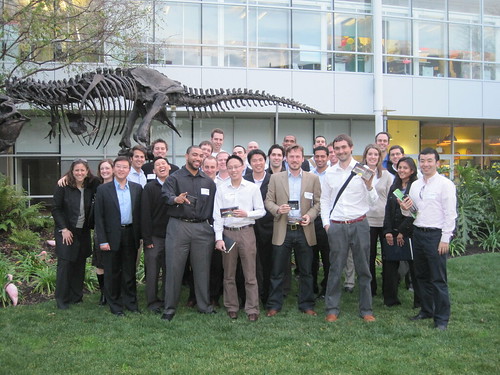
Last Friday, a group of 50 Haas MBA students visited the Googleplex. During the 3-hour afternoon visit, we had an enjoyable tour of the campus, and engaged a panel of Googlers (many of them Haas alums!) from various products and functions in a lively round of discussions. A big shout-out for my classmate and former Googler Lauren Gellman for organizing this spectacular trip!

Haas MBA Google Trek 2010

Besides having a great time talking with the Googlers, I was also lucky enough to win one of the 5 Droids handed out in a surprise lottery (you can see the winners showing off their gear in the photo). The phone, targeted for developers, comes with a one-month free trial from Verizon, as well as a nice discount for a 1 year or 2 year contract.

This is the first Android handset I have used, having been a loyal iPhone user since January 2009. There are things I immediately like about the phone, and it really is almost a completely different experience from the iPhone. I know there are plenty of Droid reviews out there (since this device has been out for a quarter now), but here are some of my first impressions:

  • Great support for Google products – really, no surprises here. The turn-by-turn navigation, a coveted app by many, could well be one of the killer apps for this device. (I am curious how well that works on the road, especially in areas with patchy reception – this was a key differentiation point Nokia was trying to emphasize for its Ovi Maps, where the maps are stored locally and require less data transmission – and therefore less dependence on reception – on the go.) And of course the Google Voice app is great, but it does make you wonder how Verizon feels about it.
  • Background apps – Pandora while surfing? No problem. However, it’s not apparent what apps are running in the background, which could both be a drain on your battery and also a potential nuisance – I realized I was always on Google Chat, even though that wasn’t my intention.
  • Poor support for business users. This is not a phone ready for corporate America. It supports Microsoft Exchange, but apparently the “corporate email” app doesn’t support search. That’s right. No inbox searching. That alone is enough for me to hold on to my iPhone. (I could, in theory, forward all my emails to Gmail, but I’m sure there are plenty of users like me out there who prefer to keep their work-email and gmail separate)
  • Very slow charging on USB? I have a habit of carrying only the USB cord, and not the adapter, for my iPhone. For some reason, the Droid charges at a very slow pace via USB – something like 15% an hour, which is not satisfactory.
  • The physical keyboard is redundant. Yes. I’ve gotten used to typing on virtual keyboards. Having to actually push down feels painful, and there is no auto-correct. In this regard I’d probably like the Nexus One a lot better.
  • App market. Good number of apps already, most of the web2.0 services are present, but much less presence of old-school stuff – e.g. WSJ, FT, NYTimes etc.

Reading through the points above, it’s interesting to note how many of them are talking about consumers’ habits. For example the point about the keyboard – if I came from the blackberry world I probably would love the physical keyboard (remember all those people who hated the virtual keyboard on the iPhone when it first launched?), but I’ve grown accustomed to virtual keyboards. Same for the email search – my work-around would solve the problem, but it is asking me to change my behavior, so I have a strong distaste for it.

One final point – I want to comment on how fundamentally different the Droid is from the iPhone. I felt it was a phone for geeks and engineers. The UI was less polished, but there was much more that the user could customize (menus, widgets etc…) You need to spend time to play around with it. The iPhone, on the other hand, is a device ready for mass adoption. It’s frustrating for geeks who want to do all kinds of things (but can’t), but perfect for everyday users who can just use it intuitively. Very different philosophies, and therefore potentially a sharp divergence in consumer segments going forward.

The Strategic Implications of Chrome OS

Excuse me for the grand title, but I’ve been writing too many marketing papers recently…

Google held a press release for Chrome OS today. All the major tech blog properties are covering it. Just check out the first page on techmeme and you’ll get a good rundown of all the discussions going on.

What I’d like to talk about is how Chrome OS might impact the computing market. Google has taken a page from Apple’s playbook by deciding that Chrome OS will be available only pre-shipped with certain devices (netbooks, at this point), as opposed to being an OS that you can get and install on whatever machine you have.

This is actually a big deal. By doing so, Google is moving away from the traditional PC hardware / software paradigm and moving towards a model more typically found in other consumer electronics – the future Chrome OS devices will be more similar to your TV or other home appliances than to your laptop or desktop, in that its feature-set is pre-defined and not customizable (unless you are a hacker). It will be a simple, straight-forward user experience – when you boot it up, all it shows will be the Chrome browser window.

Commentators are divided over the OS, but the differences really are due to very different vantage points. The infoworld article boldly titled “why Chrome OS will fail – big time” focuses on how Chrome OS is not a substitute for Windows or Mac, and thus claims it fails. Robert Scoble on the other hand focuses on how Chrome OS is really about low cost supplemental access to the web, and a competition over web standards and tools – HTML5 vs. proprietary frameworks like Flash or Silverlight.

My concern with Chrome OS is really about the bigger picture of netbooks – having never bought one myself (though quite tempted at one point when the EeePC first came out), I am still not a big believer. Netbooks are a niche category on a rapidly converging field, squeezed between ever-more powerful smartphones one the one end and laptops on the other. In one sense there’s a definite value proposition for it – a $100-200 device that you can just boot up and google a recipe while you’re cooking, or just do some casual browsing while you’re on the couch does have some marginal benefit, but the emphasis here is really on “marginal”.

For Chrome OS and netbooks to succeed, Google is really betting on a couple of big industry trends. One is that HTML5 adoption will be smooth and major web properties will convert to it, instead of running on proprietary platforms such as Adobe Flash or Microsoft Silverlight. Of course in this aspect Google does have some control, since it owns Youtube, so at least it can ensure that the biggest video site on the web will be compatible.

The second big trend is the wide-spread availability of wi-fi, since the device is Internet only. Google and its hardware partners can opt for 3G capabilities, but that’s a harder sell because of the additional telecom fees. In one sense, wi-fi is pretty widely available, but it’s far from ubiquitous, and while the device will still sell, people will talk about it less if they don’t use it on the go that conveniently. To a certain extent, this point is more of a technical issue, but Google and friends will have to come up with some solutions to make the device more usable.

In sum, Chrome OS is perhaps just the beginning of the future – a future where every device is a thin client to access the web and everything is stored in the cloud. It may be too early for its own good. Only time will tell.