2025 year in review

Previous yearly reviews: 2024, 20232022, 202120202019201820172015.

This is my 10th year-in-review post – I just feel old writing that. Anyway, let’s talk about some themes of the year.

AI accelerates

Skip to the next section if you are tired of talk of AI; but for me, AI’s continued advancements remained the biggest topic. This was something that I experienced and felt first-hand. Early in the year, I dabbled in vibe-coding and did some small demos in office to spread awareness; at the time, professional programmers’ response was generally “this is cute, but not ready for real game-dev work.” (I was happy that they did start tinkering.) Fast forward to December, the most aggressive adopters’ mindset has already shifted to “I’m not writing any code anymore; how do I effectively manage many AI agents?”

It’s clearer than ever that we are in the beginning phases of an asymmetrical revolution to how all software (including games) is developed. Despite the current lack of mature tooling (and best practices / workflow know-how), we can already confidently predict that it will be far easier to scale AI agents than to hire and manage a large corp of developers. Each human programmer is now theoretically capable of performing as an engineering manager, managing a team of AI devs. And these AI devs will be working 24/7.

This revolution is and will continue to be controversial. Not all programmers want to be managers; many will continue to cherish handwriting code. Soft-skill attributes such as curiosity and bias for change will determine who survives (and thrives in) this turmoil. Quite possibly a lot of jobs will be gone. I’m not taking a moral stance here, but rather making a simple economics-based prediction: we won’t (and can’t, really) put the AI genie back into the bottle.1

Back to the practical implications. When I wrote “asymmetrical” earlier, what I meant is that many things that we previously considered as competitive advantages are going to be flipped upside down:

  • The organizational capability to hire and manage large dev teams is a questionable asset now. Smaller teams have far less human communications (and alignment) overhead, and can drastically scale up production capacity with AI.
  • Similarly, prior investments in optimizing human efficiency (in the old dev workflow) are also possibly rapidly depreciating in value. For example, game engine editor features / tooling that made it easier for manual editing (and enhanced productivity previously) could now be impediments to a full AI workflow (since they may be less AI-friendly to direct data manipulation).

It will still be years before the dust settles on the new software development paradigm; 2026 will be a busy year. At the same time, we are also seeing a brewing consumer backlash. I feel it’s partly a continuation of existing cultural wars (just a new battlefront), though this is clearly a tricky issue for developers to navigate. It’s also interesting how sentiment on this differs by country. There will likely be further conflict/drama before a realignment.

The market stagnates

Last year I spent some time sharing an analysis on the mobile games market. I was going to post updated macro charts (I already populated the data from Sensor Tower), but really the lines for market consolidation barely moved. Meanwhile, we have to put an even bigger caveat on not over-interpreting this data due to the growing fog of war: Apple and Google’s share of spending is rapidly decreasing thanks to factors like web-stores (DTC) and the Chinese mini-app platform.

With that said, let’s take a look at the top of the charts:

Rank2024Revenue Growth %2025Revenue Growth %
1MONOPOLY GO!93%Last War: Survival36%
2Honor of Kings-9%Whiteout Survival44%
3Royal Match48%Royal Match-6%
4Roblox20%MONOPOLY GO!-21%
5Last War: Survival7535%Honor of Kings5%
6Candy Crush Saga-7%Candy Crush Saga0%
7Whiteout Survival249%Coin Master2%
8Coin Master-4%Roblox-42%
9Dungeon Fighter Mobile3191%Peacekeeper Elite9%
10Peacekeeper Elite-6%Pokémon TCG Pocket137%
  • Illustrating the fog-of-war issue I just mentioned, Roblox mobile revenue did not decrease by 42%, but rather, they likely executed a successful shift to their own payment channels
  • The Chinese 4x (or SLG, as Chinese devs would call them) games continued to scale up, all the way to the top of the charts
  • 9 out of the 10 titles are the same, with the only change being Dungeon Fighter Mobile (its decline unsurprising, in hindsight) replaced by Pokemon TCG Pocket

The market continues to be difficult for games to break out. Scanning the top 100, we have the following 11 new entrants (as in, appearing in the top 100 for the first time):

  • Gossip Harbor (no. 11) – an “old” game released mid-2022, but having a breakout year scaling up with 239% revenue growth, 137% downloads growth, and 198% DAU growth
  • Kingshot (no. 15) – another Chinese 4x, globally released in 2025
  • Delta Force (no. 28), globally released in 2025
  • Last Z: Survival Shooter (no. 29), globally released mid-2024, scaling up in 2025
  • Royal Kingdom (no. 31) – globally released late 2024, so 2025 is its first full calendar year
  • Dark War: Survival (no. 39) – guess the genre and which country this is from? Globally released mid 2024, revenue grew 840% in 2025
  • Archero 2 (no. 67). Globally released Jan 2025
  • Color Block Jam (no. 73). Globally released mid 2024, scaling up in 2025
  • Disney Solitaire (no. 84). Globally released Apr 2025
  • Seven Knights: Re:BIRTH (no. 87). Squad RPG, globally released Sep 2025
  • Where Winds Meet (no. 94). Chinese MMORPG, globally released 2025

7 of the above 11 are from Chinese devs; 1 Korean; the rest are all casual genre from the west. Similar trend as last year.

A few other worthy callouts – not new entrants to the top 100, but impressive growth (>50% revenue growth) in 2025:

  • Clash Royale (no. 13, 152%)
  • TopHeroes (no. 41, 135%)
  • Seaside Escape: Merge & Story (no. 49, 67%)
  • Wuthering Waves (no. 56, 56%)
  • CookieRun: Kingdom (no. 82, 83%)

Game devs, what is your China strategy?

(This could have been its own post, but I got lazy.) With the increasing dominance of Chinese devs, it’s worth being a bit provocative towards game devs elsewhere: do you have a China strategy, from the following perspectives?

  • China as a market opportunity – is this something you care about? I’m very opinionated here. On mobile, I remain bearish for the “average” foreign studio. The regulatory barriers to entry remain very high (only 95 licenses granted to foreign games in 2025, compared to 1,676 domestic), while the home turf competition is astronomical. It’s a hugely lucrative market for the winners, but it’s arguably not even worth the effort for the rest. Steam is a whole other story, but we should remain vigilant about the continued legal uncertainty
  • Chinese talent. Chinese devs have accumulated strong know-how in specific genres and mobile. Is this capability of relevance to you? If yes – unlocking it is not straightforward (build/buy/partner?), but perhaps worth a deeper investigation.
  • Chinese games going global – from a defensive perspective, how are you stopping them from taking your lunch? Or stated neutrally, what do we think the stable equilibrium will be of Chinese games’ market share in western markets? Will this play out more like the film industry (where Hollywood productions collectively dominate the box office everywhere, aside from a few specific markets), or the auto industry (with a lot more geo-market share variance, associated with regulatory protections)? A common critique I hear is that Chinese devs still don’t have the cultural taste for the west – how strong is your conviction that they will never acquire this (or, can they acquire it faster than you can catch up in capacity deficits elsewhere)?

Personal bits

I didn’t play a lot of new games in 2025. I remember spending a lot of time on Hades II while it was still in early access, but ironically I still haven’t experienced the ending since its 1.0 release. In December I jumped on the extraction shooter train, but no, not Tarkov or Arc Raiders, but rather Escape from Duckov, the PC game made by a tiny Chinese team. It is very good, especially the first 20 hours. It’s clear the devs took to heart key design principles from not only Tarkov, but also games like Dark Souls and Diablo, and fused them together in a truly addictive package with a whimsical (and smart – as in cheap to produce) art style. And on mobile, more than anything I played a lot of Merge Tactics in Clash Royale. (It’s great to see the former Clash Mini team take another swing at mobile auto-chess.)

During the summer I started binging The Expanse. First the TV series, then the books – all of them. One thing that left a strong impression was how I felt the writing noticeably improved after the first book. Perhaps it’s just a subjective feeling, or, this is a good example of craft growth.

I kept up decent active habits (for my standard), averaging 10,882 steps per day which was a small 2.5% increase over 2024 (10,608). I kept up sports climbing, continuing at a fairly beginner level but somehow managing to sustain some over-use injury on my fingers (so I’m taking a few weeks rest currently).

  1. I’m not endorsing a laissez-faire position either: sensible (consumer-oriented) regulation of AI is needed, similar to how there is growing appreciation for regulating social media.

“Breakneck”, Setbacks, and 996: What the West Should (and Shouldn’t) Learn from China

A truck carrying dozens of shared bikes along a Shanghai street already full of bikes

There’s been a bunch of discrete but interconnected topics that have been on my mind, and I wanted to attempt to write a post that strings my thoughts on them together. And as a teaser, I promise to explain the meaning of this caption photo below!

Breakneck

First, let’s start with some quick commentary about the book  Breakneck: China’s Quest to Engineer the Future by Dan Wang. Dan has a knack for presenting his observations on China via engaging and (often) moving prose. I first learnt of him through his annual letters, and this book is, in his own words, a series of annual letters packaged together. To quote Dan:

The simplest idea I present is that China is an engineering state, which brings a sledgehammer to problems both physical and social, in contrast with America’s lawyerly society, which brings a gavel to block almost everything, good and bad.

Through this lens, the book presents a narrative for the rapid transformation and modernization of China, against the relative stagnancy (or decline?) of the U.S. And as a “subplot”, the book looks at one of the costs of the U.S. offshoring of manufacturing, which is the loss of process know-how in skilled labor: using cooking as a metaphor, you may have the raw ingredients (the capital and resources), the recipe (the IP), but you cannot cook the meal to a high quality unless you have the experience and training as a chef. And what’s worse, the lack of such know-how also prohibits process (and eventually, product) innovation. Fast forward to the present, this is why China is now in the lead in areas like infrastructure, EVs and renewable energy, and thus well-positioned for the AI age.

I’m not here to give a long critique of these ideas – I recommend you to read the book and form your own opinions. At the very least, you’ll probably become a lot more knowledgeable about China1. I think it is useful and explains lots of phenomena, but like many ideas presented in business books, it probably suffers from overfitting and over-generalization. I do think the book is well-timed, as the West – with America at the center – is undergoing a phase of decline in its democratic institutions, a reshuffle of industries and jobs due to globalization, and a form of cultural wars in many areas of society. China is often looked at as a contrast, as it seems to be doing better in many aspects. (For a deeper probe on this contrast, I highly recommend this new essay by Kaiser Kuo – The Great Reckoning: What the West Should Learn from China.)

Western game devs’ setbacks

With Breakneck as reference, let’s now talk video games. Western game development, especially U.S. game development, is noticeably going through a contraction after a frothy COVID bubble. There are many reasons for this – frothy VC capital allocation, a corresponding startup bubble, and misguided expansion strategies at many large game companies, to name a few. But it is tempting to also look at the sector as (yet) another example where the advantages have (gradually, then suddenly) shifted to the Chinese ecosystem; indeed, you can argue that’s been a long-term thesis on this very blog.

In recent months, we’ve seen a wave of high-profile Western gaming startups announce closures or have products “flop” in the market. This is both due to a funding crunch by VCs who’ve flocked away from their brief infatuation with gaming, and developers who’ve misjudged their runway and (grossly) overestimated their chances of success with their first releases. The old-fashioned way of iterating through smaller successes2 is in conflict with the VC model, at least given the sums raised (in some cases, with only a powerpoint deck). Founders also seem to have forgotten even some of the biggest venture-backed successes of the 2010s, for example Riot and Supercell, had typical crisis moments (and pivots) in their early years.

Some of the studios who have shuttered can blame a bit more on bad timing. They started towards the end of the bubble, and therefore received smaller amounts in backing. Having only been around for about 2 years with little hope to extend their runway, these studios would have some merit in saying they didn’t have enough time to ship something. But “enough time” is relative; “work expands to fill the time available”, and we are now witnessing a cold demonstration of this law in reverse.

996 is not the answer

996 is an idea that China is already rejecting; curiously, the West is now looking at it as one path to salvation. I can’t help but share some thoughts here.

For one thing, it’s arguable how effective mandatory overtime like 996 ever really was. I’ve worked 80-hour weeks before, and I’ve also seen 996 in action at some large Chinese game studios. There is a lot of slack in those supposedly 12-hour workdays, because workers figure out all sorts of ways to relax (otherwise they will quickly burn out). A real 12-hour day thus could look something like this:

  • day starts at 9:30 – 10am (or even later, depending on how late the team worked the previous day)
  • 11:30am – lunch time, followed by official nap-time til 2pm (lights are turned off in the whole office)
  • 2 – 6pm afternoon work time
  • 6-7pm dinner and break
  • 7pm – however late: depends on how much pressure the team is under

Now, there are famous cases where teams worked around-the-clock and delivered big successes – PUBG Mobile was shipped in just a few months, and their daily playtest often happened around midnight. But the graveyard is also full of games where teams hustled just as hard to no result. Partly as a result, attitudes have been shifting. Nowadays, 996 is increasingly being rejected by the younger generation entering the workforce – I recently even visited a startup in Shanghai where their official policy is a 4-day week.

Secondly, working long hours isn’t a foreign concept anywhere. Back when I was a fresh grad, consulting and investment banking were often the most sought-after jobs, and those were often celebrated as 80-hour-week careers. It seems that 996 is just the latest exotic phrase borrowed by Silicon Valley to advance its hustle-culture. There’s some irony in how we seem to have gone full-circle: before tech became the most sexy jobs for young college grads, consulting & i-banking glamorized “work hard, play hard”; then Google popularized the cushy office perks in the talent wars, which eventually bred entitlement and complacency; and now comes 996 to save the day…

Be curious about China, but look deeper

I don’t think it’s a bad thing that China is now often looked at with a mix of envy and fear from the West. In some ways, this is a begrudging (and belated) sign of respect. And perhaps in a unfashionably cosmopolitan perspective, free competition, and learning from each other, is how progress for all of us will accelerate.

But I would certainly caution against looking at China and taking away superficial lessons (like 996), or magical-thinking style narratives. Take the caption photo for example. Shared bikes are common enough in many parts of the world these days. And arguably it’s one of the first widespread examples of the West importing a Chinese innovation. But uniquely, China seems to have the worst of it when it comes to waste with shared bikes. They are undoubtably over-supplied, and clog up valuable side-walk real-estate3. There’s little sign of progress a decade after their initial appearance, and the market has gone stagnant with entrenched vendors.

“Brute force” is an apt (and often used) description for how problems are solved in China. In the above example, it’s also how negative externalities are created. I see similar phenomena in the local games industry. Borrowing a meme – for questions like “what live-ops tools do we need in our game?” or “which of these features should we build?”, the Chinese dev team’s answer is (too) often simply “yes.” Take the recent gameplay trailer for Ananta from Netease:

The game is incredibly ambitious, looks great already, and apparently was quite a sensation at this year’s TGS. But it also seems that the devs have a “brute-force” approach to content and mechanics, which creates unrealistic expectations (the Youtube comments are hilarious), and may well crush the game under its own weight. Sorry if I sound too negative – but if I’m promised “Everything: the Game”, the odds are I’ll be disappointed…

There are teams moving in the opposite direction. Young people leaving prestigious big studios to make smaller-scope (e.g. PC single-player) games; incubators that cater to such inexperienced new teams are also appearing. I feel Chinese developers have often admired the western indie scene for its creativity (and purity in goals); perhaps we will see a Chinese indie flourish soon.

  1. This assumes you are a “Western audience.”
  2. Blizzard started out doing porting contracts in the 90s; it was only with the 3rd iteration of The Witcher that CDPR became a household name with gamers. For a Chinese example, Genshin was miHoYo’s 5th game, shipped in the 9th year after the company’s founding.
  3. I suspect the road where I took the photo, which is not a busy foot-traffic street, is used as a dumping ground to reallocate bikes.

Shooters: Tencent Hits, Lilith Misses

Tencent announced its 2025 Q2 results this week, and one game it has consecutively mentioned is Delta Force: monthly average DAU exceeded 20 million in July, versus 12 million in April (both China domestic figures).

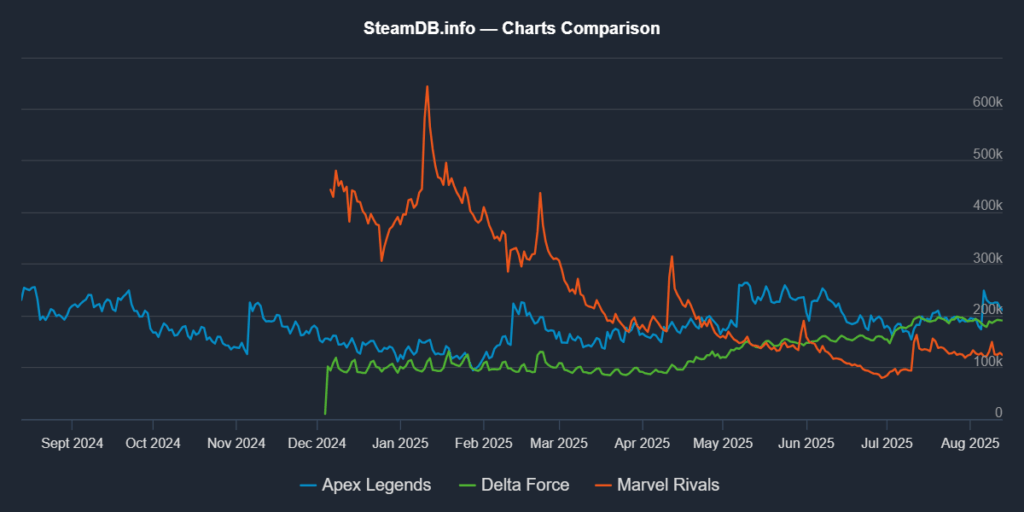
Elsewhere on Steam, Delta Force has slowly but steadily gained on Marvel Rivals since both games launched last December, and is now neck and neck with Apex Legends.

It’s safe to say that Tencent, and specifically TiMi’s J3 Studio (also marketed as Team Jade?), has found the recipe for success in the HD shooter space globally. This capability was not built up overnight. J3 has been making shooters for a long time – Nizhan (PC, UE3) back in 2012; Crossfire Mobile (Unity) in 2015; one of Tencent’s 2 competing PUBG Mobile games in 2018 (the losing one which was shut-down, UE4); Call of Duty Mobile (Unity) in 2019; and finally Delta Force (cross-platform, Unreal).

One thing I heard recently is that J3 got some code access to Call of Duty during the development of CODM. This was cited as a factor that helped them improve their ability in making the gunplay feel good. Whether this anecdote is truth or fiction, J3 devs definitely would have had some amount of discussion and interaction with veteran Call of Duty devs, and it would have likely enhanced their domain expertise.

In contrast, Lilith Games’ Farlight 84 finally launched in China (also cross-platform, Unreal). Local media widely talked about its 6-year dev cycle and “1 billion RMB” budget (~$150M). Unfortunately the game is quickly dropping in the charts. I’ve been surprised that Lilith stuck with this game for so long, given its lack of market resonance from its previous launch outside of China.

A long-running theme of this blog is Chinese devs’ steady expansion in the global games market. They started with mobile leapfrogging, back in the early-mid 2010s, and first in China and then globally. But they were never going to be confined to the mobile platform. They are now knocking on the doors of the core HD genres – often referred to as “cars, guns and balls” (“车枪球”) locally. The contrasting outlooks of Delta Force and Farlight 84 show that the technical barrier to entry remains high, but some teams are getting through.

Book review: Play Nice (2024)

pages on an opened book

Play Nice: The Rise, Fall, and Future Of Blizzard Entertainment – I finally got around to finishing Jason Schreier’s account that spans the 3+ decades of the storied company. I was left with a variety of feelings, loosely captured below.

A trip down memory lane

I have to start with my relationship with Blizzard as a player. As someone born in the 80s and who spent my teens in the mid-to-late 90s in Beijing, I first fell in love with Blizzard through shareware versions of their games that floated around on pirated CDs (or even floppy disks). I still remember playing the shareware versions of The Lost VikingsBlackthorneand the original Warcraft. (I was particularly charmed by The Lost Vikings – even the shareware version’s few levels I played several times over.)

Later on, I first saw Diablo (the shareware version) at a friend’s house. His PC had a sound card and a couple of speakers. As we descended Tristram against the drums of the deeply atmospheric soundtrack, I still remember the visceral feedback of every mouse click against a zombie. That was the magical moment that cemented Blizzard as a QUALITY brand for me.

Starcraft took that fandom even higher. It remains my favorite Blizzard franchise, and contains the most childhood memories. I played StarCraft and Brood War a lot with my friends, even though we never really got past beginner levels of mastery. (I partially rectified this 10 years later, as business school overlapped with Starcraft II – I mained Protoss and 4-gated my way to Diamond.) I played Warcraft III but didn’t like its smaller scale and much more tactical combat; I did get hooked on that DotA map and that almost impacted my college diploma.

The ambitious scope of the book means that any particular episode of Blizzard’s journey could not be covered in sufficient depth. I felt the book flew through the 90s and Blizzard’s first 10 years – my favorite decade of the company. I was a bit disappointed by this, but it’s an understandable trade-off. As a side note – I would heartily recommend Stay Awhile and Listen books 1 & 2 by David Craddock, which covers the making of Diablo and its sequel. (I briefly wrote about book 1 back in 2013 – with an anecdote about my legal copy of Diablo.) These 2 books focuses more on Condor / Blizzard North, but there’s still an excellent picture of those early days of Blizzard.

Scaling under different owners: Davidson, Vivendi, Activision and Microsoft

One of the remarkable things about Blizzard is how its identity (and core talent) stayed intact despite the number of times it was sold. The owners list above actually skips over a few transactions in the late 90s: Davidson & Associates was acquired by CUC, which through a merger became Cendant; a subsequent major accounting scandal led to the division that included Blizzard being sold to a French company called Havas (which had just been acquired by Vivendi).

The studio’s track record since founding through the first few expansions of World of Warcraft obviously helped – don’t kill the goose that laid golden eggs, after all. Blizzard veterans, with Morhaime at the helm, eventually lost the fight to remain operationally autonomous in the Activision era, but they had a long run.

I never got into WoW.1 So in the mid 2000s, I was oblivious to how much WoW transformed Blizzard as a company, for better and worse. Play Nice does a solid job capturing this chaotic and lucrative transformation. From an archived New York Times article back in 2006:

Since the game’s introduction in November 2004 the company has expanded to more than 1,800 employees from around 400. Almost all of the additions have been customer-service representatives to handle World of Warcraft players, helping them with both technical advice and billing concerns.

This rapid scaling of full-time player support staff stands in contrast to another tidbit from the book – Kotick questioning why Blizzard wouldn’t scale up the WoW team to achieve an annual cadence (or even create multiple teams to work on future expansions in parallel – such a strategy had great success on Call of Duty). However even to the end of Kotick’s own tenure, he wasn’t able to realize this vision. The book doesn’t provide a comprehensive discussion of why Blizzard did not buy into this vision – it seemed to be a mix of feasibility challenges (”this is not possible”) and misalignment in goals (”why do we need to grow even bigger”). Unsurprisingly, such a rift between the stakeholder and the team will eventually result in a shakeup.

“Suits” vs creatives

This might be a central theme of the book: the fraught relationship between the business “suits” and the creatives. This is not unique to Blizzard or the games industry, and it’s not just Activision vs Blizzard or Kotick vs Morhaime. (The book features a few examples where a project was canceled by Blizzard execs to the shock and surprise of the team.)

The stakeholder – team relationship is never easy to navigate, because at the core it’s about flawed humans, their predictably irrational decisions, and that finicky thing called trust which holds the relationship together. There are no principles that work in every situation. The stakeholder could argue for one thing in one context, and the complete opposite in another. For example, a common conflict is in the team wanting more time or money, and the stakeholder questioning that – in more recent years, Blizzard’s project delays were certainly causing such ire with Activision; at the same time, the fun examples in Play Nice were the opposite, where a team (WoW team above, and later the Overwatchteam) pushed back against the stakeholder’s push for headcount growth.

The book leans towards the creatives and implicitly casts Kotick and his army of consumer-packaged-goods lieutenants as the villains who eventually took the knife to the golden goose. In an alternative book centered on Activision, perhaps they’d be the *Moneyball-*like heroes who figured out the hack to sustainable growth in a hits-driven business. If my stance here sounds wishy-washy, it’s because while my heart is with the creatives, I feel it’s imperative to be on the same page with the stakeholder on strategy. If you as the creative cannot convince them of a better path, you’d better full-heartedly commit to their path. “Misalignment” is one ominous word that you don’t want to hear your stakeholder utter.

Titan and the pitfall of abundance

One last ramble – the story of Titan is a familiar cautionary tale about the necessity of constraints. It sounded like a perfect storm of a team awash with the abundance provided by WoW coupled with boundless ambition. In such a combination, years can go by with little to show for it. There is sort of a redemption with Overwatch, but it seems the team later committed a similar sin of over-scoped ambitions with Overwatch 2. This is a familiar tale, and it happened (repeatedly?) too at Riot’s campus, only a 2-hour drive north from Blizzard.

Hearthstone provides the counter-example of how modest beginnings can grow into billion-dollar games. (Ben Brode has often told the story of how the best thing to happen to the project was when most of the team was pulled off to fight fires elsewhere. The skeleton crew left made remarkable progress through various scrappy means.) Linking back to the stakeholder thread above, a tightly-scoped project has a lot going for it – smaller initial budget, shorter timeline, and earlier results to make follow-on decisions on. It has one major detriment – it can be perceived as “not ambitious”, and not worth the company’s time (even though the team is not asking a lot!). And so it requires belief from the stakeholder that such small bets can create outlier successes, and skillful upwards management from the team to keep that belief firm.

  1. Until much, much later out of professional interest (I played Warlords of Draenor with coworkers at Riot).

2024 year in review

white rocket

Previous yearly reviews: 20232022202120202019201820172015.

Industry stuff

Some shifts in mobile

I recently did some quick analyses using Sensor Tower data, and found a few surprising bits worth discussing here.

Some caveats to all statements in this section first, mostly noting the limitations of Sensor Tower:

  • These are 3rd party estimates for App Store and Google Play, usual grains of salt apply
  • No China Android or WeChat mini-games coverage, so the data heavily discounts games that primarily serve China
  • Similarly, ad revenue, webstore revenue, and cross-platform revenue are not captured

What I did was mostly scrutinizing the top 100 games (ranked by combined revenue estimates across Apple and Google), and I ended up going back several years to see trends. Let’s first look at the top 10 for 2024 (I’m not showing the revenue numbers as I’m unsure of Sensor Tower’s confidentiality policy):

RankGameRevenue Growth %
1MONOPOLY GO!93%
2Honor of Kings-9%
3Royal Match48%
4Roblox20%
5Last War: Survival7535%
6Candy Crush Saga-7%
7Whiteout Survival249%
8Coin Master-4%
9Dungeon Fighter Mobile3191%
10Peacekeeper Elite-6%

MONOPOLY GO!, Last War: Survival and Whiteout Survival were all globally released in 2023; Dungeon Fighter Mobileis also a “new” game, thanks to its massive China release this year. Their rankings prove there are some desirable volatility (and vibrancy?) at the very top of the mobile market, and the best-in-class games can still scale up tremendously in a matter of months.

2024 is also the first year where all of the top 10 games grossed over $1B1 across Apple and Google. Even in the peak pandemic year of 2021, the top 10 games didn’t achieve this. So the biggest games are getting even bigger, and pulling ahead of the market:

On the chart above, there’s a clear 2-part story: from 2014 to 2019, the total market grew much bigger every year, while the 10 biggest games quickly hit a mature scale and remained flat; and from 2020 to 2024, the market got a pandemic bump but has since stayed relatively flat, while the 10 biggest games have gotten bigger.

Another way to look at this story is from the market share (of spending) trends over the same period:

In terms of “consolidation” or concentration of wealth, the industry is actually still more equalitarian than the early years of 2014-16, but indeed, there’s been a gradual upwards tick in consolidation since 2020.

Back to 2024 – it’s also worth noting the growth of somewhat “old” games such as Royal MatchBrawl Stars (rank 11, revenue growth 483%), and Fight for the Golden Spatula (rank 20, revenue growth 46%). Scaling live-ops remains an arms race with never-ending mastery, it seems.

Scanning the rest of the rankings – and this was not an exhaustive exercise, so I certainly could have missed some games – I found the following “new” games (released in 2023 or 2024) that broke into the top 100 for the first time:

RankGame
25Legend of Mushroom
32Love and Deepspace
34Pokemon TCG Pocket
58Match Factory!
59Zenless Zone Zero
71AFK Journey
82BangBang Survivor
90Wuthering Waves
923 Kingdoms: MouDingTianXia
99Solo Leveling: Arise

With the exception of Match Factory!, all the other games above were by Chinese (7), Japanese (1) or Korean (1) developers. This reflects the asymmetrical realities of the ecosystem: China, Japan and Korea are 3 out of the top 4 biggest markets worldwide, and homegrown developers enjoy various natural and artificial barriers to entry. Meanwhile, Chinese developers have long established beachheads in various global markets (including the difficult Japanese and Korean markets). The combined effect is Chinese developers’ over-representation in the rankings.

I think it’s also not crazy to say Zenless Zone Zero and AFK Journey, while featuring excellent production quality, have probably not lived up to the developers’ expectations. Or at least, they are living in the shadows of their respective prior games:

I removed the revenue labels from the charts above – but the shapes and proportions still tell the a clear story. I think this is a soul-searching moment for Chinese developers – even the likes of miHoYo and Lilith. The post-Genshin era of production-quality “involution” (卷) has clearly hit the wall of diminishing returns.

I’ll end this bit with a quick summary of the “bar” in 2024:

  • To be a top 10 mobile game globally, you need to be over $1B gross revenue/year (to be in consideration)
  • Top 20: >$500M (ballpark)
  • Top 50: >$250M (ballpark)

Chinese devs make further inroads on PC

Black Myth: Wukong is the obvious title behind the headline here, and I don’t have much to add to my original review. There’s some disappointing (if not surprising) brouhaha online over it not winning GOTY at The Game Awards, which I feel is a waste of time to get into.

We should also talk about Marvel Rivals and Delta Force:

I think both are doing reasonably well – but the head-to-head Steam comparison is a tad misleading, as there’s a significant difference in the two games’ China distribution strategy: Marvel Rivals pushes Chinese players also to Steam and Epic Game Store (same as global), while Delta Force actively pushes the Chinese playerbase to Tencent’s own platforms. As a result, Gamalytic estimates the Chinese player share of the two at ~45% and ~15% respectively. Take that out, and Marvel Rivals is still clearly the more popular game, but the gap narrows a lot.

In the final days of December, Netease also released in China to PC Where Winds Meet, its AAA wuxia open-world RPG. This was after a 6-month delay of a summer release date. It already has 3M downloads; the mobile versions are launching January 9th 2025. I guess I should play it soon…

Taking a step back – the bigger picture here is the “big devs” in China are fully committed to the “cross-platform” arms-race. This is motivated by the hunger for incremental growth and profit in a maturing sector. Having struck gold in mobile, these teams are now eyeing the other half of the global games business (PC+console). There are some rookie mistakes being made – that’s the price of admission. But let’s see where things are in 5 years.

Work stuff

2024 was a great year to work at Supercell. Brawl Stars was a rocket ship, and even though I had 0 contribution, it was still great to cheer them on. And it was reassuring to hear the team talk about the role of luck; otherwise I’d be worried about potentially learning the wrong lessons from success.

In Shanghai, Project R.I.S.E was announced and the team has already conducted a couple of low-key playtests. (The next test has also been just announced.) This is the team I work with the closest, and I’m happy to see how much the team has grown and evolved this year. Not without hiccups, and there always seem to be some fires to put out, but things feel they are headed in the right direction. I’m hopeful of some bigger milestones in 2025.

In the role I’ve had for the last 18 months or so, I no longer lead a game directly, so I’m definitely missing some of the thrills of “leading from the front”. But I get to have a lot more time to focus on coaching people and being a sounding board. I really enjoy it; and I daresay I’m not bad at it (thanks to decent perceptive skills and empathy). This would have been difficult to imagine for me 15 years ago – the introvert back then would much rather scrutinize data than talk to people.

Personal stuff

I invested a bit more into health in 2024, in a very low intensity way. I averaged 10.6k steps per day in 2024, a 14% increase over the 9.3k of 2023. Shanghai life is conducive to walking – getting off the subway 1 station in advance is an easy way to get an extra 1-2k steps. I also made some progress in my bouldering, though my son is advancing at a much higher rate.

“Consumption downgrade” has been a buzzword in China – people choosing cheaper alternatives, often driven by economic anxiety. I definitely experienced it in some small ways in 2024, even though financially I’ve been lucky to be quite steady. Instead of going to Starbucks (without even thinking about it), I go to Luckin and order the RMB9.9 weekly special discount. And once you accept 10-15 RMB as the “correct” price for coffee, it feels ridiculous to go to a Starbucks or Peet’s, unless you are specifically rewarding yourself (or it’s a business meeting).

Over the summer, the family did a 2-week roadtrip primarily across eastern Canada and a bit of Northeast US. Starting from Virginia, we went as far northeast as Quebec City, and had stops in Montreal, Thousand Lakes, Toronto and Niagara Falls. On the US side, we stopped by Ithaca, Skaneateles (a very nice, if very white, lake town), Lancaster county (Amish country) and finally Washington DC for a few days.

Media consumed

I’ve glad to report that I did finish The Republic for Which it Stands, which last year I said I was struggling with. Mid-year I read Project Hail Mary by Andy Weir, but I really didn’t like his prose (even though the plot and setting were imaginative). After a brief hiatus, I recently got back into my journey through US history, with Grand Expectations: The United States, 1945-1974. This book is written in a more digestible style.

Perhaps my only trip to the cinema in 2024 was for Alien: Romulus, which for some reason was spared any additional cuts by the Chinese censors. (And since China doesn’t have a ratings system, some comical events happened where ill-informed parents took their kids to this particular movie.) Anyhow, I enjoyed it (7/10), but I’m also a bit sad at the state of the franchise. Of the small number of films that I watched during the year, my favorite is The Fabelmans (2022). It’s a love letter to cinema, and nobody writes those better than Spielberg.

Helldivers 2 is probably my favorite new game of 2024 – its spiky game design oozes personality and the fantasies played out are just so different from what’s available elsewhere. It’s had a rocky year, after the launch glow faded and live-ops incidents soured the community. But it seems to have turned a corner at the end of the year. I’m rooting for them. I also continued to play many action roguelikes – for research! – and I found Hades II and Windblown both enjoyable (if quite early still). One mobile game that I’ve played a surprising amount of is Royal Kingdom – maybe I’m aging into the player segment? I’m currently at “end-game” and am always waiting for the devs to release new levels every 2 weeks.

Featured image by Pexels

  1. Sensor Tower estimates are net revenue (after platform fees) – I used a rule of thumb “divide by 70%” to get the gross.

Black Myth: Wukong (2024)

After spending 55 hours in Black Myth: Wukong (BMW below) for a first playthrough, I’ve finally gotten around to this write-up. At this time – 4 weeks since the game’s launch – a lot has been said already about the game from many different angles. So I won’t elaborate too much on areas where a lot of good analyses already exist.

What’s Black Myth: Wukong?

BMW is the first premium game title from Chinese developer Game Science, and the 3rd game the studio has shipped (the prior 2 being mobile free-to-play titles). The project took over 6 years, and the team eventually grew to about 140 people. Built with Unreal Engine 5, the action-RPG game boasts impressive visuals, and is deservedly hailed as the landmark first Chinese “AAA” game.1

It has sold over 18 million copies in 2 weeks and set the current record of 2.4M for highest concurrency in a single-player game on Steam (and 2nd highest ever of any game, only behind PUBG’s 3.2M back in 2018).

While the vast majority of sales are from China (estimated 80%), it’s still an impressive feat for a debut title to claim a few million copies sold from overseas at launch – as a simple comp, 2019’s acclaimed Sekiro (one of my favorite games eversold 2 million copies globally in its first 10 days. And BMW’s western community is steadily growing, with its subreddit crossing 300k subs (up from ~160k when I first started visiting in early September).

Game critique

I found the game’s 81 rating on Metacritic to be quite fair. I enjoyed my playthrough, and am certainly tempted to play more to chase all achievements; but I’m also well aware that my cultural affinity to the subject matter is playing a big part.

Visuals

“Uncompromising high-quality graphics” is reported to be one of the 5 key product principles of Game Science2 – and BMW faithfully realized this vision. Never before has Chinese fantasy been presented in such vivid and high-fidelity fashion in a video game (or arguably, any visual media), right from the flashy (and a tad over-exerted) opening scene with Wukong facing off Erlang and the 4 Heavenly Kings. Along the journey, there’s plenty of breathtaking and varied scenery,3 often painstakingly captured from real-life locations via 3d scanning tech. And there’s lots, and lots, and lots of unique enemies you’ll encounter, each intricately made.

The overall visual fidelity has not only captured the hearts of many gamers in China, but drawn great interest from the broader population. It’s not an exaggeration to say that the game has by itself shifted Chinese public perception towards games. (More on this later.)

Combat

If I score the graphics a 9/10 (the 1 point deducted for technical performance issues, even on beefy hardware), then combat gameplay would be a 7/10. The gameplay is fundamentally enjoyable, as the base structure of overcoming a difficult (but generally fair) boss-fight has been well-tested by Soulslikes and other action games. Players are offered plenty of complexity and choice in creating their builds, and there is execution depth with mechanics such as perfect dodge and attack combos (with some advanced parry combos). However, one common critique (link in Chinese) is the combat can get repetitive: enemies often have very lengthy (and very performative) move-sets, during which players have limited responses aside from spamming roll to dodge4; on the other hand, players’ offense is either the basic cycle of “spam light attacks to charge up heavy attack, then unleash fully-charged heavy attack”5, or, casting most of your spells in a short time window to burst the enemy down.

BMW tries to break this repetitiveness with the occasional hard-scripted behavior – certain enemies will always side-step a fully-charged heavy-attack, they are immune to certain spells, or one of their powerful abilities can be fully negated by one of the utility items you can equip. In the extreme cases of the final boss and the secret boss, this hard-scripting ventures into easter-egg territory, with lots of unique interactions – these two fights are thus highly theatrical and memorable, and the developers’ blood, sweat and tears are on full display in these moments.

One other grievance I have with the combat: at times, the game is clearly choosing to prioritize the performative (how the fight looks) over the actual experience (how it feels to play). Encounters with large enemies, or enemies in the sky, will often contain frustrating amounts of missed attacks and janky camera-work. These are known hard problems, and I’m unsure whether to praise the team’s courage or fault their stubbornness.

Level design

Level design is the sole area where BMW earns a fail grade (4/10) outright. The biggest problem is a lack of respect for any type of design consistency, leading to constant player confusion, and taking away enjoyment from exploration. For example: the game teaches players early on that they cannot fall off cliffs (and the player character will even play a specific balancing animation to show they’ve hit the edge); then in the 3rd chapter, fall damage is introduced, but it only exists in very specific areas. And then there are the infamous invisible walls – liberally used to block off inaccessible areas, but often contradicting the art visuals (open space or pathway that invites exploring).

Another issue is the lack of cohesion, or rather, the willingness to throw in one-off sequences that might be novel but don’t tie in well to the game’s overall flow. Early in Chapter 1, the player is transformed into a flying cicada, and is taught to scout ahead with this ability; this is never repeated in the rest of the game. In Chapter 5, there is a short platforming sequence where you have to dodge a roaming death-ball – mechanically highly similar to chariots from Elden Ring. And the entirety of Chapter 6 feels highly experimental, where player movement is completely upended. These are not bad ideas individually – though some clearly lack polish – but they feel out of place, and possibly are the vestiges of deeply-cut features.

General level design know-how is available in China – at least grasp of the theory, as evidenced from this lengthy level design critique from a local game developer (link in Chinese). I suspect in BMW’s case, the team suffered from both a lack of experience and an unwillingness to change the art to fit the gameplay. They liked how it looked, and with no time to find more elegant solutions, they spammed invisible walls.

Narrative design

I won’t dwell too much here, as I don’t have many insights to offer (and this is of the biggest areas of debate in the Chinese internet), but I think the game made a number of clever decisions to elevate the feel of the narrative (without actually delivering a very cohesive story). Using beloved characters from Journey to the West, the game skipped over laborious character-building while also tapping into affinity and nostalgia (especially for the 80s TV series). Also, by segmenting into 6 standalone chapters, the game makes players accept that there is little narrative continuity across chapters. At the end of each chapter, players are rewarded with a beautiful animation (each done in a different animation style, by talented studios the developers had partnered with) that provocatively echoes the theme and also serves as an intermission.

Greater than the sum of its parts

While I’ve called out above some deficiencies in the developers’ craftsmanship, an entertainment product is not measured by a simple sum of its parts. BMW has clearly captured the imagination of an entire country (and beyond), thanks to its overall quality. On this point I’m reminded of The Witcher 3a game that I personally found pedestrian in many aspects – save for its relentless dedication to storytelling at an open-world scale, and through that relentless drive it became one of the most beloved (and best-selling) RPGs of all-time.

Implications of BMW’s success

Moving on, let’s discuss the implications of the game’s success.

From a production standpoint, BMW is proof that Chinese developers has accumulated enough know-how to now effectively compete in the AAA space, long seen as the most prestigious (but not the most profitable) part of the industry. The sheer scale of the game is a feat, and a demonstration of Chinese developers’ openness to embrace production volume. “If the game’s not fun, just add more content” is wasteful and often not the answer, but here it is befitting the developers’ ambitions. Also, we should not overlook the role Unreal Engine played here, as the great leveler and enabler.6 Prestige studios such as Rockstar and Naughty Dog will still be at the bleeding edge with their proprietary tech, but scrappy upstarts can now punch above their weight thanks to Unreal raising the floor.

From a market perspective, the impressive sales figures are a validation of the PC premium games model in China (everything old is new again). Intuitively we always knew the audience was there – the yearly Steam MAU growth and Chinese language share data are in plain view – but until BMW definitely proved it, there was always room for doubt. One common analogy that’s been made: BMW to Chinese AAA is like Wolf Warrior / The Wandering Earth to the Chinese box office (and their respective genres) – it’s a validation of the China domestic market size and a validation of local production to win that market.

Having said this, I would be cautious to forecast an overnight change in the funding landscape for AAA games in China. For one thing, if we only talk about market size and ROI, mobile still dwarfs PC; for another, the size of the investment and the long development cycles mean there are few teams readily available, and likely fewer capable backers who can stomach the whole ride. Indeed, even with BMW and Game Science, their early investors Hero Games (invested in 2016, 60M RMB for 20% ownership) divested their stake in 2022 for 480M RMB.7

Last but not least, I also did want to mention that BMW is also a great illustration of the ambiguity of the regulatory landscape in China. By all accounts, the great majority of the game’s sales happened on Steam, which operates offshore in a grey-zone with spotty service availability in China. Case in point – the “game accelerator” (VPN services legally sold here, specifically to access games) I use to access Steam was promoting a BMW cloud-save feature to mitigate Steam Cloud sync failures (which I frequently encountered). Meanwhile, Tencent’s Wegame service was distributing the officially approved onshore version of the game, and as such has a number of censored content.8 And for playstation players in China – since the government had only approved the PC version of the game, by definition all of these players are purchasing and playing offshore versions. (Suffice to say, if I were an investor, I don’t know what discount I would apply to a business case to account for the uncertainty of Steam in China. Fortune favors the bold, I guess?)

It’s time to wrap this up – I want to congratulate Game Science for what is clearly a labor of love. They stuck to their guns, and with the right mix of talent, a lot of hard work, and luck, they’ve achieved a milestone that will be referenced for a long time. (Maybe it’s time for me to go back to the game and finish those remaining achievements…)

Easter egg: if you’ve been somewhat annoyed by my (very intentional) choice to shorten Black Myth: Wukong to BMWthroughout this post, here’s a little reward for you (and this is if you really want to go down the rabbit hole).

  1. Matthew Ball in his recent post disagreed with this notion that BMW is China’s first “AAA” hit, using Genshin Impact as the counter-example. While “AAA” has never had a strict definition, I think most people associate it more with premium-purchase products and not free-to-play.
  2. From this 2020 IGN China article (link in Chinese), another being “immersive progression-driven gameplay”, the others unknown.
  3. Thanks in part to some key pieces of new tech in Unreal Engine 5 – Lumen and Nanite – that greatly aided the team’s production.
  4. You can use spells to disengage, and I do, but since mana is such a scarce resource, this is usually saved for the hardest enemy combos.
  5. Some of the stance combos provide flashy parries, but the risk to reward is not worthwhile for most players.
  6. At the recent Unreal Fest in Shanghai, Game Science didn’t send representatives as they were all-hands on deck for their game release. But they did make the effort to record a short video – prominently shown during the first morning – extolling UE5 features Lumen and Nanite.
  7. Of the 480M RMB, 280M was transferred in 2022, the remaining 200M are yet to be paid and perhaps has some additional conditions. As disclosed in their annual report, and also reported here. Both links in Chinese.
  8. Link in Chinese; some of the changes are disputed, per the user comments on the page.

Chinese app stores ecosystem, revisited

selective focus photography of person holding turned on smartphone

Several years ago I wrote about how China’s Android app stores ecosystem took a different path after Google’s exit. It’s time to briefly revisit this topic, thanks to some recent news.

The first news is related to Dungeon & Fighter Mobile’s China release. It’s been widely reported that the game generated $270M of iOS gross revenue in its first month, and Chinese media have further guessed a staggering RMB 5B ($690M) first month combined gross across iOS and Android.1 With this massive launch as the backdrop, Tencent then decided to pull the game from certain Android app stores – players will instead have to download from other stores, or directly from the game’s official website (i.e. sideloading, the behavior Epic had wanted people to adopt for Fortnite).

We can speculate the rationale behind this move. It’s probably a combination of the following factors:

  • The game is primarily targeting legacy Dungeon & Fighter PC players, who are tolerant to jump through hoops to play the game – in other words, there is little to be lost from reducing the distribution footprint;
  • The launch metrics emboldened Tencent to push for higher margins, even at the expense of new user acquisition.2

This is not the first game to get more selective with Android app stores in China. The fragmented landscape and the various tricks/schemes played have always incentivized developers to have a mercurial or even hostile attitude towards the store vendors. But combined with the next piece of news, I wouldn’t be surprised to see developer – store relationships further splinter.

The second news is about Huawei’s HarmonyOS(which started off as an Android AOSP fork), and specifically, the next major version HarmonyOS NEXT scheduled for Q4 2024, which will officially drop Android compatibility. This is a fascinating development. Most people (myself included) would say the mobile OS wars have long been over – and both iOS and Android won – so it’s intellectually exciting to see a dramatic new entrant.

Huawei has a big uphill battle, but it certainly has some advantages as well, and the current Android-compatible HarmonyOS has established a foothold already – Counterpoint Research estimates it has 17% OS share in China, slightly ahead of iOS (16%), with the remaining majority being Android. Now of course, dropping Android compatibility is still a huge gamble, but at least Huawei can present a somewhat legitimate sales pitch to developers given its market share.3 So far, Tencent has been a notable holdout, and apparently there are negotiations ongoing about porting WeChat (but I’d assume also the tentpole/cash-cow games).

  1. Using a rule of thumb 60/40 Android/iOS split – not accurate, but not a bad ball-park guess.
  2. As an aside, I’m a bit surprised at some of the analysts’ bullishness on the title. The first month figure is certainly staggering – even by China market standards – but the title is a unique snowflake (given its years-long regulatory limbo) with lots of pent-up demand. Its performance in Korea (a big sharkfin graph) is certainly not inspiring from a longevity perspective.
  3. just look at this amusing headline today from TechRadar – “Huawei succeeds where Microsoft failed miserably — HarmonyOS now on almost one billion devices, and China’s largest mobile phone manufacturer has completely eliminated Android”.

The futility of predictions (and a path for seizing success)

I’ve now worked in the games industry for well over a decade. And with the accumulation of experience (and hopefully some wisdom), I’ve formed a few convictions. One thing I feel strongly about is that “hits” (massive successes) are fundamentally unpredictable.

What do I mean by this? The industry’s biggest hits (in terms of engagement or revenue, and regardless of platform) are often surprises out of left field. Helldivers 2 and Palworld are two examples just in the past two months; from the past 5 years, Monopoly Go!, TFT China (Fight for the Golden Spatula), Among Us and Fall Guys come to mind; and if we go back to when I was a newbie to the industry, Minecraft and League of Legends both seemed to come from nowhere. After the fact, people can come up with plenty of rationale to backwards justify each of these cases, either trying to look smart (”it wasn’t a surprise to me!”) or being driven by an innate desire for attributing causality. But before the fact, if one were to analyze any of these games and try to assess a business case – I’d argue that the more you thoroughly analyzed the less you’d be able to confidently present a bullish case. Each of these cases was a low probability event.

Let’s take Helldivers 2 as a concrete example (I’m lovin’ it, and just want to talk about it). Its sales performance has blown by internal expectations. But pre-launch, there seemed to be little to be bullish about this title:

  • It’s competing in a crowded 3rd-person shooter market, and this is the first game from developer Arrowhead in this space (lots of execution risk on “table stakes” features);
  • To make matters worse, it’s made on a discontinued engine, Autodesk Stingray, further raising concerns of execution risk;
  • As a sequel title, the brand has little recognition; the sci-fi setting feels generic, and again, the competition is fierce (Halo, Destiny);
  • The co-op gameplay is punishing (mandatory friendly-fire), which suggests a niche audience and presents a challenge for onboarding and retention.

Post-launch, it’s clear that not only did Arrowhead nail the execution, but the gameplay also managed to capture the zeitgeist as a bit of counter-programming to modern shooter design conventions. And if you trace back to the original Helldivers, it’s “obvious” in hindsight that the team had already “found the fun” of the core game mode (albeit in a top-down camera-angle; and thus the design risk is not as big as it first seems). Furthermore, when faced with the unexpected success, Arrowhead managed to quickly overcome the server capacity issues, and thus sustain the momentum – this is an important feat that I’ll come back to later.

It’s not just that the “unknown” hits are unpredictable. Even for “sure-bets”, sensible analysts would likely be laughed out of the room if they made forecasts that actually lined up with the outlier results. Success is nonlinear, while the burden of proof in justifying a nonlinear forecast is insurmountable. One recent example is Elden Ring – FromSoftware had built up an impeccable record and a loyal fanbase prior to its release, so there was plenty of ammo to be bullish, yet the actual sales performance still shattered expectations (at least 2-3x internal forecasts). Going further back, it’s fun to look at Wall Street analysts’ forecasts for *GTAV* (probably the biggest “sure-bet” ever), and compare to the results.1

This is not a rant against analytics, or business forecasting. “All models are wrong, some are useful.” We need to remember that these are just tools to assist decision-making – “what needs to be true, to justify this amount of marketing spend?” The danger is to blindly follow the outputs of the models.

What I’ve found more interesting – and to make this post a bit more constructive – is to think about whether there is a better way to develop games, given that we know we have very little ability to make good predictions about outcomes. For starters, given the above discussion, it seems that we must allow the game to see the full light of day – no amount of confined player research is a substitute for a real launch and the potential surprises. I’d go as far as to argue, even in the cases where there is little organizational faith in a product, it should be allowed to launch – TFT China is one such example where Tencent launched it with minimal commitment and have been completely floored by its performance.2 This also means that the team needs to be able to cut their losses early, if needed; and that there needs to be a delicate balance between controlling the marketing budget and not starving the game of the minimal spend needed for a viable launch.

The next part is tricky. One thing that separates the outlier successes versus their peers is the developers’ readiness to solve the myriad emerging challenges associated with unexpected success. For example – Arrowhead’s performance so-far in tackling Helldivers 2 capacity scaling has been impressive, given this is the first time they’ve ever encountered such scale.3 And I’ve always felt that a big reason Epic Games leapfrogged PUBG with Fortnite was because they were perfectly positioned with the engineering know-how to quickly iterate and deliver a more polished and stable service. So ideally, the dev team has either the previous experience and/or has done some scenario planning in advance, so that they can better react to situations in real-time and not lose the momentum. But too much pre-planning can derail the development momentum as well, and the team could get paralyzed pre-solving problems that may never arrive. In hindsight everything is obvious – before then the team just has to make their bets and live with them.

In summary, I think I’m advocating for:

  • Don’t let forecasts dictate launch decisions;
  • Take real shots by launching games;
  • Build teams such that they have the problem-solving experience / skills to be responsive to the challenges of unexpected success.

This is by no means rocket science, nor is it the only way. But even when this seems to be the desired approach by an org, it’s very hard to actually practice it. There are a lot of needle-threading and judgment calls, which in hindsight looks either foolish or ingenious – “history is written by the victors.” But I find this ambiguity to also be the appeal of the craft.

  1. Even though many of the game examples I’ve used are premium games / AAA, I’ve seen the same phenomena in free-to-play.
  2. One typical push-back against this approach is the potential damage to the brand (in the case of a poor product). This is a real concern – Google now has an uphill battle with any new consumer product/service launch because they’ve launched and killed off so many (rather haphazardly). But this surely can be mitigated, by carefully managing the player expectations and the launch spend.
  3. I still remember that when I first joined Riot Games in 2011, the all-hands-on-deck situation was that the server tech at the time couldn’t keep up with the game’s growth, and this got to the point where the company had no choice but to make the painful decision to split the EU server into 2 servers to buy some time. (This migration itself took many months, and was painful and controversial in the community.)

2023 year in review

flare of fire on wood with black smokes

Previous yearly reviews: 2022, 202120202019201820172015.

Industry stuff

The global games industry had a peculiar year in 2023. Pandemic-delayed production resulted in one of the most stacked years in memory in AAA releases (and I’m ashamed to say my backlog is so long I might as well just declare bankruptcy). Meanwhile, mobile didn’t grow, and China arguably led the decline.

Sadly, layoffs were a major theme of the year too. In the west, the main drivers were over-expansion in the pandemic-boom (Epic) and the end of zero-interest fueled acquisition sprees (Embracer Group). The Embracer story was particularly depressing, because even during the buying frenzy it was highly questionable how operationally the whole strategy was supposed to work – and when it didn’t, it was the thousands of developers at those various studios who paid the price first.

In China, layoffs were also ongoing, with the Bytedance event late in the year being probably the biggest. What’s notable about the Bytedance layoffs is that it was mainly driven by the company’s shifting strategic priorities, rather than financial pressures or over-expansion per se. When Bytedance marched into gaming 4-5 years ago, it was driven by a desire to create a significant new source of revenue growth. Gaming has always been “core” to Chinese internet conglomerates (in contrast to FAANG), so the decision back then made strategic sense even if there were lots to critique about Bytedance’s execution plan. However, Bytedance has since discovered a new revenue engine in Douyin e-commerce, while the gaming initiative has been predictably slow to show results at a scale that is material to the company’s ambitions. So the strategic divestment of gaming assets reflects a desire by management to focus and shed distractions – and once again it’s the developers in the affected studios who are paying the price.1

Depressingly, as I’m writing this in January of 2024, we’ve already seen a bloodbath of new layoffs – Unity, Riot and Blizzard (to name just a few). The Riot news hits close to home, since I worked there for 8 years. To be honest, I was shocked reading the publicly released email that since 2019 – which happened to be the year I departed – the company had doubled in size. The reason for my shock is simple – I felt back in 2019 the mood of the company was already “let’s be more fiscally disciplined and improve operational efficiency, since the new games outlook is uncertain”. Thus, it’s very hard to not point the blame at management, for either misjudging the big picture or not being able to fight back the institutional growth inertia (or both).

Moving on – the metaverse hype-cycle may have passed, but 2023 actually saw some tangible developments in games with platform ambitions. Epic unveiled UEFN to developers at GDC, and ended the year with a major expansion of diverse experiences in Fortnite – Lego, Rocket Racing and the Festival. Meanwhile, the “party-game as platform” war commenced in China, with Tencent launching Dream Stars in December in a direct head-to-head against Eggy Partyfrom Netease. Dream Stars released with a staggering (and almost comical) amount of features and game modes, including a UGC-platform that was already seeded with community-made content. As a small sample, the official game modes already include the classic Fall Guys race, an Among Us clone, a team vs team hide-&-seek mode, and a team death-match 3rd-person shooter mode.

Valorant finally launched in China; I’m unsure if it’s living up to expectations. Judging from PC cafe data, it’s a distant 5th in market share, behind the perennial top 3 of League of LegendsDungeon Fighter and CrossFire, as well as 4th ranked Battle Royale game Naraka Bladepoint. This may be more of a regional product-market-fit issue rather than any particular execution failures – mobile is just too dominant in China, and we may be past the days where a PC game can break out of its niche hardcore audience into true mass market (like League of Legends did over 10 years ago). At the same time, from some anecdotal figures I heard, Valorant’s revenue performance in China is quite strong.

One dark horse the past couple of years in China has been Battle of the Golden Spatula – this is the Tencent-made China-only mobile version of Teamfight Tactics (Riot’s take on the auto-chess genre). The story of this game’s journey deserves a proper account some day. Suffice to say there were not high expectations for this game initially – both Riot and Tencent only had a skeleton crew to support the launch. And it has outperformed since, frequently overshadowing the much bigger Riot-Tencent mobile production Wild Rift. By 2023, it has become a regular name in Tencent’s quarterly filings – a honor bestowed only to the very few titles that are driving significant impact to the corporate P&L.

One last China-related commentary – the big game teams seem to have consistently gotten bigger in the last few years. I feel this is a combination of the “industrialization” death march and the market uncertainty driving consolidation. As one anecdote, I’ve heard Dream Stars has over a thousand full-time devs supporting its launch (this includes the “game team” and also supporting resources pulled in.

Work stuff

Last year was a rollercoaster of emotions at work, coupled with a lot of change. The highs involved reaching a successful internal project milestone, and stepping into some new responsibilities that forced me out of my comfort zone. The lows were several unexpected people-related challenges. One was particularly stressful, and in hindsight a big test of whether we lived our culture or was just paying lip service. I’m thankful we passed that test with flying colors.

All in all, I think I grew a lot personally through the trials by fire, and the Shanghai teams and games did so as well. Hopefully there’s more things public to write about next year:)

Personal stuff

I want to say “back to normal” was the main theme last year. I’m not sure how accurate that really is. Sure, I traveled a lot more, both for work and leisure. (I even managed to take my better half on a trip abroad, just the two of us – I can’t recall the last time we did that.) And it seems everyone quickly forgot what life was like under zero-Covid; I was only occasionally reminded by the box of leftover antigen test kits in my living room cupboard. They were put to use again when I got my second infection in July.

One thing I should a tiny bit proud of – I’ve gotten into a semi-regular habit of rock climbing, thanks to all the Sunday afternoons taking my son to his classes. In the grand scheme of things I’m still an absolute beginner, but it’s been great challenging myself and my comfort zone. One memorable failure was a session where the gym was more packed than usual, and I was too afraid to make a fool out of myself on the wall to get enough reps in. I think I’ve made some meaningful improvements on this, though I’m still painfully self-aware some days.

Media consumed

I did a bunch of catching up on my American history last year. I read in order 3 books by Alan Taylor – American ColoniesAmerican Revolutions and American Republics. I then moved on to the Civil War, with Battle Cry of Freedomby James McPherson. I’ve since hit a total roadblock with the reconstruction and the gilded age through The Republic for Which it Stands, a much difficult read for me. I’ve just gotten back to it recently – hopefully I can say I finished it in the next yearly review.

In terms of film and TV, I did a lot of “Netflix and chill” last year (when I felt too fatigued to even play video games), and honestly there didn’t seem to be many memorable stuff (Blue Eye Samurai was great!). I do believe it was last year that I did a full rewatch of The Wire. Apple TV+ has some decent shows – I’m a fan of For All Mankind (which wins by sheer scale of ambition) and Slow Horses – but it doesn’t seem to have the quantity or the prestige yet.

Games – I sampled many games for work; one of the few games I finished was Final Fantasy XVI, which I played at home during my July bout of Covid. Diablo IV made me realize that I’ve always been a casual player of the franchise, and I bounced off it very quickly after its launch. I went back to Dead Cells and sunk a couple of hundred hours in it – I need to go back to it still since I haven’t finished 5BC difficulty yet. Towards the end of the year I picked up Warcraft Rumble – I wouldn’t say it’s a great game, but it perfectly served a need and I’ve played it almost daily since its launch.

Closing thoughts

This is a shorter piece than some past year’s, mostly due to a hectic January. I’d like to be a bit more disciplined about writing this year – otherwise this is going to be an annually updated blog (as opposed to a quarterly one) – let’s see how that goes…

Featured image by Pexels

  1. As an aside, last month I had lunch with some folks from one of the affected Bytedance studios. They were on a sales tour pitching themselves to potential buyers. (Bytedance’s general approach was – if you were in an R&D team, you would be laid off immediately; if you are in a live game team, the company would like to find a suitable buyer to acquire the game and the team as a package.) I have a lot of sympathy for those folks – they were in a deeply ironic situation.

Final Fantasy XVI (2023)

I’ve been down with Covid again the past week (second infection, I still had a nasty fever and sharp throat pain for several days), while the family is out of town. The downtime did give me the opportunity to play through Final Fantasy XVI.

I should state that I’m not a loyal fan of the series – I was a PC gamer growing up, and have only finished Final Fantasy VIII previously. So I’m viewing FF16 from a relatively casual lens, or rather, as a standalone RPG game (versus other RPGs) and without any franchise-related expectations.

Combat

Having said that, even I could tell that FF16 is a departure and perhaps new era for the franchise. To begin with, the combat is a full real-time action-RPG experience, with flashy combos, skills, evades and parries. And even though you are often traveling in a party, in combat you have few meaningful interactions with your companions, and hence the combat is focused on your lead character.

I didn’t enjoy the combat initially, but it grew on me as I unlocked more gameplay and also learnt to work around the rough edges. To start off, I personally didn’t like the input system that was fairly restrictive on when button inputs would register – during an attack animation, there is a long window where all inputs are discarded and not buffered. For me this incentivized button spamming – I found I could reliably do a 4 melee + 1 missile attack combo (one of the first combos you learn) by spamming (at a fixed pace) the melee button 8 times and the missile button 2 times. This is exacerbated by the game’s general enemy design of all enemies being meaty HP sponges – I would assume this is to afford the design space for your active abilities, so that they can do 20-40 times the damage of your basic attack.

In any case, the combat system primarily evolves around boss fights against a powerful solo enemy. Bosses have 2 bars, the HP bar and a “Will” bar (stagger meter). At 50% of the stagger meter you get a mini stagger (5 seconds?), while fully depleting the stagger meter gets you what feels like 10-20 seconds of free attack time. In a typical boss fight I feel I need to stagger the boss 3-4 times.

I remember from FF8 the over-the-top (and lengthy!) combat animations, and that seems to be a tradition that FF16 also maintains. Many of your skills have extravagant presentation that takes over the full screen, during which either time is completely frozen or at a very slow pace so you are rarely at risk of taking damage. And the bosses will also have skills that shower the screen with VFX. It’s clear the “cinematic”1 combat is a design priority here – and I generally bought into it, except in the frustrating edge cases where it takes away gameplay entirely. For example: quite early on I learnt a skill that literally creates a tornado on screen. (This skill is labeled as low HP damage but high stagger damage, and I was interested in building around it.) However, the VFX of said tornado is so dense that I literally cannot see the enemy in it – including what attack animation it is doing.

I also had some other general issues of combat clarity. Sometimes the camera would get in the way, especially when you are up close with a large enemy. And early on I often felt that enemy design was a bit gimmicky when I couldn’t get the evade timing right. What rekindled my enjoyment of the combat was the discovery of a neglected skill that provided a defensive shield (which could also deal damage). Said skill (Will O’ The Wykes, probably overtuned) completely changed my combat flow – it could absolve several hits for me, which provided enough margin for error of my evade timing to make most fights a straightforward affair.

Systems

Along with this new combat system, many traditional RPG elements have also been greatly streamlined. While there’s a large cast of characters you frequently engage with in the game, you don’t manage your party. Inventory management is also almost non-existent: yes, there is gear to craft and equip, and accessories and potions to use, but it’s clear they are meant to take up little of your play time. For gear, there are only 3 slots, and at any given point in the game there is clearly one best choice. Accessories (amulets) offer a tiny bit more itemization choice (and is the game’s messiest list to scroll through), but I felt it’s also entirely ok to not tinker with them. And with regards to potions – the game is so forgiving with health potions (when you die in a fight, you restart with full potions) that I’ve never purchased a single one.

That isn’t to say that the gameplay lacks variety or customization. Instead, the game’s equivalent of a skill tree offers plenty of build options, and I felt I only explored a little. At the start of the game, you have a couple of fire-based abilities on top of a basic fire-class utility (which makes you gap-close to enemies to set up melee attacks), and as you accumulate ability points (through combat and questing) you can invest to learn a few new ones or upgrade existing ones. When you progress further, you start unlocking new classes of abilities – wind is the second unlock – which each has 4 abilities on top of a basic class utility. By the end of the game, you would unlock a total of 6 such classes. You can equip 3 classes as your loadout, so in effect your combat toolkit is 3 class utilities and 6 abilities – that’s 9 active skills you are juggling at any given moment. (As a random comparison – Diablo IV only allows 6 skills on your active toolbar.)

Story and quests

FF16’s story is melodramatic, over-the-top and perhaps overlong, and fits my limited impression of the franchise. It has a M rating, so the tone is quite dark. It is a bleak fantasy set in a land near end-times, and it is about a group of heroes who are literally trying to save the world. There is ample amounts of tragedy, and there is a heavy-handed theme about systemic discrimination (class-based / race-based) and the injustices of slavery. Oh, and there’s a dose of Game of Thrones (a land of six nations with ample palace intrigue, politics and wars). It’s all very on the nose (but that isn’t to say I disliked it – I thought it was sincere and consistent).

The narrative is delivered through quests, which are divided into main and side quests. The mechanics of side quests are often straightforward and repetitive – fetch quests are common – but it’s clear there was real effort in their writing. I felt the game established quite early on that side quests are not to be missed – they provide important background on characters, advance significant side plots, and a few even unlock important mechanics such as the mount system (I’m curious if it’s possible to have missed that quest entirely…). Memorably, the game also does a good job keeping track of Chekhov’s guns from earlier quests – there was a “filler” quest where you collected some garments for a character, and they asked you for your color preference of a dress. I thought the game had forgotten about it, but towards the very end of the game, through dialog your love interest gives you a present calling back to this earlier choice.

I did feel the game had issues with the pacing of releasing side quests. This is tied to how they are unlocked based on the state of the main quest progression. If the main questline is flowing really tightly, there may not be a good window for a while to inject half a dozen side quests. It’s also exacerbated by the fact that as the story goes on, more side characters have been introduced, which naturally affords more side quests. This combines to create a very awkward pre-finale moment, where story-wise you are bidding farewell to loved-ones to go on a mission of (likely) no return, but on the map you see almost 10 new side quests pop up (and indeed, some new ones show up after you’ve done a few). I ended up spending a good 3 hours just clearing those side quests.

There are few more points of narrative dissonance with quests. For one, any side quests portray a sense of urgency (something bad is about to happen, you need to get there ASAP), but of course from a game mechanic perspective nothing is going to happen until you get there. Secondly, you need to just accept that “it’s a game”: when the main plot has you stuck somewhere, most of the time you can easily open up the world map and teleport anywhere (go back to base and buy some stuff? Do a side quest since you are feeling like it?).

These are not unique to FF16 of course, but it does get a bit hilarious and ridiculous when you have 5-10 side quests stacked up, and your presence is urgently needed everywhere and all at once. (At least the game is self aware about this – quite a few times you make a not-too-subtle comment about your “impeccable timing”.)

One last thing about the story – clearly there was a lot of effort invested in the setting, and the game developed not one but three features to present it. During cinematic scenes, if you pause the game you can call up an “active lore” page which shows you the characters featured in the scene and some simple intro to who they are. And then in your base, there are 2 characters dedicated to showcasing the world – 1 provides access to the compendium with entries on all characters, landmarks, enemies etc.; the 2nd gives you a people chart of all the characters for the current “state of the realm”, as well as a war map style world map explaining the major current events. I generally enjoyed those features and spent quite a bit of time going through them.

Wrap-up

All in all I enjoyed FF16, and my impressions of it got more favorable the longer I played. I speculate it’s the product of a team aware of what their focus is – exciting action combat, cinematic presentation, and an epic story with a large set of characters. Given the ambition of the scope in these areas, they made meaningful cuts in others (gear, open-world style map etc.). I’m not surprised if some fans are unhappy with the set of choices here; I personally feel the dev team did a great job.

  1. Speaking of “cinematic”, the game also literally has a series of QTEs (usually during the “big” boss fights) called cinematic strike (hit attack fast) / clash (spam attack) / evasion (hit evade fast). Those are so over-the-top that I had to appreciate the game’s dedication.