I’m on a late summer vacation and wanted to get back to writing. Sheep a Sheep provides an easy topic, even though it’s not usually the type of game I would comment on.
The short story: Sheep a Sheep is a hyper-casual match-3 puzzle game, available as a mini-program (roughly HTML5-based) within WeChat. The game has become a controversial viral sensation in China the past week. (Here’s a write-up about the game for more context.)
The controversy stems from a few areas. First, there is the question of whether this game is a copy of other works. The base gameplay is similar to mahjong solitaire. Many people have also pointed to the game 3 Tiles as the source of inspiration – indeed, 3 Tiles itself has shot up to the top of the App Store download charts in China on this unexpected tailwind (so, should they be thankful for getting ripped off?).
Second, the core hook of Sheep a Sheep is ethically shaky, to put it mildly. The game is labeled as an “ultra-hard puzzle game where only 0.1% of gamers can win.” After a quick tutorial level-1 where players are taught the match-3 mechanic, players are immediately presented with a procedurally generated level-2 that in vast majority of cases are mathematically impossible to complete. By watching ads – this is the game’s sole monetization -or sharing links to the game via WeChat, players can access a very limited number of power-ups that can improve their odds slightly – but usually this is not enough to actually win.
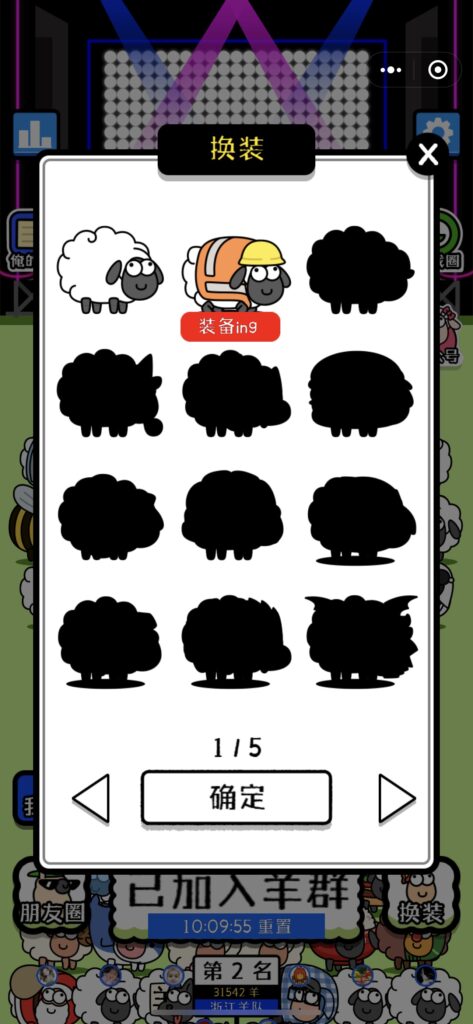
The game employs a proven bag-of-tricks to entice players to try for the impossible win. Even winning once is huge bragging rights, which plays right into the game’s viral referrals – “have you won once yet?” Furthermore, there’s a province-based leaderboard right on the game’s home screen, and by winning you contribute to your province’s rankings on this leaderboard. And winning games also gives you currency to buy cosmetic items, which of course are more avenues to show off and brag. All of these are battle-tested mechanics in China’s top games, and immediately familiar to players.
I’ve played maybe 10-20 rounds, and in a couple of tries I felt I was close to a win – but it’s hard to know for sure since the tiles can stack infinitely and thus you never know for sure how many tiles are left. Despite knowing that this game is in many ways a scam / hoax and the odds are hopelessly stacked against me, I felt compelled to play more, to just win once; and I gladly clicked to watch the ads which raised my chances by an infinitesimal amount (99% of the ads shown to me were for Pinduoduo). I guess this is similar psychology to people buying lottery tickets or playing slot machines.
In contrast – 3 Tiles is certainly a better-made game, with superior aesthetics and a traditional free-to-play puzzle-game difficulty curve. Like many other puzzle games, it has hundreds of levels and I cruised through the first dozen levels. My only complaint is the game’s high frequency of ads – an ad is played before every level and there are some UI “dark patterns” during the ads to trick click-throughs.
And this is where this “case” gets interesting for me. Comparing the 2 games, it seems like a no-brainer that players should choose the better-looking game where they can actually finish the puzzles, instead of the deceptive and poorly-made game where 99.9% of the time you are set up to fail. If you were to bet on the outcomes of the 2 games ex ante – say, you are a publisher or an investor looking at these 2 game pitches – it would seem crazy to bet on the latter. And yet, in this case we know the latter is the winning bet by far. What, if anything, should we take away from this case?
Well, “maybe there’s not much to really take away” is a reasonable answer in my opinion. No one expects Sheep a Sheep to have longevity – after realizing the game’s objectively bad (intentionally deceptive?) puzzle design, many people feel tricked and there’s likely a backlash.
At the same time, from a “jobs to be done” perspective, we should realize that 3 Tiles and Sheep a Sheep target entirely different needs (and thus different audiences): 3 Tiles serves the motivations of the traditional puzzle-game demographics, while Sheep a Sheep is about serving a flavor-of-the-month novelty to the Internet at large. The necessary ingredients of such a flavor-of-the-month novelty could be: illusion of skill, high element of randomness/luck, and a subversive x-factor that drives virality (“only 0.1% can do this – can you?”); it is coincidental that the 3 Tiles gameplay could be successfully twisted into this recipe.
For “serious” game devs, perhaps there’s some room to interpret Sheep a Sheep as yet another case for subversive design choices. Making the 2nd level of your game incredibly hard is a subversive decision, and maybe it does make sense in some very rare set of conditions.
[Sep 27 update]
I thought it was worth a minor addendum, one week after the original post above. A couple of things happened:
First, it seems the devs drastically reduced the difficulty of the game – by drastic, I mean that the odds of winning went from 0.1% to 5% (illustrative numbers, but you get my point). The net result is that in absolute numbers there seems to be a lot more players getting a win every day (in the above screenshot, there were already 500k winners during the day), but percentage-wise it still feels like a fool’s errand.
Second, I finally got my personal first win, after maybe 100 tries? Anyway I’ve played for ~10 days and this is the first win. With my win I got a cosmetic (the constructor sheep above). With this win, I also finally realized that the game also emulates Wordle‘s “a puzzle a day” format – once you’ve won a round, you have to wait 24 hours before you can challenge again, in effect setting up an appointment mechanic.
If 2020 was a year where the global games industry got drunk on pandemic growth, 2021 was the hangover. Consumption growth stalled, as expected. Supply chain disruptions have meant a difficult transition for the new console generation. And developers also wrestled with production delays and ongoing uncertainties of office re-openings.
In China, there was even less to cheer for. Game license approvals have again been stalled since August, and thus there were only 755 games approved for the whole year – a 46% decrease from 2020. And there were only 76 imported titles – it’s important to note that any game that’s based on a foreign IP is typically treated as an import title (e.g. Netease making a MOBA with Marvel characters), so the number of licenses issued to games made by developers outside China is even smaller. In comparison, NPD reported over 2,000 premium games released across consoles and Steam in the US in 2021; and there’s about 10k games released on Steam every year, and certainly a lot more on mobile free-to-play. So the license approval in China has become this ironclad gate, where the vast majority of games produced globally every year are not allowed legal entry. It’s not hard to imagine the rent-seeking behavior this creates.
And then there were the newer and stricter regulations. Minors are now limited to a total of 3 hours of gaming a week, designated at specific hours from Friday to Sunday. (If you work in server operations, these kinds of schedules create the worst traffic spikes during your peak hours – and indeed Honor of Kings suffered server outages when millions of youngsters wanted to login at the same time Friday night.) Tencent also voluntarily introduced time restrictions for adults, and thus it’s now a common sight to see streamers swapping accounts to extend their playtime while on air.
And thus Chinese game companies continued their international expansion, looking for greener pastures elsewhere. miHoYo opened a studio in Montreal, following a series of studio openings across North America by Tencent. But there’s also regulatory headwinds, with the US government scrutinizing Chinese services. This is partly what prompted Tencent to unveil a new publishing entity, Level Infinite, headquartered in Amsterdam and Singapore; and likewise miHoYo transferring Genshin Impact’s publishing to its Singapore entity Cognosphere. It’s unclear to me that such attempts to create a legal separation between China onshore and offshore entities would appease regulators outside of China, and the legal gymnastics could eventually become untenable.
Speaking of Genshin Impact, it continues to impress on the global stage, not just in terms of its business performance, but also cultural impact. I think it’s doing a lot to elevate the stature of Chinese games with players globally. Another mobile game worth mentioning is Harry Potter: Magic Awakened, developed by the Netease team that created Onmyoji. This game has set a new bar for launch live-ops in China: players were allowed to download the game, log in to create their characters, and socialize with other players in-game a few days before the official launch date; combined with a creative marketing campaign (a “back to magic school” theme that coincided with the real-life back-to-school season), the game was a viral sensation.
On a separate note, one positive development was the formal end to “996” at most large tech companies in China. Partly spurred by regulatory scrutiny, and partly perhaps due to an attitudinal shift in the new generation of talent, this is one more sign that the hyper-growth years are over.
Oh, and there was the Bubble – metaverse, web3, NFTs, play-to-earn… Even to a disinterested observer like myself, these concepts seemed to have sucked all the air out of public discourse. In China, discourse around NFTs and crypto-gaming have been much more muted, thanks to the ongoing government crackdown against crypto. But the “metaverse” hype cycle was in full force. It’s hard not to be skeptical, when you hear about some blue-blood VC eager to fund a team (which has never made a game before) pitching a cross-platform metaverse MMO. But for now, the music hasn’t stopped playing, and so the game continues.
Finally, Wild Rift – the game I worked on for 2.5 years from late 2016 to mid 2019, and where I was one of the first 3 people on the team – finally launched in China, as the more straightforwardly (and better, IMO) named League of Legends Mobile. Early data seemed to have been very good, at least good enough for the project team to win the prestigious “major business breakthrough” award within Tencent. But of course the jury is still out on whether the game can sustain. In any case, I’m just happy that Chinese players can enjoy it (or unite in complaining about the matchmaking – but that should a post for another day).
Work stuff
2021 was the second full calendar year I worked at Supercell Shanghai. The office was open year round, except for a couple weeks when one colleague was quarantined by the Shanghai government in a contact tracing effort. (In my colleague’s case, apparently the Didi ride they took had transported someone flagged as a close contact of a suspected case, and so my colleague was flagged as well – this is one anecdotal example of how contact tracing had been enforced locally.
It was still far from a normal year for work, since it was a massive undertaking to enter or leave China. So we really missed out on cultural exchanges and collaborations with other Supercell offices. And it also took a heavy toll on our recruiting strategy, since it was practically impossible to hire from overseas.
It’s hard to develop new games and build new teams and establish a new studio’s culture all at once. (Duh!) And thus it was an exciting milestone (and a big sigh of relief?) when my coworkers soft-launched Clash Mini towards the end of the year. I didn’t work on the game, but given how small our studio is, I’ve had a great front-row seat to its trials and tribulations. There’s a Chinese idiom that says a bystander sees more clearly than the person directly involved; I certainly felt this way in the numerous peer 1-1s I’ve had with Mini’s game lead.
As to my own project, there’s not much to talk about publicly, yet.
One book that had a significant influence on how I worked was Noise: A Flaw in Human Judgment. Whatever its flaws (reviews online are fairly mixed), the discussions of how to run better recruiting and performance evaluation processes prompted me to change my approach on these topics.
Personal stuff
As a family, we still didn’t do much travel in 2021. A large part of this is thanks to the tight travel policies of local schools, which implemented extra restrictions on top of city-wide policies. For example – if my son left Shanghai, at the minimum he will have to submit a negative PCR test result and self quarantine for 48 hours before he can return to school.
For many Chinese families, such requirements haven’t dampened their interest for travel. And some have gotten quite creative at beating the system – for example, if you have multiple mobile lines (which many Chinese do, partly due to the low cost and the restrictive carrier lock-ins), you can leave one SIM inactive at home, and use that number to generate a green report (based on carrier location tracking) that says you have not left the city.
But anyhow, in my family’s case we played it safe. That has meant opportunities to pick up new hobbies. During the pandemic, my son became a huge fan of American Ninja Warrior, so I’ve tried to gently nudge his athletic interests. (He’s definitely starting from behind in this regard, since my wife and I both lack good exercise habits or play any sports still.) I couldn’t find a Ninja Warrior style gym in Shanghai – so we picked up rock climbing (in gyms) instead.
Anecdotally, rock climbing feels like an up-and-coming sport in China. There’s not a huge list of facilities in Shanghai, but it’s been a mini adventure taking my son to a handful of gyms over the past year. There’s usually 2 distinct groups of customers at these venues. The first is kids – parents paying for private lessons for their children, perhaps hoping to get some certifications that help towards high school applications. The second is young people in their early twenties, skewing slightly more female than male. And if I had to guess, I’d say the first group overall outnumber the second – so you could say that the job-to-be-done of climbing gyms in Shanghai is primarily to address the education-system anxieties of Chinese parents.
There are a few lessons I’ve observed from all these trips to climbing gyms. The first is how people overcome their natural instincts through practice. All beginner routes at these gyms use auto-belay devices for safety: they respond to your weight and will lower you at a controlled pace when you fall. So the first thing all new climbers need to learn is to let go of the wall to safely descend. This can be a lot harder than it sounds – I’ve lost track of how many kids I’ve seen that are “stuck” at the top of the wall because they can’t let go. It’s a counter-intuitive move that requires a leap of faith initially. With enough repetition though, you can overcome your natural survival instincts.
Another small lesson is how first-time customers (especially parents taking their kids to try out climbing) misjudge the relative difficulty of bouldering (3-5 meters tall) versus wall climbing (12-15 meters tall). They assume that the taller wall, which requires protective gear, must be harder; whereas gym staff will almost unanimously tell them that bouldering is more technical and harder, especially compared to the beginner climbing wall routes that are effectively ladders. I guess this is another example of how subject-matter literacy is required for informed debates (yes, I’m alluding to the NFT discourse on Twitter that is driving game devs mad).
Media consumed
I played a lot of Hades in the beginning of the year. I was quite hooked, so much so that I was carrying my PS5 controller with me when I traveled for work. Besides getting platinum in achievements (alas, I have almost no friends on Epic Game Store to brag to), I even attempted speed-running and was very proud of myself for setting a personal best of a sub 9-minute run (which is ranked about 300ish on speedrun.com).
Towards the end of the year I binged Wild Rift a lot on China server, probably more than I would have expected. I can now see it’s a bit of an acquired taste – it’s the most competitive and serious real-time PVP game I’ve played on mobile, and the intensity of the experience is a notch higher than pretty much any other mobile game. The literal $B “product-market-fit” question is how many players there are in the world that want this intense an experience on this particular platform. In China it’s a lot – quite a bit smaller than Honor of Kings, for sure, but we are still talking about tens of millions of players at least.
The rest of the year I can’t really recollect what I played. I sampled a bunch of games on Xbox Game Pass, but didn’t play anything deeply. On the indie/AA side of things, I enjoyed Death’s Doorand F.I.S.T.enough to write about them, and I was impressed with the latter as a very competent first outing for a Chinese studio.
For film and TV that I watched for the first time last year, Dune (2021), Samurai Rebellion (1967) and Free Solo (2018) were my top 3 feature films; Generation Kill (2008) was my favorite TV series, though the latest seasons of Succession and Ted Lasso are also very close to my heart. Squid Game – by far the biggest surprise hit of the year – was in my opinion another reminder of how fruitless it is to make ex-ante forecasts; we can only make ex-post rationalizations of the show’s success.
F.I.S.T.: Forged in Shadow Torch is a Metroidvania game made by Shanghai developer TiGames, and released first on PlayStation recently (coming to PC in future). The team is about 20 people.
With a Metacritic score of 81, this game is in my opinion a good example of a new breed of Chinese games that are successfully establishing a beachhead in the premium console space. And now it’s not so far-fetched to envision a future where Chinese developers can ship successful $70 AAA titles cross-platform, competing with the biggest console franchises.
I’m not heavy into this genre, and during my first hour with F.I.S.T. I was not too impressed. I didn’t like the grimy dieselpunk art style, and the starting weapon, the eponymous giant fist felt too slow. At this particular moment, I felt I was playing the game more due to professional curiosity (and a natural desire to support a Chinese title).
But the game does open up over the next few hours, as you unlock new abilities, including traversal abilities like double jump and wall jump that are staples of the genre. (I would argue that perhaps these abilities can be unlocked even earlier – at the cost of a more accelerated learning curve for players new to the genre.) And once you acquire the second weapon (out of 3 total), the game’s combat system fully reveals its deep combo-chaining potential (seemingly inspired by action games and fighting games).
Probably around the 10 hour mark of my playthrough, I was fully hooked on the game. I felt compelled to explore every corner of the map, and practiced every boss fight like how I would approach a Soulsbourne game. The game is quite hard – there were few boss fights that I completed in 1-3 tries, and many took me practicing up to an hour to crack.
I ended my first playthrough at the 26 hour mark. I still didn’t care much about the game’s narrative – but I was completely sold on the combat and level design. There are some really fun and intuitive puzzle elements to the levels – an area focused on puzzle gameplay that unlocks very late in the game is especially memorable – and I was impressed by the mileage that the level design got out of a single mechanic.
What’s most impressive about the game – and I’m paraphrasing a line from a Chinese review I had read – is that I don’t need to go out of my way to hype up this game because it’s made by Chinese devs. The game’s quality speaks for itself, and while it’s maybe not at the very peak of the Metroidvania genre, it is a very competent entry with a super-rich combat system. The production feels very mature and there doesn’t seem to be many rookie mistakes (I will complain about the font-size feeling too small for couch-play).
My recap posts on 2019, 2018, 2017, 2015. I don’t remember writing with such consistency (my son was born Jan 2016, I guess that explains the gap?). Skimming these prior posts, I do see I’m repeating myself an awful lot, but it’s still rewarding to see how the same themes (and my attempts at framing them) have evolved over time, and quite gratifying when some predictions I’ve made turn out to be on the money.
As usual, I’ll write about a few topics that I personally found fascinating.
Genshin Impact and the coming “Industrial Age”
At the end of my 2019 post, I called Genshin Impact an aspiring blockbuster, which was not that bold a claim given the viral hype (and controversy) it already enjoyed in China at the time. It has easily surpassed my expectations, even more so in western markets.
I’ve already written a long post about the game. In the aftermath of the game’s explosive launch, much of the Chinese industry chatter was about “industrialization”. I’ve not seen a clear definition of the term in this context (it seems taken for granted), but loosely, the logic is that as consumers demand higher fidelity games (rivaling PC/console AAA in quality) and ever more content, Chinese developers will have to embrace the flywheel of “bigger teams (and more specialization of talent), more sophisticated production pipelines, and more advanced technologies and tools”.
In other words, Genshin Impact is seen as a landmark game, one that has permanently shifted consumer expectations higher, and subsequently started a new industry-wide arms race in China. In my view this is quite overblown – the dominant market leaders Tencent and Netease have for years chased higher budget productions made by “armies of developers” – but Genshin captured the zeitgeist with the audacity of its vision.
What’s next? A lot of UE4 projects, for one thing. To name a few: Tencent Quantum Studios’ Dawn: Awakening is an open-world survival game (with 3rd-person shooter gameplay) made in UE4. Lilith Games recently announced Farlight 84, another UE4 project with a post-apocalyptic theme, Battle Royale PVP gameplay (perhaps amongst other game modes) and mobile-PC cross play. (I don’t know if either of these will take off – their themes lack the easy viral appeal that Genshin Impact had.) Meanwhile, Tencent Timi Studios recently posted job ads for a “AAA-grade” realistic racing simulation, built in UE4 for mobile; and miHoYo has been recruiting UE4 developers as well.
When China meets the world
Chinese game developers have for years studied and learnt from their global industry peers – whether it’s GDC talks, studio visits, academic studies or direct talent acquisition. There still doesn’t seem like a lot of information flowing the other direction – language and culture are big barriers (for Chinese developers to share outwards – the “supply” side), but lack of interest on the “demand” side has been a deterrent as well.
In this aspect, the games industry seems a step behind the broader tech sector, where Silicon Valley now clearly pays a lot of attention to trends in China. When there is more interest, and deeper exchange of knowledge about China’s game development practices, I suspect there will be a good amount of bemusement and shock from the outside.
I’m reminded of an ancient news piece – when the first MacBook Air was announced in 2008 (by Steve Jobs memorably pulling it out of a manila envelope), a group of Japanese engineers did a teardown and expressed surprise at the “wasteful” and “expensive” internal design:
“If I proposed such a design, our company would never approve it,” said one of the engineers. “I can’t find anything that is technically superior. We can make the same computer at a lower cost,” said another.
In hindsight this was obviously missing the forest for the trees – the Japanese experts weren’t necessarily wrong, but their points were irrelevant in the big picture. Game developers should avoid making the same mistake when they examine Chinese game development – the sausage might be made in an ugly and wasteful way based on your perspective, but don’t neglect the end results or their growth trajectory.
Chinese developers have been self-reflective about the gaps. For instance, in this recent interview (in Chinese, but the Google translate is well worth a read) with the head of Timi J3 (the team behind Call of Duty: Mobile), he called out investment in tooling as one area where China still has much to learn:
Yao Yuan (head of Timi-J3): …Furthermore, European and American manufacturers’ practice of tooling is much stronger than ours. I talked to the team of “Ghost Recon: Wilderness” before, and they said it took 5 years to make an editor. How strong is this editor? Basically do some drag & drops, and all the villages, roads, people, animals, and vegetation will come out. This is Ubisoft’s industrialization capability.
Interviewer: Domestic manufacturers may not do similar things.
Yao Yuan: Yes, many domestic projects have no time to build tools due to development cycle constraints, but European and American manufacturers are different. Ubisoft’s editorial team will do various military and historical research in the pre-research stage, go to relevant places to collect features, improve tools, and then slowly start the project. This process is very worth learning. If you really want to pursue efficiency, you still have to be prepared from the beginning.
(English via Google translate with light edits.)
Earlier in the interview, Yao made this comment about their production capabilities:
For example, compared with a year ago, we have the same size of two or three hundred people, but our production capacity has increased by 3 to 4 times. By cooperating with an outsourcing team of nearly 300 people, we can now make several game modes and maps, hundreds of weapons and dozens of characters in one month. Although some content requires a relatively long production cycle, for example, it takes 3 months for a character to go from conceptual design to IP-stakeholder approval, but the production process and pipeline are very strong and mature.
(English via Google translate with light edits.)
So the picture here is, this team is consistently churning out vast amounts of live-ops content, despite relatively immature tooling (compared to their western peers), and their efficiency is rapidly improving. And they have stayed on top of the organizational challenges of running such a large team. And there is still a lot of productivity upside if they do seriously tackle tooling – that’s the scary part.
5 years of Honor of Kings
Honor of Kings launched in late 2015. SCMP did a profile recently, and their graphs painted the picture succinctly:
Let’s be clear: the “real” lifetime revenue is a lot higher than this $7.8B figure from Sensor Tower, as it does not include China Android revenue (understandably hard to model), and Honor of Kings has very low revenue outside China. Indeed, I would say you can double that figure to $16B and possibly still be low. Coincidentally, $16B is a cool 100B RMB, a nice round figure for half a decade.
Beyond these eye-popping (and speculative) numbers, it’s hard for me to talk about Honor of Kings without doing some soul searching. Professionally I had a ring-side seat to this spectacle – I was a part of the China team at Riot Games, based in Hong Kong in 2015/16. I played the game when it launched, and was 1) amazed by how it recreated some of the high satisfaction moments of PC MOBAs, but 2) also confident that it was not a major threat to League of Legends as the gameplay was still too shallow for core players. My main takeaway was that Riot should absolutely look into making a mobile MOBA as well.
To show my thinking then: in March of 2016, I wrote a post titled “Are mobile games disruptive?“, and the disruptive game I was talking about was Clash Royale (which took up every second of my day when I wasn’t taking care of my newborn):
I believe mobile games have so far followed the [disruption] theory here:
– They have focused on catering to previous non-gamers / casual gamers, and most of the early successes reflected this (Angry Birds, Candy Crush Saga, Flappy Birds)
– These games were simpler to play, and offered less complexity in the gameplay
– These games were generally looked down upon by core gamers
What gets interesting is what happens next. The disruption theory says that from this low market position, the new entrants are able to mount an attack on the establishment thanks to both product evolution (so they catch up in product experience) and their new attributes which the power users (core gamers) previously didn’t care about.
While my memory is fuzzy, I believe I largely stopped playing Honor of Kings for fun after the initial few months. However, by Chinese New Year 2017, it was clear that a disruption was playing out according to Clayton Chistensen’s theory. League of Legends players were being pulled into Honor of Kings en masse: it turns out social ties and bragging rights were more powerful motivations to many (if not most) people than gameplay depth and mastery. But really, the bigger story was how Honor of Kings activated so many non-gamers.
So that’s what it feels like to be disrupted.
I’ve often described Honor of Kings as an attack from below – if you think of the hierarchy of MOBA players as a pyramid, with the very pinnacle being esports players, Honor of Kings successfully activated the bottom tier first. There was little organic endorsement or word-of-mouth from the establishment influencers. (The game did try to piggyback on the popularity of League‘s esports celebrities, with ambush marketing like getting Faker to do a livestream.)
League of Legends: Wild Rift, in contrast, will be an attack from above. I played a modest role in getting this project off the ground (and I’ll shamelessly overstate it on my Linkedin page), so it’s something quite close and dear to me. The existential question for Wild Rift has always been: is there any chance against Honor of Kings?
Sentiments aside, I think the answer is yes, even in China. The League “establishment” that shunned Honor of Kings have been dying to play a League mobile MOBA, and perhaps this echelon of esports pros and streamers can create a big enough beachhead. And there is still a brand premium in my opinion, though that picture is nuanced as Honor of Kings has leaned into Chinese culture – in a way, it’s a bit like Apple versus Huawei in China. At the end of the day, players across all tiers of the pyramid will try Wild Rift – the question is can Riot get them to stay.
As an anecdote, I’ve been lurking in a wechat group of League influencers who have overcome formidable obstacles to play the game on Asian servers. Some of them are already organizing pro teams and recruiting players at the top of the ladder. Their enthusiasm is infectious, and gives me cautious hope about the next chapter in this saga.
Lastly, one other personal reflection from these 5 years is that, even with the personal experience of how Honor of Kings disrupted League of Legends, I was able to repeat the mistake when it came to thinking about PUBG Mobile. I had seen an early build before its launch, and I was impressed. But my gut again told me that it would not satisfy PUBG players, and its input complexity would be overwhelming for casual players. I was definitively wrong on both – I guess that speaks to how strong one’s biases can be.
(Optional extra reading – this piece in Gamesindustry.biz shows Timi leadership’s reflections about Honor of Kings and their views on industry trends.)
China’s dynamism
Taking a step back from games for a moment. I came across this year in review letter by Dan Wang, who is a tech analyst based in Beijing. It is thought-provoking and beautifully written, and honestly I envy his prose. (Seriously, you should stop here and go read that letter instead.)
This small bit particularly resonated with me:
This year made me believe that China is the country with the most can-do spirit in the world. Every segment of society mobilized to contain the pandemic. One manufacturer expressed astonishment to me at how slowly western counterparts moved. US companies had to ask whether making masks aligned with the company’s core competence. Chinese companies simply decided that making money is their core competence, and therefore they should be making masks.
This “can-do spirit” is Chinese game developers’ biggest (and perhaps most overlooked) strength – it’s the rising tide that lifts all boats. While studios elsewhere debated first principles about whether MOBA / FPS were viable on mobile, Chinese studios simply hacked away at it. When the Chinese government tightened the publishing license process, companies rapidly pivoted to overseas expansion. And with this “industrialization” wave, Chinese developers are again just diving head-first.
Having recently lived in the US for almost a decade, I feel the stark contrast. As I was writing this, a mob of Trump supporters stormed the Capitol building. (It may well have been a scene from a dystopian video game like The Division 2.) There are bitter divides and deep social justice issues. It feels trivial, and perhaps disrespectful even, to be discussing game development against such a backdrop – but I feel the need to argue that Americans must find a way to rekindle a similar can-do spirit, and just build stuff. Build institutions, social welfare, infrastructure, housing, startups… Whatever it is that motivates you, which hopefully for some would be video games.
This is obviously a huge topic that was discussed in the US in 2020, when Marc Andreessen wrote his “It’s time to build” post. I didn’t follow the rest of the discourse closely, but I enjoyed reading this essay “On cultures that build.” I’m not well equipped to really add more to the conversation, but I will say this: China faces huge (if not bigger) societal challenges as well, but part of the dynamism is rooted in people’s belief that they can (and must) improve their livelihood via hard work. They have the lived experience of the dizzying growth – the building of everything – of the past 40 years. For Americans, more cultural exchange and economic ties with China – not less – may have a nice side-benefit in combating the complacency.
M1 Macs
In my 2018 post, I briefly speculated on “the beginning of the end of the PC (x86) platform”. With the arrival of the M1 ARM-based Macs (finally), I’d like to raise my bet.
I haven’t used a M1 Mac yet, but from everything I’ve read so far, it sounds like a generational leap in objective performance as well as subjective user experience. Now the question becomes, is this strategy and capability unique to Apple, or will others attempt to follow suit? I’d argue yes, if not simply because of the gravitational force of the mobile ecosystem. In particular, if Nvidia’s acquisition of Arm is cleared, Nvidia will be in an enviable position to attempt some big integration plays here.
If there is such a foundational migration on the Windows side of PCs, one clear worry is app inter-operability during the transition. It’s hard to imagine the Windows side offering as smooth a transition as Apple is doing with Rosetta 2, thanks to the much more fragmented hardware stack. And games as a special category of applications may suffer the worst of any transition. Again – a gaming-focused company such as Nvidia could be particularly motivated to navigate a path through this.
There is some irony, to me, if at the end of this, it’s consoles (due to their long generational cycles, and current commitment to backwards compatibility) that become the laggards that stick with x86.
Personal stuff
2020 was the first full year I’ve lived in mainland China for over a decade, and the first time I’ve lived in Shanghai. My timing was pretty good, in retrospect. When the strict lockdown started in late January, we thought we had the worst luck, but by May, life was mostly back to normal (even masks were mostly gone, except where mandated such as in public transit).
In the summer, many friends went vacation traveling again; we didn’t as we had very young children. But we couldn’t resist booking a short vacation trip for December. Alas, the weather in Xishuangbanna wasn’t warm enough to take advantage of the private pool we had in our villa, but it was still a pleasant trip.
Shanghai is a very livable city. I say that as a proud Beijinger. The summer is still too hot and humid for my liking, but the city has a good balance of culture (with a dash of western influence), urban planning, and pace of life. Beijing feels too bureaucratic, and it takes too long to get anywhere. Shenzhen feels too rushed, and the hot humidity is just as bad as nearby Hong Kong. Los Angeles – I love the climate, and the parks, but I don’t miss the driving.
The pandemic also gave me some new perspectives about effective governance. The US response has been appalling to see from afar. I wonder how much of it is uniquely the failings of the Trump administration, and how much is reflective of the general state of decay and complacency in US institutions. To be clear, I’m not looking at this from a lens of US versus China as superpowers, or other sorts of macro-economic debate. I’m much more concerned with the micro-economic life decisions we make as a family – where we should spend our precious years together, and can offer us the best mix of professional fulfillment, income, education, and life experiences. And for me the US fell a lot in the rankings this past year.
Investing: some years ago, there was a popular startup catchphrase about seizing the big trends, coined by Xiaomi founder Lei Jun: “even a pig can fly if it is in the middle of a whirlwind.” (Jack Ma, who’s living through some interesting times himself recently, apparently had a witty response: “when the wind stops blowing, it’s the pigs who fall to their deaths.”) The stock markets certainly made me feel like a pig facing a hurricane, torn between FOMO and having a nasty fall. It was quite surreal to see the market movements in contrast to pandemic life.
Remote work was a much discussed concept, and a collectively forced experiment. In my case, with 2 young kids running around the apartment, working from home simply did not work. When my older son’s kindergarten re-opened, it was marginally better. I’d probably need a private office away from the office to make remote work viable.
To wrap up with the games I played in 2020. I played various mobile games due to professional interest, but the one that stuck with me, surprisingly, is Merge Mansion. (Disclosure: my current employer, Supercell, invested in the developers.) I’m not a puzzle game player, and this is a game that’s still very early in development with a lot of rough edges. But it became the perfect time-killer game, and I’ve averaged 20 minutes of play every day for several months now.
On PC/console, I played Hades more during early access in 2019 than I did in 2020, but I should go back and play it some more to experience the complete game. During the depths of the spring lockdown, I occupied myself with Ghost Recon Wildlands and The Division 2. Fall Guys probably brought the most joy and laughter, and it was eye-opening to see how much it resonated with my 4 year-old. Later in the year, Ghost of Tsushima was an easy crowd-pleaser, which I spent more time on than I should have.
The game that resonated the most with me though, without a doubt was The Last of Us Part II. Its harrowing discussion of trauma, empathy and perspective-taking was particularly fitting for these times we live in. And the toxic fandom around the game felt like an inadvertent meta commentary that echoed the game’s core themes. Months after my playthrough, I still think about my experience with the characters. Perhaps it’s time to pop the disc into that new PS5…
With Chinese New Year right around the corner, the annual ritual of burning a full month on corporate annual parties has thankfully come to a close. Here I’m jotting down some observations about the practice.
First off, to state the obvious – Chinese New Year (CNY), which usually lands somewhere in January/February is a big deal. The whole country shuts down for about a week, as literally hundreds of millions of people scramble to get back home for family gatherings. For corporate life, right before CNY annual bonuses have usually just been decided; there are a lot of year-end business summaries, presentations and discussions.
And then there are the annual parties, which occur at every level of the org. Tencent, for example, has a corporate annual party (tickets are raffled) usually held at a sports stadium, where key executives take part in some performances. Then the business units will have their own respective parties, trickling down to the departments / teams.
There are 3 typical components of any party:
The performances, usually singing / dancing acts, and often modestly budgeted mini-films. Usually each sub-department provides one act
Prize raffles, which occur throughout the night, with each prize’s sponsor (a “boss”, partner team etc.) clearly identified. A current-gen max-spec iPhone is a typical good prize, while grand prizes can go quite a bit higher. If a “boss” (say, a director level manager) happens to win a prize, there can be a loud chant of “double”, which means the “boss” is supposed to re-draw the raffle and double the reward out of their own pocket
Drinking and toasting. For mid-level managers and above, this feels like the main function of the night: an elaborate and potentially stressful ritual of toasting and hazing, accompanied by private conversations. These conversations are often powerful bonding moments where important business alignments are forged / reinforced. It’s one huge networking and alliance-building session facilitated by a lot of alcohol
The reason I said at the beginning that a full month is consumed by these annual parties at various levels is because of the invitation format. All these parties can have guests external to the org, and it is important to pay respect (and who you send to the party shows your level of respect to the host). If your work depends on a web of relationships with other departments at the company, you may be expected to attend a whole host of parties to oil these relationships. Which ones you go (and skip) reflect your priorities.
At the ground level, these parties are rare moments for the team to vent and let off some steam. At the studio/team level party (usually the smallest and most intimate party you attend), many people get very, very drunk. Subordinates team up and get their team leads drunk. Disciplines which feel they have been under the whip of another discipline (say, game design barking orders at engineering and art, as is the norm in Chinese studios) extract revenge. The next day often is still a work-day in theory.
An unfashionably late (as usual) post about 2019 and the big games industry themes that I found interesting. Similar to last year’s post this will be focused on the China perspective.
Further global footprints
A continuation of the past several years – 2019 saw Chinese devs & publishers continue to expand globally. Representative titles such as PUBG Mobile continued to gain ground, ending the year as one of the year’s biggest games in terms of revenue and active players. (Note that the game’s revenue is going to be meaningfully higher than popular estimates, as the game is integrated with various non-Apple/Google 3rd party payment channels that are significant – or even the majority in terms of payments market share – in Southeast Asia and other emerging markets.)
Similarly, Garena’s Free Fire was also raking it in – primarily from Southeast Asia and South America – reporting over $1B in lifetime revenue since its 2017 launch. (Garena is based in Singapore, though Free Fire‘s dev team is based in Shanghai if I’m not mistaken.)
To sum it up – real-time competitive PVP mobile games (by Chinese developers) PUBG Mobile, Free Fire and Mobile Legends are now household names across the Middle East, South and Southeast Asia, and South America.
It wasn’t just about emerging markets – Call of Duty Mobile blew open the gates to the prestigious North American market. While it has a lot to work to do to lift monetization, it is likely changing the perspectives of the gamers who have the most platform choice (and who have been the most snobbish towards mobile gaming).
IP partnerships
Staying with Call of Duty a bit more: I’m very confident we are going to see a lot more of these types of East-West IP partnerships, purely out of necessity. Simply put, I’m not aware of any western studio that have the proven capabilities today to execute in-house against the development and publishing of a mobile game similar in technical complexity to PUBG Mobile or Call of DutyMobile. Epic and Fortnite is the closest example I could think of – but even there, their mobile optimization and global footprint pales compared to the above.
In a way, these partnerships, or talks of such partnerships, are nothing new – for example, over the past few years, Blizzard have certainly talked several times with Netease, Tencent et al about mobile projects around all of their various IPs. (Personally I’d love to see a Starcraft game on mobile.)
But what is likely new is the seriousness of these conversations now – the Chinese devs have a lot more proven successes to point to, and the western IP holders are a lot more educated about the proven market demand. So expect to see a lot more of these, and possibly a lot sooner than you’d guess.
Chinese design innovations
What I personally found most interesting last year though, was the startling success of Chinese devs when it came to their biggest deficit traditionally – game design innovation. It was truly a break-out year.
Each of these games were hugely successful in 2019 in some way. Auto-Chess spawned a esports genre after itself (and certainly disrupted the landscape of adjacent CCGs). Archero caught lightning-in-a-bottle with its surprisingly elegant (and highly addictive) core combat. Arknights and Punishing: Gray Raven both represent best-in-class games in their respective genres today (tower defense and 3rd-person action), on top of stylishly creative original anime-IP (interestingly, both were apocalyptic sci-fi in theme). And mobile developers couldn’t seem to stop talking about AFK Arena, a brilliant iteration from Lilith Games on a genre they themselves largely created half a decade ago.
Also – almost all of these games on the list come from relatively unknown developers (the exception being Lilith). This certainly feels like the silver lining in the deep winter that Chinese devs have inhabited the past 2 years (venture funding has been nonexistent since 2017, and the game license issue has froze up the domestic market). I look forward to the many pleasant surprises that the surviving studios will bring to market – whether it’s aspiring blockbusters from known studios such as Genshin Impact (by miHoYo), or the next wave of indie hits.
This seems to be a re-occurring discussion I have on this blog, but with the release (and early positive reception) of Call of Duty Mobile (developed by Tencent Timi – J3 studio; published worldwide by Activision and Garena in respective markets), it’s worth refreshing this conversation.
Similar to PUBG Mobile, Call of Duty Mobile seemed to immediately receive praise for its technical performance. Players are wow’ed that “this is playable on mobile”, “it runs so smooth!” Etc. It is indeed an impressive feat, with no doubt lots of hard labor and ingenious solutions to hard problems. In its sum it’s Chinese developers reaping the rewards of their half-decade investment in mobile development at AAA scale.
Framework sketch
If we take a step back and snapshot Chinese developers’ capabilities in the global games industry value chain, we might get something like this (excuse my crude hand-drawn graphic):
China’s capabilities in the global games industry value chain
Here, the value chain component labels are intentionally generic (I’ll come back to this later). And the artificial separation of “Design” and “Manufacturing” are divergent from reality, but you get the rough idea.
The main observations I tried to capture are:
In the console platform, China has traditionally only had a minimal / partial “manufacturing” role, in insourcing or outsourcing (e.g. western developers’ China studios that help their western teams finish their games; or large outsourcers like Virtuos). A lot of this is due to the lack of a home-grown market
In PC, Chinese developers made lots of games, but they were generally non-AAA and in the lower end of the market (for example browser games). There were various attempts at shipping these games to a global audience, but nothing that became a cultural phenomenon
In mobile, Chinese developers are leading the charge on almost all fronts (with exception of “design” which I will break down in a bit), pushing the technical boundaries as well as going deeply to emerging markets that have historically been neglected by most publishers. Their capabilities in manufacturing and distribution are industry-leading
Now coming back to why I generically labeled it “manufacturing” and such: this is thanks to a quick chat I had with a co-worker this week. My colleague has an education background in industrial management. When I started discussing with him what I thought were the strengths / weaknesses of Chinese developers, he instinctively mapped it to industrial manufacturing – “it sounds like they are very good at running the factory – operating manufacturing processes, solving the production line issues, ensuring output quality etc. But these production line engineers tend to be terrible at new product development because they are focused on totally different sets of things.”
I thought this was a great insight. And yes, game developers tend to know whether they enjoy and are good at making new games or working on live titles (very few developers are great and passionate about working on all stages of a product’s lifecycle). But mapping it back to an almost archaic manufacturing-line metaphor really helps distill the point.
(One other benefit about the generalized industrial labeling is we are reminded to explicitly reference what has happened in other industries – for example appliances and consumer electronics.)
A side-bar about Design
So, to the part about “design” and China’s capabilities here. First off, here I’m using “design” in the more general sense (and it’s probably a poor word choice on my part) – it refers to loosely everything to do with new product development. I think this is by far Chinese developers’ weakest area. Thinking out loud here, there’s a few factors why:
China has a relatively shorter history of game development, and the industry has always been skewed in narrow areas (online f2p)
Much of China’s recent growth has been in perfecting the production line – working around harsh memory constraints to realize a feature, designing a networking model that supports twitchy real-time multiplayer gameplay in unreliable mobile network conditions, making the game run on 5-year old phones, efficiently integrating with a long list of social networks / app stores… When most teams have focused on being the best production line team, they lose the mindset for new product development
China’s shorter-term planning and rampant clone culture results in less value placed on original design, and thus less exercised muscles
And to some extent, China’s education system and societal values are detrimental to fostering type of talent that excels at creativity and independent thinking (this is obviously a huge topic in itself, and it’s easy to overstate this factor’s impact; but I think it does exist and should be listed)
Known unknowns vs unknown unknowns
So, coming back to Call of Duty Mobile. In many aspects it’s a great product and the team should be proud of what they’ve accomplished. It’s a great showcase for the Manufacturing prowess of Chinese developers.
From the extremely few anecdotes I’ve heard about this project (casual conversations with folks from both Activision and Tencent), the Activision team was fairly hands-off with the game’s development. (In Activision’s IR comms, the game is also described as “Published by Activision, and developed by Tencent Games’ award-winning TiMi Studios”.)
I think in this specific case, this IP-licensing model works, because there was likely little doubt what the desired gameplay experience is (bookended by PUBG Mobile on mobile, and the decade-plus refined Call of Duty experience on console).1 That is to say, the challenges in this project are mostly known unknowns – “how do we solve the input challenges?”; “how do we recreate these iconic CoD maps to fit the memory budget?”; “how do we ingest Activision’s raw assets into our assets pipeline?” etc. Or really, mostly known knowns, as Timi has already overcome most of these challenges in their previous (now canceled) PUBG game.
For this type of known unknown work, as it relates to mobile games, I doubt you can find more capable developers than Tencent and Netease. And I expect them to find further success with other IP licenses, for example, the rumored Apex Legends mobile game, or even the negatively primed Diablo Immortal (which I still cautiously hope will defy expectations). And I could imagine them tackle something like Destiny or World of Warcraft2.
Basically, anything where there’s a beloved IP on top of proven gameplay (that can be adapted to f2p)- call Tencent / Netease and get it on mobile. Forget your own biases about what should / shouldn’t be on mobile. The Chinese teams will solve all the seemingly impossible challenges, and the game will reach an otherwise unreachable audience (the billion plus players in emerging markets, the older / younger gamers for whom mobile is a much better lifestyle fit than console / PC).
But for exploring unknown unknowns, or in our industry, creating games that doesn’t have a clear reference or have so many new ideas ingested that it has become something evolutionary, I still think the heavy-weight teams in China generally lack the DNA, culture and org structure to effectively pursue. Games like Zelda: Breath of the Wild, Portal and Clash Royale, to name a few random examples.
Thus as a closing thought, the marriage of global Design capabilities to Chinese Manufacturing seems like a literal $10B opportunity (if not more). It is clearly incredibly hard to do, starting from a lack of talent – people who are passionate / knowledgeable about game dev, speak the languages, and are adroit at bridging the cultures. But I’m quite optimistic that this will improve over time. Perhaps Apple’s “Designed in California. Assembled in China.” Is one gold standard we could look at.
Before PUBG Mobile there were perhaps lots of questions of “why would players want to play that on mobile?” But now that’s been answered loud and clear by literally hundreds of millions of players. ↩
This simple mobile game has been quietly popular in my part of the Riot office recently, and I found myself quickly spending 2 hours a day on it, so I thought it deserved a quick write-up.
Reading the credits and the publisher’s website, Archero is developed by a small indie team (11 people listed in the credits, including 2 programmers, 4 artists and 1 game designer) in China. The publisher HABBY has a stated strategy to identify high quality indie productions from China and bring them globally. (I’m generally a fan of this approach and think there’s an arbitrage opportunity here currently.)
Core gameplay
The core gameplay is deceptively simple but with a sharp design insight. This is an action roguelike dungeon crawler, where you control a character that can perform ranged attacks. You only control the character’s movement; when the character stops moving, he attacks based on AI auto-aiming. The insight is the interesting tension / trade-off between moving and attacking, and the high mechanical satisfaction gained from stutter-stepping / orbwalking (to borrow MOBA mechanics terms) that effectively weaves together dodging threats / repositioning and dishing out damage.
This is literally a game that can be played with one thumb, but it can feel very satisfying with a good amount of depth and skill expression. At any moment in time, players are reading the dynamic battlefield for upcoming threats, and making rapid decisions around optimal positioning.
The roguelike elements play nicely into content replayability. Players are offered random power-up choices (from a pool of skills) as they level up in a single run. These choices loosely constitute a “build”, though that is an under-utilized design space in this game in my opinion – there are skills that are clearly more powerful and are almost always prioritized. Despite this, the sheer RNG nature does provide lots of variability to each run, with the usual satisfaction highs/lows of RNG.
(A side note, the core gameplay largely holds up, but sometimes can get into a degenerate, unreadable state visually due to too many projectiles on-screen.)
Meta loop
The meta-game loop is where this game could really be upgraded. Core game content is segmented into “Chapters” of increasing difficulty (enemies with tougher mechanics and higher stats). Your character has permanent progression through gear (which can be dropped through play or loot boxes, can be fused to a higher rarity, and leveled up) and persistent stats power-ups.
The stats power progression (and thus, monetization of power) is really steep. A casual glance at Reddit shows most players talking about being stuck on Chapter 7 for weeks on end. (I’m stuck on Chapter 5 after a week’s play, with no monetization.) This is where the game sort of falls apart – the loop becomes a very long grind (farming earlier chapters) for gear drops, so that you can fuse / level-up to increase your stats, so that eventually you meet the power level to beat the chapter you are stuck at.
So why is it implemented like this, and how can it be better? If I were to speculate, this is likely a content production problem, with the small team making a conscious trade-off of using a steep power progression in place of a content treadmill they can’t keep up with. In other words – for live-ops there’s better churn/LTV by forcing players to farm for months vs. players cruising through the content and “completing the game”.
There are a bunch of systems that can be introduced to partially alleviate this. A random daily quest system would go a long way to introduce variety and make farming more tolerable. Social features are an entirely untapped space as well. For a small team though, these are likely substantial engineering challenges, so I don’t begrudge the team for not taking them on already.
Watch this space
My overall feeling from a couple of weeks’ play is this is likely a core gameplay concept that will be lifted by another studio with a larger budget, and married with a more mature meta loop. This is very much a diamond in the rough.
Arknights is a new mobile F2P game from Hypergryph, a studio founded in 2017 in Shanghai. There’s not a lot of info about this young studio, aside from “the founding team are from Google, Massive Black and Cygames.” I’d guess it’s about 50 people in headcount.
The reason I’m writing about this game / studio is I think it’s a good example of the new gen of Chinese developers’ capabilities. This is not a Tencent / Netease studio with massive headcount and brute-force production. The scope and production budget seem carefully managed, while still achieving a sharp impression of high quality and polish.
Game overview
So what is the game? Arknights is an original IP / anime-themed / character-based / tower defense game, with f2p gacha monetization & progression. This video covers the gameplay:
The game art and UI leaves a strong first impression:
Main menu, with the menu UI tilting to gyroscope movement (creating a pleasing effect). The UI is surprisingly clean (especially compared to most Chinese games) given how many features are actually on displayCharacter info screenCharacter skin select (more of a placeholder for now, as most characters only have the base skin)
Chinese studios have developed a specialization in anime-based IP for a while now. To name a few brands that have struck it big in China and/or overseas: Honkai Impact 3, Azur Lane, Girls Frontline, Onmyoji. Given the ecosystem of talent, I’m not surprised that a new studio is able to execute on new IP creation here well.
Core gameplay summary
What I am pleasantly surprised by is the gameplay: this is a fairly thoughtful iteration on the tower defense genre. (Scroll up to the video to see it in action.)
To quickly summarize the gameplay ruleset:
Deck-building: players start each level with a deck of 12 characters, plus one optional additional character from a friend (or socially recommended)
Grid based, real-time combat, with goal of stopping enemy units from reaching assigned grids on the map. Energy charges up over time, and can be consumed to place units. There is a cap on number of units placed per map
Unit placement is based on class restrictions – generally, melee are placed in low ground (where ground enemies will pass through) while ranged are placed in high ground
Units can be recalled from the map. Recalled or killed units go through a revival timer, after which they can be placed again, at a higher energy cost
Level design elements:
map grids where enemies can be pushed off, or give special buffs and consumable abilities (an AOE stun)
Large amounts of special level rules, for example melee units only and no energy auto-generation
Unit classes that fulfill specialized roles, formed through the following building blocks:
Unit attributes: HP, attack damage (physical, magic, heal), attack range, , attack speed, attack effects (single target, AOE, slow), defense, magic resistance, number of units blocked, deploy cost, revive timer
Units have special abilities that charge up over time, with diverse effects ranging from basic attack steroids (attack speed buff, increased attack range, next attack hits 2 enemies etc.) to resource abilities (generate extra energy for players) and displacement abilities (pull / push enemies)
The 8 character classes, standard fare for RPGs but provides a good foundation for gameplay depth
This is not a particularly complex system but it has enough space for a lot of variety in characters, and the characters are certainly the heart and soul of the game. Players do need to invest broadly in many characters, as the classes each play specific roles and different levels will emphasize different classes.
The generic single level strategy is as follows: put down some Vanguards (melee, low cost, abilities related to energy generation) for early defense; with more energy, build up your core defense of Defenders (high HP / low attack, can block multiple units), Snipers (ranged physical) / Casters (ranged magic) and Medics (healers); recall your Vanguards to free up cap to put down situational units such as a Support that slows, or a high damage Guard to pick off a single threat. In line with the overall tower defense genre, this flow clearly has shadows of classic RTS games (build up economy, expand, adapt).
The specific level design will ask players to adapt their strategies, sometimes quite drastically: for example one of my favorite level types has no energy generation at all, which forces players to thoughtfully utilize Vanguards throughout these levels as a source of economy.
The common game loop is like this: try out a new level a couple of times to understand the level design and different unit placement strategies; if needed, make some tweaks to your deck to address the level’s specific challenges and/or invest in leveling up your characters, and repeat the level until you are able to perfectly complete it. This is where F2P business model tensions creep in (more on this later).
Macro systems
I don’t play gacha RPG games deeply, but the general systems here look similar enough.
Monetization – premium currency can be converted / funneled through various systems to advance the player’s progression. Most notably, it can be used on 1) gacha draw of characters; and 2) Recharging stamina, which is consumed when levels are played. There are also various real-money packages that can be purchased directly, which offer a bunch of progression resources (crafting mats) such as XP cards for leveling up characters.
Character progression – 4 major components:
“Potential” upgrade – duplicate gacha draws of the same character can be consumed to improve character attributes (e.g. reduced cost) up to 5 times
Character leveling – only through consuming XP cards (which can be farmed / purchased)
“Elite” conversion – at max level, consuming a bunch of mats to advance the character to the next stage (unlock new abilities and passives), resetting the level count. Characters have several Elite stages, which extends the leveling ceiling
Abilities leveling – consuming mats to level up the ability level
Relationship – accumulated through playing with the character (also using the character in the base building system – see below), grants bonus stats
Another significant macro-system is the base building system, which takes cues from the likes of XCOM and Fallout Shelter:
Base at a glance – certainly looks similar to XCOMZoomed-in view of one of the rooms in the base
The base building system primarily serve the following goals:
Another axis of progression, as the base is gradually expanded over time and requires mats / resources to do so
A reliable source of economy for players to produce mats, and also grow relationships with characters
A presentation of the characters
Light social interactions amongst players
A engagement habit-forming hook, as you need to check in regularly (at least once a day) to collect your outputs and manage your team
As characters are the central driver for player engagement, both in terms of IP / narrative (these are appealing characters that attract players) and progression (want to see these characters become more powerful). The daily engagement thus is fulfilling quests and replaying levels (once you’ve perfectly completed a level, it can be auto-played at 2x speed) for mats, and doing base management about once or twice a day.
A quick note on the game’s social systems. The game directly requests the player’s phone number to register, and doesn’t have any alternative logins (e.g. QQ / wechat openID login). This shows the dev / publisher’s intent to grow its own social graph, but at a notable cost. There are no group social features such as guilds; you can add friends, which gives you the benefit of borrowing your friends’ characters for levels, and also for some light co-op related to base management. As is standard with many gacha games, the game also recommends strangers (through recommending characters to borrow).
Gameplay issues
Briefly discussing the game’s issues:
The obvious tension between gameplay and F2P. Game levels have recommended character levels, which compels players to go through the progression grind. After a few days of play the game quickly becomes primarily about the progression grind as the content pace slows down dramatically
To make matters worse (and also common for many gacha games), game levels have low replay value. Once the puzzle of a level is figured out, there is very little outcome risk (since there’s low execution variation). The only question then is whether your character progression meets the level’s demands. And thanks to the internet optimal level strategies are only a few clicks away, further aggravating this issue
Weak social play. The game feels decidedly lonely and the acceptance rate on stranger invites feel lower than other gacha games
This is going to be a difficult topic to write about, and one outside my usual product strategy focus. However, it is an incredibly important topic, and one that I have some frontline exposure to, thus I do want to exercise my mental muscles to put together some coherent points.
A brief recap
996 refers to the often unspoken, but in some cases explicitly spelt-out work hours at many tech companies in China (9am-9pm, 6 days a week). There has been an ongoing debate in China the past few years, and recently Jack Ma and Richard Liu, founders of local tech giants Alibaba and JD, both voiced strong support of the model (Liu claimed even though he can’t work as hard as he used to, he still works 8-11-6 hours). Also, I don’t think it’s a pure coincidence that the rise in discussion of this topic is happening while the Chinese tech sector is widely predicated to face its most challenging years (and thus widespread hiring freezes or downsizing across the big names).
As I’ve commented before, the gaming vertical is viewed as much more strategic / integral to Chinese tech giants (it’s a core part of many Chinese tech conglomerates’ business model – gaming is seen as an obvious way to monetize traffic you’ve aggregated on your consumer-facing web properties, similar to how advertising is often the de-facto model in Silicon Valley). So the 996 conversation in China almost wholesale applies directly to the Chinese gaming industry.
In the west, gaming is a much more insular / isolated industry (in relation to the broader tech sector), with its own history of excessive work-hours and its own label to the issue – crunch. Crunch has always existed, thanks to the combination of scope and polish arms-race, ever-high player expectations, and fixed deadlines tied to major seasonal launch windows (and quarterly earnings pressure for the publicly listed games publishers). However, in recent years, the dramatic growth of Games-as-a-Service (GaaS) threatens to further exacerbate crunch, as GaaS fundamentally means a never-ending live development & release cycle (until the project hits end of lifecycle and is no longer financially viable), which puts sharp focus on the inability of studios to meet players’ insatiable demands for content. Fortnite and Apex Legends, two of the biggest names in GaaS currently, thus bothhad articles discussing the content / crunch tension.
Underlying GaaS economics
It’s worth doing some dissecting of GaaS economics. Firstly, GaaS similar to many general internet services, exhibit strong winner takes all tendencies:
Games, in particular those in a GaaS model, have sharp network effects (the more players you have, generally the better the experience for everyone, and conversely beneath a player-base threshold the game is unplayable)
Games, somewhat unique to other forms of leisure (especially physical sports, which PVP games share many other attributes with), have a much higher threshold for extended time engagement. This leads to intense competition for players’ time and significant effects of crowding out alternatives. (Competitive PVP games are often intentionally designed with extremely high skill-ceilings, which reward skill acquired through a mix of natural talent and lots of practice, which creates the need for high time investment)
To make matters worse – the means of production in gaming, the technology, hardware and tools are constantly evolving, and there is an ongoing variable cost in adopting and adapting your development to stay current; in mobile, there is also a Herculean effort required in device compatibility that is directly proportional to the addressable install-base your game can run on, which is a critical element to unlocking network effects.
Furthermore – as the biggest games have gone mainstream culturally (current representatives: Fortnite being the prime example in the west; PUBG Mobile in a swath of emerging markets such as India and the Middle East; and Honor of Kings in China), the content requirements are ever more diverse. When you are servicing a player-base of tens of millions (or hundreds of millions in mobile), you can’t just develop for the niche hardcore audience that your initial game thesis was founded on. You have to cater to a broad array of needs, for instance social networking, expression of individuality, vanity / showing off, and the pursuit of collecting content. You also have to work constantly to keep your game fresh, with novel product + marketing ideas such as an in-game concert or tie-ins with big brands outside of gaming.
Globalization and the China angle
To further complicate things, whatever fragile consensus or common language (or action, such as unionizing) studios and employees in the west can reach with regards to crunch, is almost immediately thrown out the window if we add in the Chinese studios.
Zooming out back to the tech sector at large briefly – it is obviously with a heavy dose of self-interest that in the past 18 months prominent voices in the Silicon Valley VC community have made statements such as this or the following:
“996” is the demanding work schedule many Chinese founders have organically adopted: 9am to 9pm, 6 days a week. To us, 996 captures the intensity, drive, and speed of Chinese internet companies, many of which are moving faster than their American counterparts.
The raw capitalist greed on display aside, there is quite a lot of factual basis to these statements. This is the by-product of a globalized economy and the comparative advantage of nations – many of the same factors that led manufacturing jobs (across many industries) to move to China (and then to Southeast Asia) are at play here. What’s relatively new to the gaming industry, but the impact of which will almost certainly be more measurably felt in the near future, is the head-on competition from Chinese studios for a slice of the global gaming market share.
The outputs of Chinese studios have historically been limited to emerging markets (Southeast Asia, for example) or “down-market” segments such as browser-based games. But we’ve clearly witnessed a turning point the past 12 months, with the likes of PUGB Mobile, Ring of Elysium on Steam (another Battle Royale, that got a decent 8.5 review by IGN) and Arena of Valor on the Nintendo Switch. The results are mixed, and there’s no shortage of “noob mistakes”, but it’s surely a sign of things to come. And whatever gaps there exist today between these hungry new entrants and the blue blood western studios, we could see them evaporate surprisingly quickly thanks to the “intensity, drive and speed of Chinese internet companies.”
When you are between a rock and a hard place
It feels like so far I’ve been very long-winded at painting a grim picture for employees from the perspective of crunch. So are there any hope at all with this confluence of industry trends?
First off, for the individual talents / employees – you have to follow your own life compass. Don’t let others or “the company” make the decision for you. In the big picture, and in the long run, your health and your family are generally more important than your passion and your work (and just to be clear, the games industry, perhaps more than most other industries, leeches off of your passion) – if you agree with this statement you should keep this in mind when you are making the short-term decisions at work. But aside from that point, I don’t think there are absolute rules. As a 25 year-old I worked the occasional 100-hour week as a management consultant, and while those days look comical in the rear-view mirror, I don’t regret doing them – I learnt some stuff and it was a memorable life experience. But I’d certainly have extreme reservations about doing anything similar these days.
Secondly, for studios, I don’t think there are any silver bullets, but the following might be able to move the needle:
This is incredibly challenging to do, but having an honest conversation with players about scope, polish and the grueling realities of game development could help partially reset unrealistic player expectations. Make players demand for a better work/life balance on behalf of employees. For poor analogies, see “responsibly grown coffee beans” or “carbon neutral products” – basically anything where the cost of rising to a higher standard (offseting a negative externality) is passed on to the consumer in a feel-good way
Don’t compete in red oceans; go for blue ocean opportunities. Stop participating in the scope and polish arms-race. For example, work on something like Minecraft when the rest of the industry is working on something like Call of Duty; or invest in a distinctive lower-fidelity art style that is cheaper to make given your pipeline and tools. Obviously, easier said than done
As a more specific instance of the above – work on a low scope project. Supercell is the best example in my opinion of doing this repeatedly with great success, despite my critique of their challenges. Hearthstone is another famous example
Collaborate with Chinese studios. For one thing, from an economics perspective, think of it as similar to industry consolidation, which helps with reducing competition (and thus reducing the arms-race). But more fundamentally, there are deeply complementary assets that western and Chinese studios could cross-leverage. This is why I still think Diablo Immortal was/is absolutely a right initiative for Blizzard – Netease to pursue
(…And with that, I’d like to wrap up this post, which has in its own way grown way out of scope. This has been one of the more difficult posts to write, and the longest time/energy I spent on one in years. I hope it sparks some thoughts.)