Should Nokia have gone with Android?

Ben Thompson writing at Stratechery has a new post today on BlackBerry and Nokia. In the post he argues that both companies should have opted into Android, and that had they done so, the Android landscape could very possibly look dramatically different (with Nokia as the clear leader, and BlackBerry holding on to their enterprise segment).

Nokia’s “burning platform” decision in Feb 2011 will likely be classic tech strategy case study material (if not already). In the 2.5 years since that fateful decision, Nokia Lumia has sold a bit more than 25 million units (according to Wikipedia), with 7.4MM in Q2 2013. By comparison Apple sold 31MM iPhones in its latest quarter, so it’s fair to say that Nokia’s Windows strategy probably hasn’t been as successful as they envisioned.

Having said that, I do have some doubts over Stratechery’s assertion that Nokia could have dominated Android like Samsung is doing so today:

  • By the Feb 2011 point, Samsung had already sold 10MM Galaxy S phones (in 2010), and a few months away from launching the Galaxy SII. Nokia’s first Lumia phone would only come in Nov 2011. In short, Samsung had already found its formula in Android, while Nokia would be in discovery mode
  • Unfortunately for Nokia, the iOS/Android smartphone era is the first mobile revolution that was started in Silicon Valley, unlike previous chapters in mobile history. The US market suddenly became the world leader in mobile innovation (you can measure it by app ecosystem revenue etc.), and this is a market that Nokia had neglected for almost a decade. Trying to regain a foothold in this market, whether with Android or Windows Phone, is going to be an uphill battle
  • In the iOS / Android era, hardware is not a differentiating factor. This is why every branded Android vendor tries to tack on their own software tweaks and/or even services. Nokia’s previous success relied on high quality hardware with memorable features (a great camera, great support for music etc.), and these strengths don’t come into play if it became an Android vendor. Going with Windows was an act of differentiation – Nokia is the majority Windows vendor with 80% share
  • Unlike the other industries that Stratechery related to (PC and console), the mobile industry has a giant elephant in the room – carriers. This is why I think there is room for a 3rd (or even 4th) platform, because there will be carriers that will give it enough distribution to survive. Furthermore, for an established horizontal service (e.g. Netflix), while the introduction of a new platform means additional cost, it is also a raising the barrier to entry for its competitors (as well as improving leverage against the existing platform owners), so the big services (Netflix, Facebook) would gladly jump in bed with the new platform

Microsoft’s future

I don’t think I’ve ever written a post on Microsoft (it’s usually Apple or Google), but the past 10 days they’ve certainly been interesting to watch.

First off, Microsoft announced a major corporate restructuring and strategy update. For a company of its size, this is certainly not a trivial matter. What was interesting to me was how similar in theme the restructuring strategy had with some recent discussions on Asymco about functional vs. divisional organizations:

Horace Dediu’s core argument is that a functional organization is better at creating and responding to disruptive innovation, as opposed to a divisional organization. The divisional organization is symbolized by old Microsoft, with large business units with independent P&Ls, whereas the functional organization is best represented by Apple – there are products, but no product P&Ls, and resources are organized by functional expertise (engineering, marketing, etc.) and allocated to different products/projects based on strategic vision. With these analyses in mind, the Microsoft reorg looks promising on paper – it is meant to tear down walls internally, so that the company can reorganize itself around future growth initiatives, instead of clinging on to dying (slowly) cash-cows. Obviously, the reorg will not happen overnight, and results won’t show at least a few years down the road (if you think of initiating a new project from scratch).

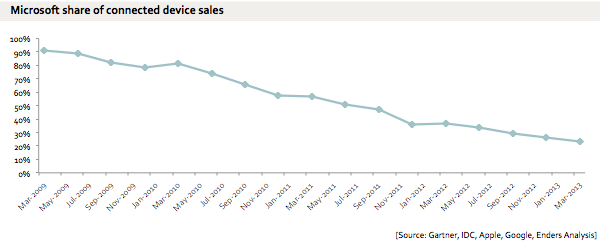
The other interesting piece is Ben Evans’ blog post, The irrelevance of Microsoft. The charts are compelling, especially this one:

In classic strategy terms Microsoft is a horizontal integration player (while Apple is the typical vertical integration player). Therefore it is truly alarming (for Microsoft) to see its share of platforms drop from a monopoly status (which is the end-goal for any horizontal play, and a key criteria for generating profits for that strategy) to something similar to a vertical integration player (which can be perfectly healthy and profitable with 20% share). Given how Android has the lion’s share of that chart now, and the fact that Android is a free beast (both price and otherwise) that Google doesn’t have strong control over, it seems a renewed horizontal strategy from Microsoft would have some really steep hurdles. I wouldn’t be surprised if Microsoft goes down a more vertical path.

There are, of course, silver linings. Freed from internal pressure from other divisions, there’s no reason why Office cannot extend to both web and mobile leveraging its own network effects, and continue to be a lucrative cash-cow as the monopoly player in the productivity space. Xbox + Kinect are a strong contender for control of the living room (despite some of the initial gaffes with the Xbox One). And Windows Phone does enjoy some Machiavellian benefits as the third platform in mobile – it will continue to get support from telcos who want to limit Android/iOS.

Microsoft is diversified enough that it will have some time to figure out its relevance in the post-PC era. And even if it doesn’t, it will still be around for a while (at least in tech time – a decade in tech feels like an eternity). Let’s see how this plays out.


The Waiting Game

Reuters had an interesting article yesterday over NTT DoCoMo – Apple negotiations over the iPhone. While reports of tense negotiations between Apple and carriers are nothing new (China Mobile pops up in the news every few months about its tough stance to Apple), I thought there were a couple of juicy bits worth pondering on from the DoCoMo article.

First, one of the sticking points of the discussion is apparently DoCoMo’s dilemma over its range of value-added-services (VAS). This is not surprising. DoCoMo was revolutionary back in the day with i-mode, which was a textbook example of a successful carrier strategy in mobile internet (so much so that a MBA case is one of the first results in a google search on i-mode). What DoCoMo was able to market with i-mode (and get people to adopt) was often considered far ahead of its time, so much so that when the iPhone first launched, quite a few people used Japan to point out that the iPhone is not “revolutionary” (see this counternotions blog referencing this).

What’s interesting to me here is one walled garden (DoCoMo’s VAS) being disrupted by another walled garden (Apple’s iPhone). The point is not that Apple is more open (it certainly is, at the App Store layer), and therefore it is winning (a big part of the iPhone’s appeal is its app ecosystem); the point is how Apple is leveraging “open-ness” at one layer to succeed with a “closed” business model. Furthermore, it certainly isn’t surprising how DoCoMo is trying to leverage Android (a far more open OS than iOS) to defend its extremely closed business model; unfortunately Japanese consumers don’t seem that engaged.

As an aside, I don’t want to use this as proof that carriers can never get services right – I don’t believe in such business inevitability (similar to how I don’t believe in “Open>Closed”). But there’s a host of organizational challenges (carriers are not known more fast moving and disrupting themselves), which is why most commentators would say “it’s not in their DNA”. I do understand the carriers’ perpetual fear of becoming just a “dumb pipe” – by definition of which they will be undifferentiated, which drives profitability down – so I think some of them will just keep trying, and a few may succeed with a deeply vertically integrated model.

Second, the Reuters article had this paragraph which I couldn’t resist commenting on:

DoCoMo’s requirement that its company logo be imprinted on all its devices also conflicts with style-conscious Apple’s insistence that its products be left as manufactured.

I would argue that this has nothing (well, almost nothing) to do with style and everything to do with brand and market power. The point is not that adding carrier logos would make the iPhone ugly; the point is this is a symbolic fight over who owns the customer – as in, did the customer buy the iPhone because of DoCoMo or because of Apple, and which brand does the customer have more affinity towards? As a reminder, a couple of years ago, Verizon had the exact same argument with Apple, and this was the result.

Some final thoughts: in this big waiting game, I think it’s a lose-lose game for the hold-out carriers (DoCoMo / China Mobile) and Apple, with clear value left on the table; however, the alternative scenario is not necessarily a win-win but quite possibly a win-lose, which is why the parties seem happy to play it out.  DoCoMo is happy to bleed customers if it thinks it can extract more value from preserving its VAS with its remaining customers; and Apple does not want to budge on handset subsidies and other points (it seems happy to pay the opportunity cost in market share for unit profitability). China Mobile seems to be an even bigger hold-out (and thinks it will have a better hand the longer it waits), as recent news indicates.

Interoperability as signal of relative market performance

There were two thematically similar pieces of news today – the first, Blackberry announced that it would add the once-popular BBM messaging service to iOS and Android; the second, Microsoft announced that outlook.com now supports chatting with Google accounts.

Going back a few years, both pieces of news would be bombshells, with bloggers likely proclaiming that hell has frozen over. In today’s tech scene, both are of minor note.

In grad school, a tech strategy professor had made the observation that efforts at providing interoperability usually make strategic sense for players who are trying to catch up. For market leaders, generally there is little strategic rationale to support your competitors’ platforms. The classic example of this would be productivity software, most famously office suites. Even today, there are a few competitors to Microsoft Office. Supporting Microsoft’s document formats are a core feature; it would be a non-starter to try to get adoption when you don’t support .doc / .ppt / .xls. Conversely, there is usually no reason at all for Microsoft Office to support competing office products’ proprietary formats. (Office may support some open standards, but that’s another story)

So one way to read these pieces of news today, is to see them as signal that Blackberry and Microsoft have on a strategic level acknowledged the dominance of its respective competitors. For Blackberry, even just a few years ago BBM was seen as a crown jewel, a killer app for its loyal user-base. To add cross-platform support would be like opening the floodgates for a mass exodus of users. – Well, that exodus happened anyway. For Microsoft, its web services have long offered some forms of interoperability (e.g. facebook chat support on Windows Messenger), but outright admitting that Gmail is more popular seems to be a first (just the title of the linked official post itself is revealing).

To extrapolate on the observation, Rene Ritchie made the observation that “as of today, every major mobile competitor… also makes apps for iOS“. This is obviously tied to Apple’s vertical integration business model, which is asymmetric compared to Google / Microsoft’s more horizontal play (hence, it is a much bigger deal for Apple to even consider making its software available to other platforms). And you can also make the comment that Apple doesn’t really have proprietary killer apps that would benefit from being cross-platform. But at least partially it is also a signal of Apple’s platform strength.

Apple: all news is bad news

Apple’s stock has taken a rather spectacular dive the past 6 months. It’s almost halved in value, and market sentiment is continually abysmal on the stock. To me it has reached the stage where all news is bad news.

I’m not a proficient trader, so I won’t comment on whether it’s the right time to buy Apple. I only want to discuss the fundamentals, and why this current stock price makes little sense in the long term.

Apple is currently trading at a P/E ratio of below 9. Bears of the stock will say this is justified because they expect Apple’s future earnings to collapse – that’s where the fundamentals come in. I think I’ve observed Apple for quite some time and I’m generally up to speed on the mobile industry trends. My opinion is that little has changed in the market outlook for Apple between now and 6 months ago (when Apple stock reached all-time highs).

Think about these pieces of info:

  • Apple’s market share in the US has stabilized, if not straight up outgrowing Android
  • In the world’s biggest growth market, China, Apple has demonstrated tremendous growth and may have become one of the largest foreign companies in China (by revenue) in the short span of a few years
  • Out of all the PC manufacturers facing the momentous decline of PC sales, Apple is the best positioned as it is the company disrupting the industry in the first place with its tablets. Yet Dell enjoys a higher PE ratio than Apple (and yes, the buy-out talks buffed Dell’s price, but the argument is still valid)
  • Most data show that Apple still completely dominates in the tablet space (in contrast, Android tablets don’t seem to be selling), and the ecosystem is thriving – Supercell, a mobile gaming company that only has two iOS games published and is only focused on designing for iPads, is on a run-rate to generate $800MM in sales in 2013. Apple’s ecosystem is a king-maker; have we seen any case studies of remotely close feats from competing eco-systems?

Apple’s stock is a weird beast. When Jobs was alive, the price was continually under-priced with fears about what his health means to the company. After his passing it had a good rally in mid 2012, but even then at its peak it wasn’t that expensive (think about Amazon’s stock, at any given point in time). Nowadays bears routinely claim that Apple is dead, has stopped innovating, and that the management is dumb (“Tim Cook should resign!”). I struggle to find any evidence supporting these claims.

Perhaps people like nothing better than for the world’s most successful, yet obviously most contrarian (it has perhaps the smallest number of SKUs for any company of its size; it insisted on vertical integration when everyone said vertical integration was dead) tech company to stumble into irrelevance, so that conventional wisdom prevails once again (“Apple is repeating its mistakes of the PC platform wars!”) and Apple is nothing but a one-time anomaly that can be conveniently forgotten. I have a feeling that Apple will live longer than they expect.

Why did desktop messaging apps fail on mobile?

I’ll start with clarifying the provocative title – when I say desktop messaging apps (referring to QQ, Skype, Live Messenger, Google Talk, Facebook Chat etc.) “failed” on mobile, I’m referring to their relative underperformance across the board compared to the pure mobile messaging apps (WhatsApp, Viber, WeChat, Line, KakaoTalk etc.). This defies conventional tech wisdom such as the power of network effects (the main driver behind the value of social network services) – why could these mobile upstarts so unanimously outperform the dominant messaging services with far greater user bases?

There are a few reasons I could think of.

One network to rule them all

To start off, it’s important to note one incredibly powerful network that has greatly leveled the playing field for mobile messaging startups – your phone book / contacts list. Phone numbers are by design unique identifiers, at a global level. Your phone book is usually far more important than your facebook friends’ list, as these are the people you’ve decided you need to be able to reach at a moment’s notice.

Mobile messaging apps such as WhatsApp use your phone book as a powerful boost to setting up your social network within these apps. This is analogous to Facebook / Linkedin asking to scan your email contacts list, but even more impactful (a stored phone number is usually more important than a stored email address). What’s more, because of the way smartphones work, mobile messaging apps generally have an easier time getting your permission to access your phone book (usually one click), compared to Facebook / Linkedin trying to access your gmail (need to type your username / password).

To make matters worse, few desktop messaging apps are designed to leverage your phone book. QQ or Google Talk has very little info to work on to merge your phone book contacts with your contacts on their network – any such process would likely be extremely manual with user approval entry by entry. Skype is perhaps the only desktop service that does somewhat better in this regard, as it has had to deal with phone-numbers for paying users of SkypeIn / SkypeOut.

Because of the above, network effects are actually working against the desktop messaging services, as they often poorly leverage the mobile social network (your phone book).

Cross-platform use cases work against the cross-platform services

At first glance, one could easily argue that the desktop apps benefit from being cross-platform (cross PC & mobile). What’s not to like about being able to chat with your friends, regardless of whether they are at their PC or just have their phones?

In practice, this again often work against the desktop apps. For one thing, users generally have very different communication habits when they are sitting in front of their PC versus holding their phone. Messaging on the PC is generally low commitment – your friends may not be online when you are, and even if they are, you often don’t know if your friend is watching a movie, playing a game, or working, so you don’t care whether they respond promptly or not.

Conversely, mobile messaging apps are meant to be always on, and market themselves as replacements for SMS. As such, mobile messaging can also be low commitment (useless texts), but carries with it a sense of immediacy not found in desktops. That’s why if you sign in to Skype/QQ/Google Talk on mobile you may prefer to make yourself invisible – you don’t want to be spammed on your phone with what you consider low impact messages/conversations from people idling at their desktops.

A sub bullet point here is that some mobile messaging apps have caught on via novel use cases – e.g. WeChat with the voicemail-like functionality. Such a function would sound ridiculous for a desktop app, but makes perfect sense on mobile.

As another aside, the difference in input speeds also make the cross-platform chat experience potentially undesirable to both parties.

At the end of the day, designed for mobile first versus “extending platform to mobile” leads to dramatically different use cases. Desktop apps make far too many compromises in being cross-platform to truly challenge the mobile first apps. A great example is actually to think about the other way round – how often would you use WhatsApp if it were available on desktops? Or even better, how often do you use iMessage, which is already cross-platform, on your Mac?

Geographic scope, focus and execution

This part is going to sound a bit fluffy. The first point is that few desktop apps have achieved global domination, which allows a mobile messaging startup to focus on cracking a specific geography and start growing its network. Indeed, there isn’t really one mobile messaging app that is ubiquitously used globally.

The second point is admittedly a bit of a conventional wisdom – mobile messaging startups have better focus, and are more agile, and therefore they have out-executed their desktop competitors. I do think this is the case, especially if you think about how WeChat caught on, but this shouldn’t be thought of as the sole reason. The above two sections cover some of the underlying enablers, and are more interesting from a strategy discussion perspective.

Facebook Home: good for Android, bad for Google

Facebook unveiled the next major part of their mobile strategy today with the Facebook Home announcement. Let’s talk about it from a few different angles.

Presentation

The event itself was quite compact, a no-fluff, well-rehearsed show (perhaps they took note of Samsung’s controversial Galaxy s4 event in New York some weeks earlier). There seemed to be some ramblings from the tech press about seating arrangements (lack of space/tables). The appearance of the CEOs of HTC and AT&T are obviously for show, but it did demonstrate that Facebook’s all grown up now and can demand the attention of industry heavy-weights when they want support.

Implications to Android eco-system

To the Android eco-system as a whole, this is overall a great new product. Facebook Home is the type of customization that may well be unique to Android (both Apple and Microsoft likely want too much control of their OS to allow this type of customization), and helps improve Android’s position at the high end of the marketplace versus Apple.

Many commentators have noted that this is not a fork; some have claimed this is the first step to a fork down the line. I think those are valid points. The consideration from Facebook’s point of view should be, what kind of an experience are we aiming to offer to Android users, and do we need to go as far as forking to offer that experience? Right now, Facebook Home is primarily about raising mobile engagement with Facebook, and taking over mobile messaging. To that end, a fork is not necessary as long as Google allows this type of deep customization.

Should Facebook Home take off in the market place, it is not inconceivable to see Facebook advance lower into the software stack, and go into a full fork when it needs to. A scenario could be – Facebook Home takes significant market share within Android; Facebook then plans to roll out its own Android app marketplace, with built-in Facebook tie in (all apps come integrated with Facebook data); by wanting to roll out its own Android marketplace, Facebook would likely have to declare a fork as it is running right against Google Play.

Facebook Home also shows a new path for all parties interested in bending Android to their benefit. This halfway measure (to a full fork, which is costly to maintain) makes a lot of sense to many established Internet services. For example, why wouldn’t Tencent do something similar (outside of the fact that the Android landscape in China is a mess and it would be difficult to create a middleware offering)?

Implications to OTT messaging apps

Just yesterday, I had written about OTT messaging apps and their potential threat to Facebook. Facebook Home is a large counter-offensive in this regard. Facebook is putting its messaging service front and center. It wants Facebook chat to be the ubiquitous messaging service for Android users.

What’s curiously missing then, as I think about it, is the lack of details around how Facebook Home will tackle the issue of address book management. Will Facebook Home merge your address book with your Facebook friends data? When you create a new contact, would it automatically try to find the person on Facebook and add him/her as a friend? I don’t think Facebook talked about this topic at all today. It would be a jarring, disjointed experience if your interactions with your facebook friends were this beautifully designed flow, while your interactions with real-life people (the folks who call you and message you) is still the stock Android experience. Perhaps this is something next on the to-do list for the product.

In this one regard, OTT apps such as whatsapp still offer a better flow. It doesn’t have the legacy baggage of trying to match a phone number with a Facebook identity – your phone number is your unique identifier, so when you add someone to your phonebook, the person will show up in these OTT apps instantly. For example, WeChat gives you a hint whenever one of your contacts has signed up for the service.

As to whether OTT apps are seriously threatened by Facebook Home – I think the answer is yes and no. Yes, in that there will be a segment of users whose needs will be fully served by Home and therefore lost. No, in that Facebook Home is unique to Android (a small portion of Android too), and one of the biggest value propositions of these OTT apps is that they are ubiquitous and fully cross-platform. A great example to think of is Apple’s iMessage – I love the service since it comes right out of the box and requires no setup, but I still need to use whatsapp / weChat etc. because not all my friends use iPhones.

Implications to Google

Everyone is now eagerly awaiting Google’s response. Many have joked today that Google will unveil “Google+ Home” at Google I/O. In all seriousness, now is a great time for Google to reflect on what is the future direction of Android, with Samsung commanding 40% of all Android shipments on the one hand and Facebook launching a direct take-over of Android’s user experience on the other.

Google could choose to close off Android in the sense that if you want Google’s services (Google Play, Gmail, Maps, Youtube) on your phone, you cannot use such a deep customization as Facebook Home; but that would also take Samsung’s TouchWiz as collateral damage, and I’m not sure Google’s ready for that confrontation yet. Of course, it could make special deals with Samsung so that TouchWiz is exempt, but that could make relationships with hardware vendors even more complicated (side deals everywhere).

Google could choose to make pinpointed counter offensives, such as cloning Facebook’s Chat Heads so that there’s less value in installing Home. But such services would quickly run into the same problems Google has on the web – it doesn’t own the social network. A fancy Android-only chat feature is of little use if you need to add your social network into it first. It could be a cool OTT app, but it won’t have access to the rich sharing and interactions that are happening on Facebook.

Google could choose to stay the course and just focus on making Android and Google’s services on Android better. It could also focus on whatever plans it has for Motorola, should it go the direction of offering strong Google hardware. As long as users demand Gmail / Maps / Youtube, to a certain extent Google doesn’t need to respond. However, they will surely be constantly bothered by how Facebook has taken over all the real estate on their OS, which Facebook surely can use to promote other services in future.

Rise of the OTT messaging apps

One topic I have been mulling over the past week is Over-the-top (OTT) messaging apps and their impact on the broader TMT space.

To start off, I would recommend a read of WSJ’s piece last week, which provides a good summary and features some good quotes from key players. The short story is that riding on the wave of smartphone adoption, a whole host of messaging apps have gained massive traction with mobile users. As Benedict Evans tweeted last week (side note – subscribe to his weekly newsletter, it’s a must read):

The notable leaders that people often mention are WhatsApp (US), Line (Japan), KakaoTalk (Korea) and WeChat (China). I’ve called out each app’s home base country, but really, these apps are fighting for every consumer across the globe. This feels eerily similar to the social networking hype cycle of the mid 2000s, in more ways than one (more thoughts on that below).

There are two major types of players impacted by the emergence of this category.

The first is telcos, whose SMS revenue is likely experiencing accelerating decline at the hands of these OTT services. (Apple’s own iMessage is also a big player in this regard.) I’m somewhat surprised at the lack of response from US telcos – SMS represent the most lucrative part of their service offering (the cost of one SMS is a tiny fraction of the rates charged). Perhaps they’ve prepared for this by tying expensive data plans to smartphone contracts – the increase in data ARPU certainly offsets the loss in SMS revenue, but from a profit margin stand point the story could be different. Another factor limiting US telcos is the topic of net neutrality, which hinders their ability to negotiate with / extract value from these OTT services.

In contrast, one of the biggest tech stories in China the past couple of weeks is telcos pressuring Tencent to pay for WeChat usage. That would certainly go against US net neutrality principles (it specifically discriminates against one application), but the underlying struggle is nothing new (or unique to China) – remember telcos trying to shut down VOIP providers to retain their voice revenue a decade ago? It is still unclear how the situation will play out, but Kaifu Lee has speculated that Tencent will bow down to the telcos and create some form of revenue-sharing partnership that telcos can be happy with – if that is indeed the case, it would be an interesting case study for companies elsewhere.

The second type of players impacted by these mobile messaging apps are the big social networks on desktops. I had mentioned earlier that the mobile messaging boom is similar to the social networking hype cycle a decade ago – one notable similarity is how these mobile apps have quickly tried to turn themselves into distribution channels for other apps (similar to how Facebook enabled the social gaming boom). A Reuters article on the topic points out that 8 out of the top 10 highest grossing apps on Google Play’s South Korea market are built on top of KakaoTalk.

There is a sub trend worth pointing out here. The mobile platform owners (Apple, and to a far lesser extent, Google) have far more restrictive terms on what functionality apps can provide, so turning these apps into app stores in and of themselves is a non-starter. That’s why these apps currently only promote 3rd party apps via an offer-wall type of interface – essentially, a list of recommended apps which will lead you to the respective official app pages on the official app store. This is obviously a far less integrated experience for users, and there may be problems with tracking the performance of these referrals. An interesting derivative, therefore, is the idea that these 3rd party apps are not native apps, but rather browser apps (e.g. a HTML5 game) that you launch inside the messaging app. This puts limits on app performance, but this scenario also more closely resemble Facebook’s browser-based ecosystem. It will be interesting to see whether platform owners crack down on this.

To wrap up, the growth of these OTT apps are clearly not over, and their experiments in building their own platforms are just beginning. I for one will be keeping an eye on this space.

What are motivations to fork Android?

There are a lot of discussions – and quite a few attempts – of forking Android. But why would a company try to fork Android in the first place? What are the strategic motivations?

To try to get a comprehensive picture, let’s put ourselves in the shoes of different players in the broader TMT value chain.

A typical handset vendor –

  • Generally speaking, forking Android allows for deeper differentiation compared to run-of-the-mill competition, if the vendor has the software prowess.
  • An extension of the above, another consideration is to offer a customized OS deeply tailored to a specific market, e.g. China, where the local Internet landscape is drastically different from the west, and hence Google search / Gmail / Youtube etc. are irrelevant (making it far less attractive to stick with Google’s stock Android). A lot of big Internet countries actually fall into this category (if partially), e.g. Russia, South Korea, and perhaps Japan.
  • Another possibility is to serve the specific needs of a big customer – e.g. a telco, or a government agency; or generally, a big company that has very specific plans on how the devices will be used (e.g. as a retail POS). This doesn’t generally impact consumers, though I’ll call out telcos later since their perspective is important.

An Internet company –

  • Very similar rationale to why Google created Android in the first place – gain distribution within target audience. For a Internet company with a large enough set of services and users, creating a controlled, dedicated and direct channel with the end-user is a strong temptation. Amazon is the first company that actually did this on a large scale with its Kindle Fire tablets; we shall see if Facebook does something similar next week.
  • Again, in places such as China, there is even more incentive for the major Internet players to fork Android, since Google is conspicuously absent and players would love to fill the void.

A telco –

  • Fewer and fewer telcos nowadays actually have strong value-added-services of their own (we can thank the iPhone for dramatically pushing adoption of over-the-top services – i.e. apps), but for a brave telco that still wants to retain a bigger cut of the pie, backing an OS of their own is a logical approach. China Mobile did this for a while with its OPhone, to little success.

A startup –

  • A startup could be trying to fill the gap for any of the entities above; in that case, the motivation is the same, except it’s being executed by an outside party.
  • There is space for a startup focusing on creating an Android fork without catering specifically any of the interests above. The initial motivation is to capture a sizable user-base by offering a better product, which could serve any number of future monetary goals. An example would be this week’s unveiling of the Smartisan OS in China, which was incredibly hyped up in the tech community. The Smartisan team is focusing on what they think is a far more usable version of Android, in the hopes that superior usability will lead to market share, which they can later monetize either by launching their own phone or other forms of industry partnerships (e.g. as a gatekeeper of their user-base for other Internet services, collecting a referral fee in the process).

MINOR UPDATES:

A couple of missing points to add to the original post.

For companies (both large and small) trying to target adjacent markets, Android offers a compelling starting point to build an offer. Example adjacent markets are gaming (where OUYA recently unveiled their first attempt) and in-vehicle systems (such as Ford’s SYNC) which are resembling tablets day by day.

Another motivation across the board for large companies is to strategically counter Google’s influence of the market. As in, forking Android just for the sake of undermining Google. To a certain extent, Microsoft’s continued investment in Bing is motivated by such thinking – keeping Google in check by owning and growing Google’s largest direct competitor.

How long can content region-locking last?

One of the questions I’ve pondered a lot recently is the topic of content region-locking. I’m mostly talking about the practice of TV/film rights owners reselling their content to different local providers across the world, with each local provider only having license to distribute the content in their local territory. Examples of this are the region codes in DVDs (and in VHS previously), and of course different TV networks across the world showing the same show to their local audience. This has been a great demonstration of price discrimination in action, and has generally helped rights owners maximize their revenue/profit.

In the analog, or rather, pre-streaming world, there were attempts to arbitrage the system, with varying degrees of success. Pirated satellite TV has been around for ages, especially in emerging markets such as many parts of Asia. And of course the whole pirated DVD industry, which was quite dominant in countries such as China – as evidenced by DVD hardware manufacturers having full region unlock as a must-have feature – if your brand of DVD players can only play DVDs coded for the Chinese market, you might as well not go into business. In mature markets, it usually wasn’t worth the effort for the average person to try to steal satellite TV; although western visitors touring China usually tried to take full advantage of the local DVD prices, knowing that they were buying pirated copies of the whole box-set of Lost (or some other long-running series).

In the Netflix/Hulu world, where rights owners are hesitantly putting their content online, the situation suddenly gets very complex. Rights owners, used to thinking of the virtues of region-locking, are rightfully reluctant to give any one streaming provider (say, Youtube) worldwide rights to their highly valued content. This is why Netflix has to expand one country at a time, while they carefully negotiate their rights; this is also why you can only watch Hulu from the US.

However, in the online / streaming world, the hoops required to jump through to pretend to be a visitor from the US (and therefore acquire the content on Netflix/Hulu) is dramatically lower vs. the offline / physical world (where you literally had to buy a plane ticket to go to China to enjoy the low cost of content). And service providers such as Netflix and Hulu thereby have a real issue of enforcing their rights management vs. harming the user experience of the primary users they are trying to serve. The monthly cost of getting a VPN that offers a US IP address is usually less than $10 – unless Hollywood can get regulators to regulate VPNs, it is hard to see how they can avoid a continued in-flood of global traffic to Hulu (as more content is put online, the value of VPNs will rise further, and more people will adopt VPNs), which undermines the entire premise of region-locking.

What’s even worse than global traffic flooding to Hulu is the fact that there are more and more content being put online legally outside the US. As US TV series have caught on in China (in a big way) in the past 5-10 years, the leading Chinese video sites are coming to Hollywood to acquire content. On sites such as Youku and Sohu, top programming from AMC such as The Walking Dead, Breaking Bad and Mad Men are all legally available (usually in a few hours after they air in the US) to users from a Chinese IP address, all free of charge. There will certainly be entrepreneurial efforts in the US to arbitrage this discrepancy – after all, why should you buy/rent these shows from iTunes when you can access them from Chinese providers with a free Chrome extension(search “unblock youku”) or a Chinese IP VPN?

This certainly begs the question – is it legal to get a VPN to enjoy content that was licensed to a certain region? I am not a legal expert, but even I can see that this easily crosses into net neutrality territory and is a legal mess for rights owners to try to enforce. Furthermore, there are so many legitimate uses of VPN tech (prime example – bypass censorship) that it seems unfathomable that VPN providers would comply to limit/monitor/block VPN traffic when it comes to video. And while services such as Hulu can be pressured to improve their tech to try to block VPN IPs (is that legal?), or add more screening measures (e.g. you must create an account with a US credit card, or show you are living in the US via a utility bill statement), all these would certainly hurt the user experience – after all, I’m just trying to watch some TV, why do you need my identity?

At the end of the day – getting a US VPN to watch Hulu is a lot better than going to thepiratebay.se to download the same show. At least in the first case Hulu generated ad revenue from the visitor, which rights owners should get a % share of. The question is how mainstream such activities can get, and how fast – if an entrepreneurial VPN provider tries to make a marketing push by highlighting the rich content available in overseas markets, will rights owners be able to effectively respond?